

Markets
Money ring surrounding earth
(Getty Images)

Fund managers are worried about AI overinvestment. Bank of America is worried about fund managers overinvesting.

For the first time ever, fund managers surveyed by Bank of America think companies are investing too much.

Luke Kawa

For the first time ever, fund managers surveyed by Bank of America think companies are investing too much.

“Bad news…1st time in 20 years investors say companies ‘overinvesting’ (read ‘slow down, hyperscalers’),” Chief Investment Strategist Michael Hartnett wrote, commenting on the results of BofA’s monthly fund manager survey. “Asked about the biggest ‘tail risk’ for the economy and the markets, 45% of FMS investors said ‘AI bubble’ (up from 33% last month).”
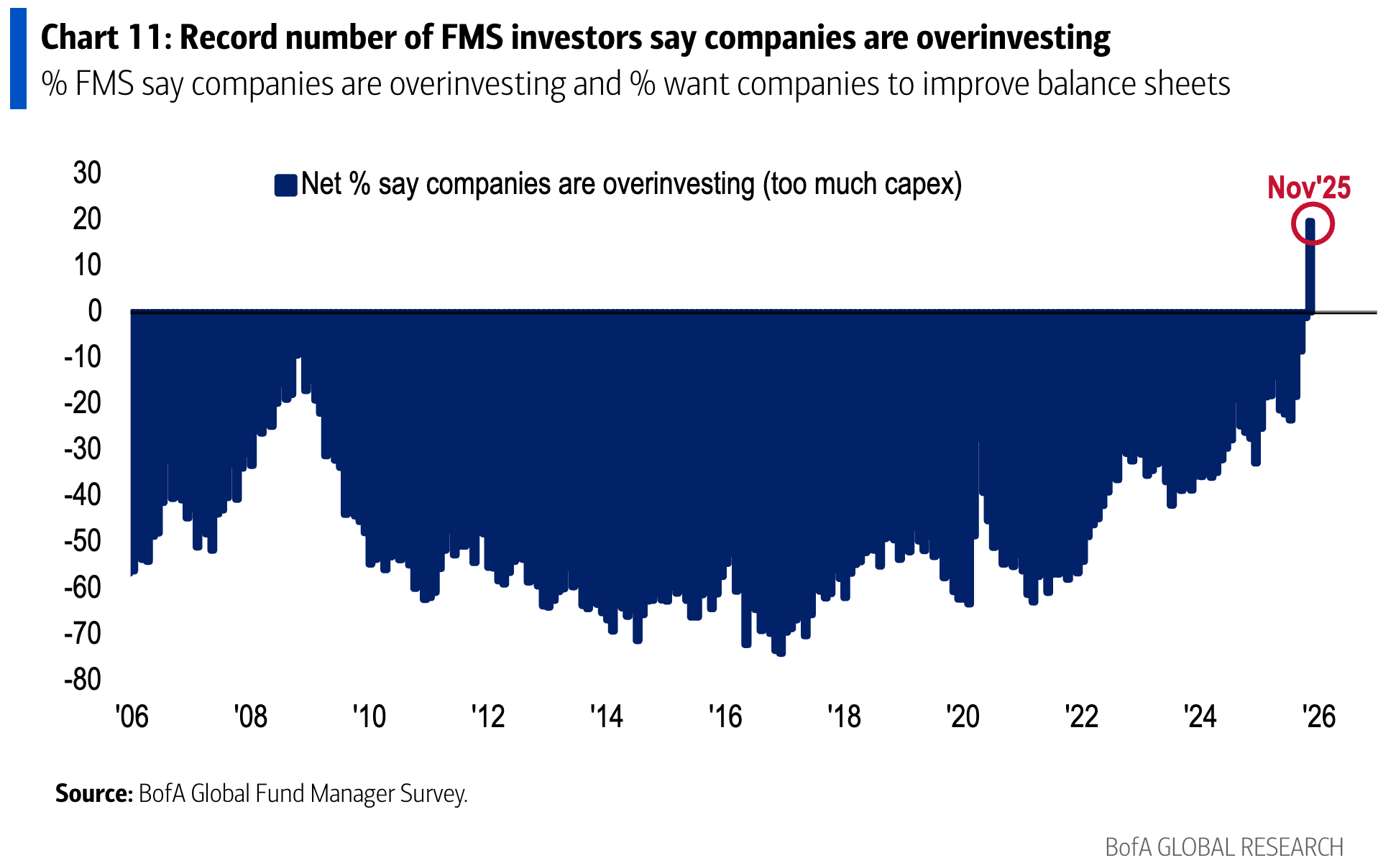
BofA capex overinvesting

Now, what this really shows, as Hartnett alludes to, is a very concentrated industry-specific concern around the aggressiveness of the AI build-out. Over on Bluesky, Bespoke analyst George Pearkes flagged that net private investment as a share of US GDP has effectively been a flat line for years.

“Just shows how tech-centric investors are. AI of course might be over-investing but the non-tech economy is stagnating or in recession and definitely isn’t overinvesting,” added Conor Sen, founder of Peachtree Creek Investments. “Office construction is weak, residential construction is weak, the freight industry is in recession, autos are pulling back on some EV spending.”

Fund managers would prefer that companies improve their balance sheets or return more cash to shareholders rather than boost business investment. That would certainly be a shift in what’s been rewarded in the stock market.

Year to date, a basket of the most capex-intensive stocks in the S&P 500 compiled by Goldman Sachs is up over 21%, outperforming baskets of companies with strong balance sheets and high shareholder returns by about 14 and 5 percentage points, respectively. Firms with high levels of investments have also bested these other cohorts over the past one and three months.

The irony about this survey is that while it says fund managers purport to be worried about overinvestment, if anything, BofA suggests that the overinvestment they should be worried about is their own: average cash levels among those surveyed dipped to 3.7% from 3.8%.

“Note cash levels of 3.7% or lower has occurred 20 times since 2002, and on every occasion stocks fell and Treasuries outperformed in the following 1-3 months,” says Hartnett, who called this low level of dry powder a “sell signal.”
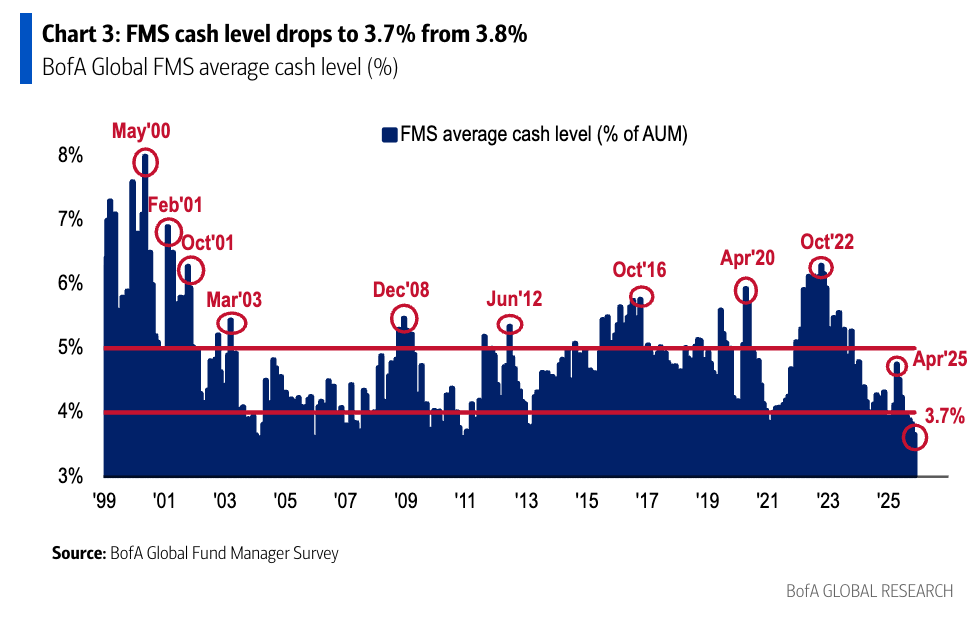
BofA cash levels

More Markets

See all Markets
Dickens, Great Expectations, He said, Aha! would you?

Tech tumbles as momentum stocks run into a blowout jobs report and a wave of profit-taking

The AI trade is under some pressure, taking prices back like... a few days. President Donald Trump is not a fan of the price action.

Trump Administration Considers Reclassifying Marijuana As A Less Dangerous Drug

Trulieve to list on NYSE, a first for US cannabis sector

More may be on the way: several other US cannabis companies have announced reverse stock splits with the intention of listing on a major exchange.

markets

Lululemon’s stretch getting tested: Stock plunges after after outlook is cut

Lululemon shares are down double digits in premarket trading after the company cut its full-year sales and profit outlook, overshadowing a Q1 beat and raising fresh concerns about the brand’s turnaround efforts.

The company now expects fiscal 2026 revenue to be flat to down 1%, compared with its prior forecast for 2% to 4% growth. Guidance for full-year diluted earnings per share was dragged down to a range of $10.95 to $11.15, below the company’s previous guidance of $12.10 to $12.30 and well below Wall Street’s estimate of $13.26.

Key numbers for Q1:

  • EPS of $1.69 vs. the $1.68 expected.

  • Revenue of $2.47 billion vs. the $2.43 billion expected.

The modest top-line beat masked a widening divergence between Lululemons geographic markets. While international revenue rose 22% overall with a 30% increase in Mainland China, the bigger problem remains North America, where revenue fell 5%.

Interim co-CEO and CFO Meghan Frank acknowledged during the earnings call that recent product rollouts underperformed. A highly anticipated yoga campaign failed to generate its expected halo effect across broader product lines.

Profitability metrics took a major hit, with gross margins contracting by 410 basis points to 54.2% due to mounting tariff costs and promotional markdowns. Operating income consequently fell 37% year over year to $276.9 million.

“We experienced spikes of negative commentary in the media and on social channels with regard to our brand, which had an impact on traffic and overall top-line performance,” Frank said during the earnings call. “And second, not all of our product launches have met our expectations. While we have had several successful launches so far this year, we have seen others as we start Q2 not generate the anticipated guest response.”

Lululemons valuation has already been steadily compressing for years. While it was once one of retails richly valued stocks, investors have been questioning whether the company can return to the double-digit growth era.

The results also arrive during a leadership transition. Lululemon announced back in April that former Nike executive Heidi ONeill is set to take over as CEO in September, with investors looking to her to revive growth in North America and restore the brands growth.

As Lululemon faces both macroeconomic pressure and brand-specific challenges, its stock has dropped around 40% year to date.

markets

US job growth skyrocketed in May, blasting past expectations

The US economy added 172,000 jobs in the month of May, the Bureau of Labor Statistics reported Friday, sending 10-year Treasury yields higher.

The strong May job market surprised economists. Experts had predicted only 85,000 new jobs — just half the reported number. The unemployment rate held steady at 4.3%, as expected.

The job growth story is a hopeful spot for the economy as consumers continue to feel inflationary pressure from the Iran war.

Job gains were buoyed by the leisure and hospitality sector, which added 70,000 jobs, as well as local government, healthcare, and education.

Both the March and April jobs reports were revised upward, making them collectively 93,000 higher than previously reported.

Latest Stories

Sherwood Media, LLC and Chartr Limited produce fresh and unique perspectives on topical financial news and are fully owned subsidiaries of Robinhood Markets, Inc., and any views expressed here do not necessarily reflect the views of any other Robinhood affiliate, including Robinhood Markets, Inc., Robinhood Financial LLC, Robinhood Securities, LLC, Robinhood Crypto, LLC, Robinhood Money, LLC, Robinhood U.K. Ltd, Robinhood Derivatives, LLC, Robinhood Gold, LLC, Robinhood Asset Management, LLC, Robinhood Credit, Inc., Robinhood Ventures DE, LLC and, where applicable, its managed investment vehicles.

