
Markets
Business consept, Financial graphs
(Getty Images)

Foreigners have piled into Japan’s stock market — now more locals are being encouraged to invest

Tokyo wants to shake off its cash-hoarding habits and get young people in Japan investing again.

Hyunsoo Rim

At Berkshire Hathaways annual meeting last week, Warren Buffett reaffirmed his bet on Japan’s trading houses — now a combined 9.3% of Berkshire’s stock portfolio, its fifth-largest holding. His successor and soon-to-be CEO of the conglomerate, Greg Abel, said they could hold the stakes “50 years or forever.”

That mindset, though, is hardly the norm back home in Japan. For decades, the culture of hoarding cash instead of investing took hold among older generations, haunted by the 1990s asset bubble burst, when overheated stock and property markets crashed and burned. Indeed, ~54% of Japanese households keep their assets in cash or deposits today — compared to just 13% in the US and 31% in the UK — per The Economist, leaving plenty of room for overseas buyers to step in.
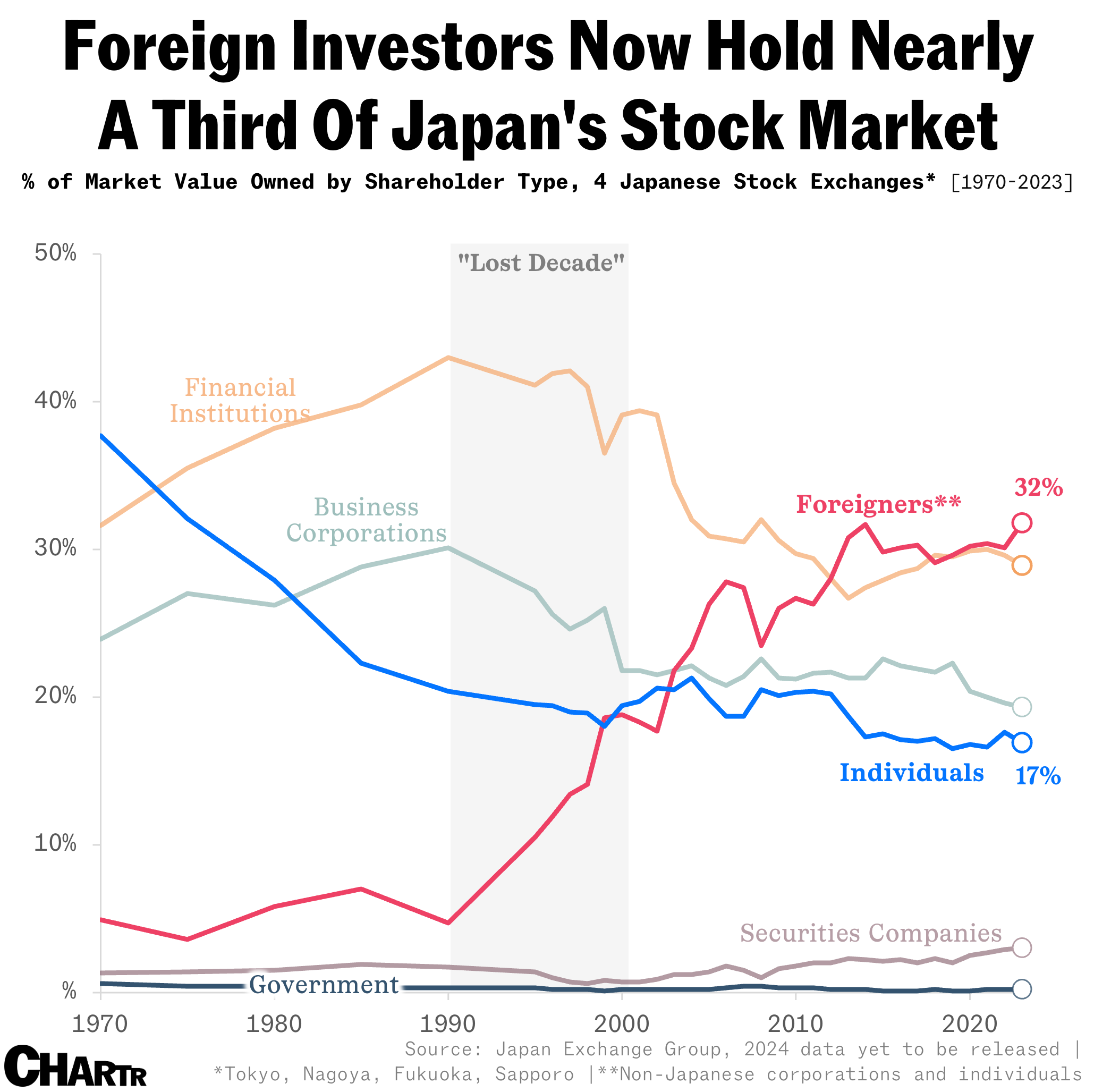
Japanese stock ownership
Sherwood News

According to Tokyo Stock Exchanges latest data, foreign investors now own 32% of Japans stock market, up sharply from 5% in the 1970s, while locals hold just 17%. And the gap might keep growing: as US stocks slumped amid tariff threats in April, foreign investors pumped a net $8.3 billion (¥1.2 trillion) into Japanese equities — a sharp reversal from net outflows in the previous two months, per data from Japan Exchange Group.

Lower the bar

Now, Japan is trying to lure its young, less trauma-ridden locals back into the market. The Tokyo Stock Exchange plans to lower the minimum investment threshold, aiming to make stocks more accessible, while the government expanded tax exemptions for retail investors last year. Its also promoting financial literacy among millennials and Gen Zs. All of this might be starting to pay off: according to the Investment Trusts Association, 36% of people in their 20s in Japan invested in mutual funds, stocks, and bonds last year, up nearly 3x from 2016.

More Markets

See all Markets
markets

SpaceX gets a wave of bullish ratings from Wall Street analysts

SpaceX received more than a dozen positive analyst calls on Tuesday — including from major Wall Street banks — as they initiate coverage on Elon Musk’s space and AI company.

SpaceX went public on June 12 at a $2.2 trillion valuation, the largest debut in history. While the company hasn’t yet posted a profit, it seems to have convinced Wall Street that it will get there and grow its valuation on the way.

Of the at least 17 analysts that gave a rating on Tuesday, all but one gave it a “buy” or “outperform” rating. MoffettNathanson was "neutral."

The ratings come as SpaceX joined the Nasdaq 100 index, a benchmark tech-heavy basket of companies that underpins millions of portfolios. The inclusion adds built-in demand for the stock from index funds and ETFs.

Still, SpaceX fell more than 5% on Tuesday amid a broader sell-off, and is currently effectively flat from its opening price of $150 a share.

markets

Nike sinks to lowest level since 2014 after warning of “challenged” sales environment in Q4 report

Did Nike do it?

Investors had a mixed reaction after the global sports apparel company reported its fourth quarter earnings on Tuesday after the bell. Shares initially rose 5% as Nike beat out Wall Street expectations amid a hefty tariff refund bonus. However, the stock then sank to its lowest level since August 2014 in postmarket trading.

Here are the Q4 numbers:

  • Revenue of $11.0 billion (estimate: $10.8 billion).

  • Adjusted earnings per share of $0.20 (estimate: $0.12).

Ahead of this report, Nike warned that results would be flattered by a one-time tariff refund (now estimated at roughly $0.52 per share for the bottom line). That gave the company an extra cushion in snapping its streak of seven quarters of year-over-year profit declines.

Over the past year, the company had been punished by tariffs on imported goods, stagnant consumer spending, and increasing competition from other footwear brands like New Balance, Adidas, and Hoka.

Outgoing CFO Matthew Friend deemed it an “increasingly challenging operating environment, where sell-through remains challenged.”

Latest Stories

Sherwood Media, LLC and Chartr Limited produce fresh and unique perspectives on topical financial news and are fully owned subsidiaries of Robinhood Markets, Inc., and any views expressed here do not necessarily reflect the views of any other Robinhood affiliate, including Robinhood Markets, Inc., Robinhood Financial LLC, Robinhood Securities, LLC, Robinhood Crypto, LLC, Robinhood Money, LLC, Robinhood U.K. Ltd, Robinhood Derivatives, LLC, Robinhood Gold, LLC, Robinhood Asset Management, LLC, Robinhood Credit, Inc., Robinhood Ventures DE, LLC and, where applicable, its managed investment vehicles.

