
Markets
Fed Chair Jerome Powell Holds An News Conference On Interest Rates
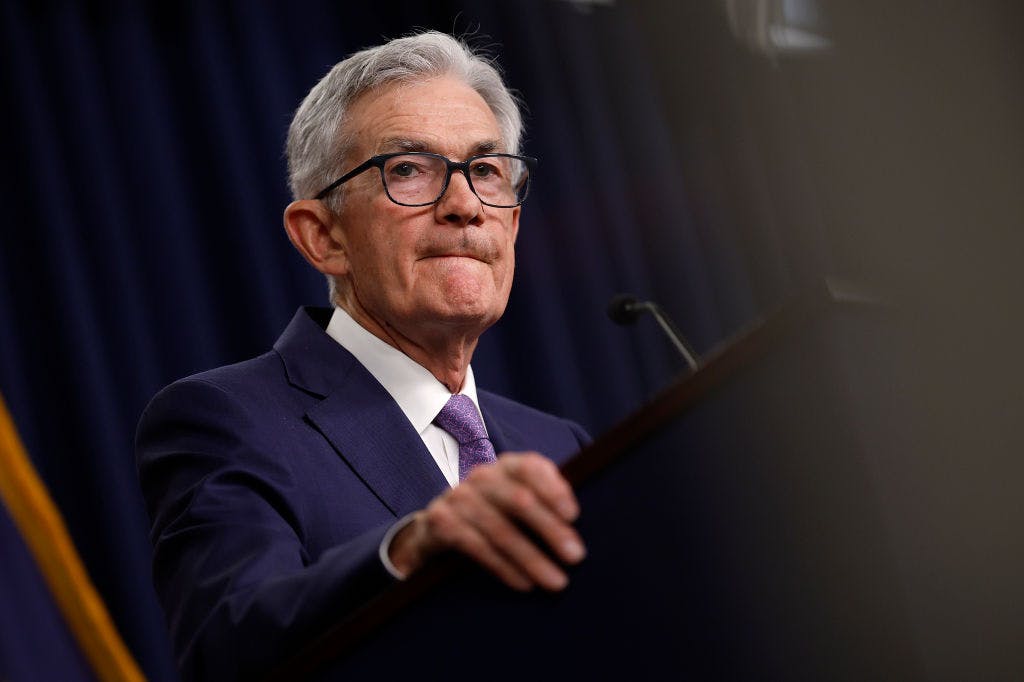
Federal Reserve Chair Jerome Powell (Kevin Dietsch/Getty Images)

Federal Reserve leaves rates unchanged; dot plot still signals lower rates in the cards for 2026

A relatively dovish reaction function from the US central bank.

Luke Kawa

The Federal Reserve held its policy rate unchanged at a range of 3.5% to 3.75%, as was universally expected.

The Summary of Economic Projections accompanying this release showed that the median monetary policymaker still expects the policy rate to be 25 basis points lower by the end of 2026 if the economy unfolds in line with their expectations.

The US central bank was very wrong-footed by the persistence of the inflation shock coming out of the pandemic, which was then turbocharged by the spike in oil and natural gas prices stemming from Russia’s invasion of Ukraine and subsequent restrictions on purchasing its energy.

Fed officials upped their forecast for growth this year and the next relative to December and raised their forecasts for inflation in 2026 — particularly headline inflation, which includes energy prices. Stronger growth and inflation would generally indicate a reduced need for rate cuts, but the median rate path through 2028 was unchanged from December.

The message from the central bank seems to be, “We’re not fighting the last war, and we’re praying for a short war.”

The SPDR S&P 500 ETF was little changed in the aftermath of the statement and updated forecasts, but extended losses to as much as 1.1% during Fed Chair Jerome Powell’s press conference.

Fed Governor Stephen Miran was the lone official to dissent, favoring lower rates.

Prediction markets thought the most likely outcome was that two US monetary policymakers would dissent at this meeting, with roughly 30% odds of just one dissent and about a 5% probability of three dissents.

(Event contracts are offered through Robinhood Derivatives, LLC — probabilities referenced or sourced from KalshiEx LLC or ForecastEx LLC.)

The war in Iran and resulting disruption to global energy markets, with US gas prices registering their sharpest increase in more than two decades, has caused traders to tear up the playbook for any easing from the US central bank this year.

Before the strikes, a full interest rate cut was priced into federal funds futures by the July meeting. Heading into this decision, a full cut is not priced in for all of 2026.

In the run-up to this release, prediction markets ascribed roughly 5% odds to a cut at the Fed’s meeting next month, and about one in three odds to the prospect of a reduction in June.

This is the US central bank’s first meeting since President Donald Trump said that former Fed Governor Kevin Warsh would be his pick to succeed Powell as chair of the Federal Reserve.

More Markets

See all Markets
Dickens, Great Expectations, He said, Aha! would you?

Tech tumbles as momentum stocks run into a blowout jobs report and a wave of profit-taking

The AI trade is under some pressure, taking prices back like... a few days. President Donald Trump is not a fan of the price action.

Trump Administration Considers Reclassifying Marijuana As A Less Dangerous Drug

Trulieve to list on NYSE, a first for US cannabis sector

More may be on the way: several other US cannabis companies have announced reverse stock splits with the intention of listing on a major exchange.

markets

Lululemon’s stretch getting tested: Stock plunges after after outlook is cut

Lululemon shares are down double digits in premarket trading after the company cut its full-year sales and profit outlook, overshadowing a Q1 beat and raising fresh concerns about the brand’s turnaround efforts.

The company now expects fiscal 2026 revenue to be flat to down 1%, compared with its prior forecast for 2% to 4% growth. Guidance for full-year diluted earnings per share was dragged down to a range of $10.95 to $11.15, below the company’s previous guidance of $12.10 to $12.30 and well below Wall Street’s estimate of $13.26.

Key numbers for Q1:

  • EPS of $1.69 vs. the $1.68 expected.

  • Revenue of $2.47 billion vs. the $2.43 billion expected.

The modest top-line beat masked a widening divergence between Lululemons geographic markets. While international revenue rose 22% overall with a 30% increase in Mainland China, the bigger problem remains North America, where revenue fell 5%.

Interim co-CEO and CFO Meghan Frank acknowledged during the earnings call that recent product rollouts underperformed. A highly anticipated yoga campaign failed to generate its expected halo effect across broader product lines.

Profitability metrics took a major hit, with gross margins contracting by 410 basis points to 54.2% due to mounting tariff costs and promotional markdowns. Operating income consequently fell 37% year over year to $276.9 million.

“We experienced spikes of negative commentary in the media and on social channels with regard to our brand, which had an impact on traffic and overall top-line performance,” Frank said during the earnings call. “And second, not all of our product launches have met our expectations. While we have had several successful launches so far this year, we have seen others as we start Q2 not generate the anticipated guest response.”

Lululemons valuation has already been steadily compressing for years. While it was once one of retails richly valued stocks, investors have been questioning whether the company can return to the double-digit growth era.

The results also arrive during a leadership transition. Lululemon announced back in April that former Nike executive Heidi ONeill is set to take over as CEO in September, with investors looking to her to revive growth in North America and restore the brands growth.

As Lululemon faces both macroeconomic pressure and brand-specific challenges, its stock has dropped around 40% year to date.

markets

US job growth skyrocketed in May, blasting past expectations

The US economy added 172,000 jobs in the month of May, the Bureau of Labor Statistics reported Friday, sending 10-year Treasury yields higher.

The strong May job market surprised economists. Experts had predicted only 85,000 new jobs — just half the reported number. The unemployment rate held steady at 4.3%, as expected.

The job growth story is a hopeful spot for the economy as consumers continue to feel inflationary pressure from the Iran war.

Job gains were buoyed by the leisure and hospitality sector, which added 70,000 jobs, as well as local government, healthcare, and education.

Both the March and April jobs reports were revised upward, making them collectively 93,000 higher than previously reported.

Latest Stories

Sherwood Media, LLC and Chartr Limited produce fresh and unique perspectives on topical financial news and are fully owned subsidiaries of Robinhood Markets, Inc., and any views expressed here do not necessarily reflect the views of any other Robinhood affiliate, including Robinhood Markets, Inc., Robinhood Financial LLC, Robinhood Securities, LLC, Robinhood Crypto, LLC, Robinhood Money, LLC, Robinhood U.K. Ltd, Robinhood Derivatives, LLC, Robinhood Gold, LLC, Robinhood Asset Management, LLC, Robinhood Credit, Inc., Robinhood Ventures DE, LLC and, where applicable, its managed investment vehicles.

