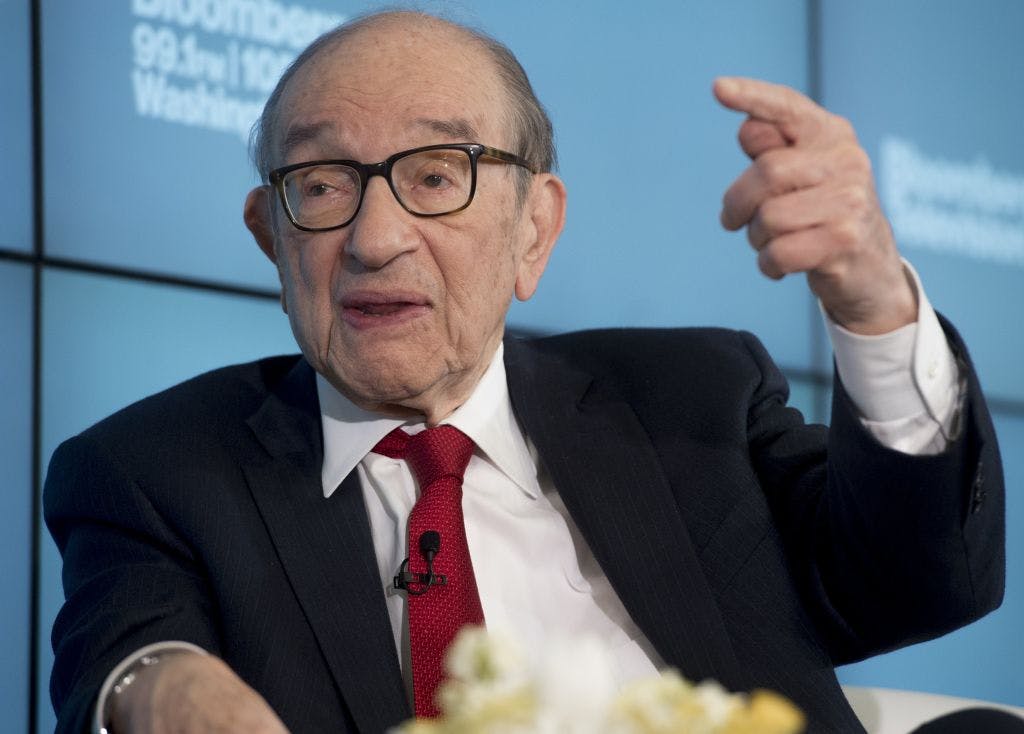
The Federal Reserve is going back to the 1990s
The big debates at September’s meeting of the Federal Reserve are going to be strikingly similar to 1995.
Coming off an unexpectedly soft jobs report, US monetary policymakers engage in fierce debate over whether to kick off an easing cycle with an interest rate cut of 25 or 50 basis points.
The year is 2024. Or 1995.
At its policy meeting this month, the Federal Reserve will undoubtedly be engaging in some of the same discussions that pre-date not only the release of Pokémon Go, but Pokémon altogether. With some similar economic trends and financial market considerations, to boot.
Dario Perkins, managing director of global macro at TS Lombard, inspired this comparison piece with a series of tweets. He told us:
I just love 1995 because it’s the textbook soft landing, and Fed Chair Alan Greenspan built a reputation – at least back then – as the Maestro. But it’s also funny because they got a horrible employment report, which triggers the cut. And the day after the meeting they get another report and all the data are revised. And then the economy bounces well before you saw any discernible impact from the easier policy.
Here’s some of the ways we’re heading into the monetary policy DeLorean, via the transcript of the July 1995 meeting.
Oh, won’t someone please think of the market?!?!
A vigorous back-and-forth was held in 1995 over how the market would perceive a cut of 25 versus 50 basis points. This is a choose-your-own-adventure approach to monetary policymaking, and the general conceit hasn’t vanished from the financial commentariat since.
There has been no shortage of economists and strategists who have argued that markets will freak out if the Fed cuts 50 basis points this month, because it would send the signal that the economy is doing worse than it actually is. The thinking goes that this would mean “The Fed knows something we don’t!” In reality, Fed officials are working with the same data as the rest of us — albeit with way more access to anecdata.
But here’s monetary policymakers debating something relatively unknowable with little in the way of supporting evidence and letting that play a key role in what they decide.
Some thought a smaller cut would be better for the markets:
Fed Chair Alan Greenspan:
I have concluded that probably the best thing to do is to move the funds rate downward by 25 basis points, which I must say likely will be a big deal because we would be changing the direction of policy. I am concerned about going further than that in part because I am really concerned about spooking the markets, especially the foreign exchange markets in this context.
Were they concerned about any part of foreign exchange in particular? Yes. Of course it’s the Japanese yen, the same currency where an unwind of the carry trade helped catalyze the violent, though short-lived, stock market downturn in early August.
Governor Lawrence Lindsey:
Mr. Chairman, I agree with your point on tactical grounds. I think that 25 basis points is the right move to make today largely because of those foreign exchange rate considerations. I would be very nervous, given the current state of the yen, about making a move that was considered bold and aggressive and might send the yen up, with all kinds of perverse implications for our bond market and for the Japanese economy.
New York Fed President William McDonough:
I think a single 50 basis point move now would be very likely to destabilize financial markets and lead to a concern that we know much more than we really do, or fear more than we really should, about a likely recession. That would disturb markets greatly…So, I think the downside risks that many of us discussed could become downside realities as a result of a 50 basis point move now.
And others argued a larger cut would be better:
Vice Chair Alan Blinder:
I think we are already behind the curve and it is useful at this point to give a signal to bolster confidence that the Fed is watching and not asleep at the wheel. In addition to that, doing 25 basis points will be read as a fairly timid action suggesting a very tentative Federal Reserve not quite sure about what should be done. Now, maybe that is in fact accurate, and we are certainly seeing a lot of newspaper reports suggesting that.
Dallas Fed President Robert McTeer:
I must admit, though, that coming into the meeting my rationale was that a 50 basis point reduction would leave the markets more settled than a 25 basis point reduction. I think they are going to start clammering for the next 25 basis points immediately.
Forget this meeting, how much are we going to cut altogether?
In deciding how big to go with rate cuts at first, it helps to have an idea of where you’ll end up. Think of driving: for shorter distances in urban areas, you’re likely going a lot slower than if you’re on the I-90 heading from the Midwest to the Northeast.
Federal Reserve officials believe that the current stance of policy is restrictive; that short-term interest rates above 5% are dampening economic activity. Given inflation’s descent, what they’ll be looking for is how low to move rates so that they aren’t a big positive or negative for the economy.
That’s the so-called neutral rate. Essentially, it’s the policy rate that, in this case, would allow the central bank to achieve its dual mandate goals of maximum employment and price stability in a world in which there are no major adverse shocks boosting the economy or dragging it down.
Note: the neutral rate, in practice, probably doesn’t exist. But the idea that there’s a single magical short-term interest rate that can play the dominant role in establishing an economic equilibrium is just a necessary fantasy for the formulation of monetary policy. It’s a rule of the game.
The Fed was thinking about the destination back in 1995, and undoubtedly will be again today.
Fed Chair Alan Greenspan:
As I read what it is that we know, the real federal funds rate consistent with achieving price stability is something under 3 percent—not for certain but with some degree of reasonableness. If that is our conclusion—and that is what I would conclude, though everyone has to make his or her own judgment on this--the question is what do we do about it.
Vice Chair Alan Blinder:
The case for easing now starts with the presumption, or the guesstimate, that the 3 percent real funds rate is too high for the long or intermediate run. Were it not for that belief, I think we would have a much weaker case for easing now. But I certainly think that it is true.
Governor Janet Yellen:
I guess my inclination would be if I had my druthers to choose a 50 basis point move today because I think it is needed, if not now then in the near future, to move to a more neutral policy stance.
Good thing we’ve telegraphed this!
In some ways, monetary policy needs action to work. Think floating rate loans: the interest payments on those won’t change until the prime rate does. But in other ways, monetary policy can work through word-of-mouth alone.
Blinder touched on that in 1995:
We would be terribly behind the curve I might add, and staring into the mouth of a recession, were it not for what you said in your Humphrey-Hawkins testimony in February, Mr. Chairman. That statement, for which I think we should all thank you, in conjunction with the incoming data has created an interest rate easing that was not of our making.
The Greenspan’s statement from February that inspired such praise, per economist Kevin Kliesen:
Thus over the past year we have firmed policy to head off inflation pressures not yet evident in the data. Similarly, there may come a time when we hold our policy stance unchanged, or even ease despite adverse price data, should we see signs that underlying forces are acting ultimately to reduce inflation pressures.
Compare that to how explicit Fed Chair Jay Powell was in late August: “The time has come for policy to adjust.”
Well, we’ve come a long way in the use of forward guidance to shape market expectations! Back in the day, Fedwatchers hypothesized that you could tell what the central bank would do by how full Greenspan’s briefcase was. The Maestro once quipped, “If I seem unduly clear to you, you must have misunderstood what I said.”
29 years ago, Yellen explained why following through on why markets expect is important:
To me, one of the major rationales for such a cut, as Governor Blinder and others have emphasized, is that we need to cement in place the existing financial conditions that are already working to provide the critical cushion against the downside risks. So, I would like to see a cut to prevent a further backup in long-term interest rates, namely, to ratify the expectations implicit in the current structure of longer-term yields.
There’s nothing new under the sun. And it’s likely that even knowing history still leaves us doomed to repeat it!