
Markets
Burberry flag store
(Dave Rushen via Getty Images)

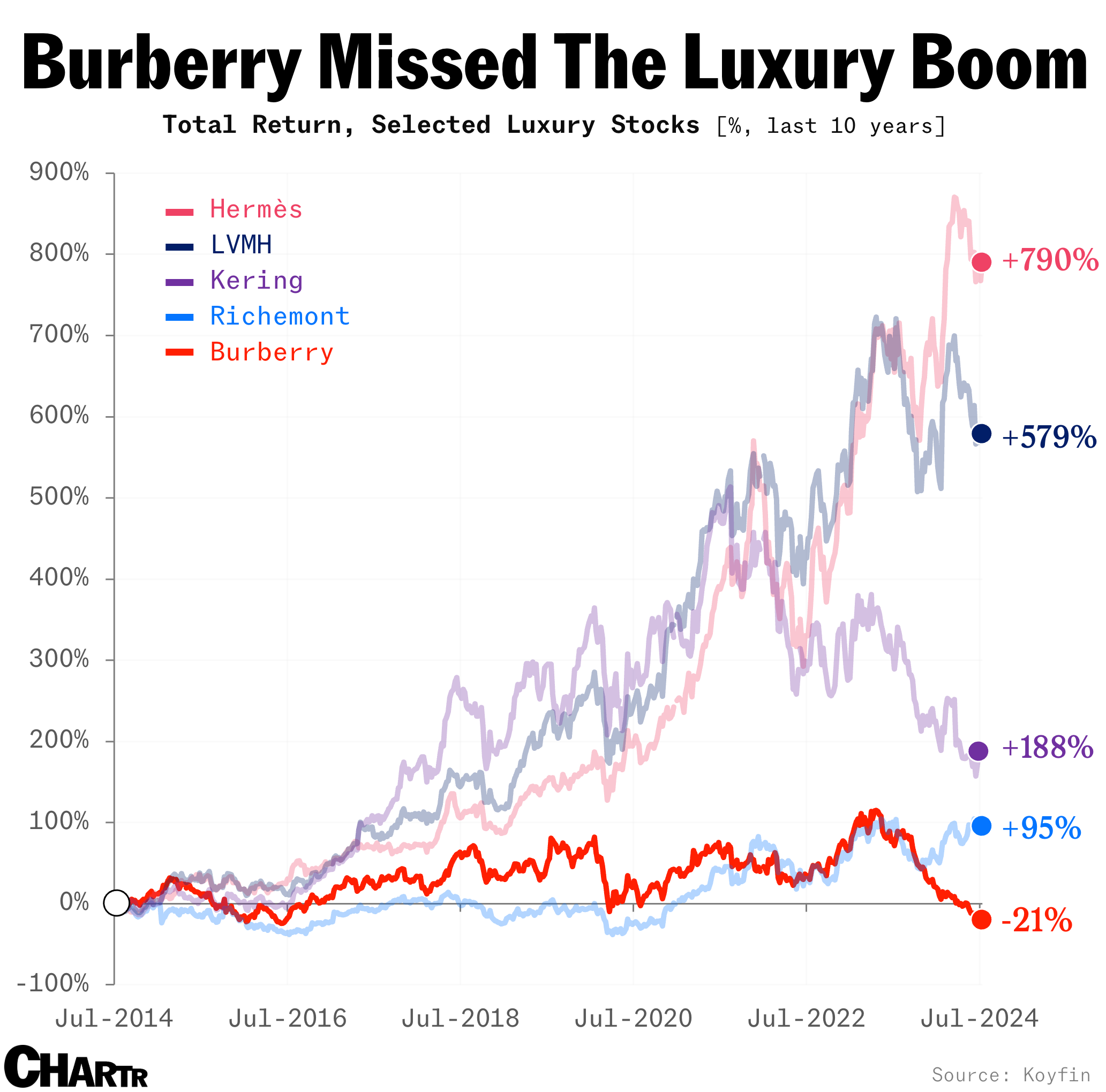
Europe’s luxury stocks have boomed in the last decade*

*Except Burberry, which has gone backwards

Burberry just reported a seriously unfashionable first quarter.

Retail revenues at the iconic British fashion house dropped 22%, the company’s CEO stepped down, the regular dividend was suspended, and sales in all but one of its major regions were down double digits (except Japan, which was up 6%) — sending shares in the company down more than 18% as of 2:45pm in London.

Plaid out

For a long time, Burberry's iconic trench coats were a must-have for the aspirational elite of UK society and beyond. Originally designed for military use in World War I, by the mid-1990s 1-in-5 coats exported from the UK bore the Burberry name. But, as the global middle class expanded, particularly in China, the company targeted a wider appeal at lower price points — diluting the brand's exclusive appeal. This contributed to a flood of knock-offs and controversies, with some bars and pubs going as far as to ban customers who wore the Burberry label in the early 2000s.
Burberry share price

Since then, the brand has undergone reinvention after reinvention. Its latest efforts have mostly focused on elevating the brand’s status, even at the risk of alienating customers with higher prices, as it seeks to replicate the success of other European top-tier labels. Indeed, Europe doesn’t do big tech — it does big luxury, with the soaring stock prices of companies like LVMH and Hermès emblematic of booming demand for European luxury products.

Burberry, unfortunately, hasn’t been able to ride the wave, standing out as one of the few European luxury goods companies to have seen its share price go backwards over the last decade. The brand’s new boss, who has been CEO of both Coach and Michael Kors, is tasked with turning the ship around.

More Markets

See all Markets
markets
Jake Lahut

Applied Digital inks new $7.5 billion lease with hyperscaler it first booked in April

Applied Digital saw its price soar after hours on news of a long-term lease agreement with the same “investment-grade” hyperscaler it struck a similar deal with in April.

The additional lease for 15 years in a take-or-pay arrangement is valued at $7.5 billion, and could rise to $18.2 billion if all options are exercised, according to the company's announcement.

This latest contract would bring Applied Digital's total contracted lease revenue to $31 billion, or $73 billion if all options are taken up.

The company also crowed about passing 1 GW of contracted capacity as it lands a customer for its fourth AI factory campus. The customer in question is not named, nor the exact location, just that the campus is “located in a northern state.”

The additional lease for 15 years in a take-or-pay arrangement is valued at $7.5 billion, and could rise to $18.2 billion if all options are exercised, according to the company's announcement.

This latest contract would bring Applied Digital's total contracted lease revenue to $31 billion, or $73 billion if all options are taken up.

The company also crowed about passing 1 GW of contracted capacity as it lands a customer for its fourth AI factory campus. The customer in question is not named, nor the exact location, just that the campus is “located in a northern state.”

markets

Intuit plummets after reporting slowing revenue growth

Is it a worse day to be an Intuit employee or an Intuit shareholder?

On Wednesday, the financial and business tech company announced third-quarter earnings and sweeping layoffs on the same day. The TurboTax parent company said it would cut 17% of its workers — approximately 3,000 people — to focus on its AI efforts, according to a memo obtained by Reuters.

The stock was down 3.8% during market hours. It dropped further when Intuit released third-quarter results after the bell showing the slowest year-over-year revenue growth since 2024, falling 10% after-hours.

Here are the numbers:

  • Q3 revenue of $8.56 billion (compared to analyst estimates of $8.54 billion).

  • Adjusted earnings per share of $12.80 (estimate: $12.54).

  • Raised full-year guidance for revenue of $21.34 billion to $21.37 billion (estimate: $21.24 billion).

“We delivered strong third-quarter results, driven by our AI-driven expert platform strategy,” said Sasan Goodarzi, chairman and CEO of Intuit. “As a result, we are raising our full-year revenue guidance for fiscal 2026.”

Shares of Intuit are down nearly 40% this year.

On Wednesday, the financial and business tech company announced third-quarter earnings and sweeping layoffs on the same day. The TurboTax parent company said it would cut 17% of its workers — approximately 3,000 people — to focus on its AI efforts, according to a memo obtained by Reuters.

The stock was down 3.8% during market hours. It dropped further when Intuit released third-quarter results after the bell showing the slowest year-over-year revenue growth since 2024, falling 10% after-hours.

Here are the numbers:

  • Q3 revenue of $8.56 billion (compared to analyst estimates of $8.54 billion).

  • Adjusted earnings per share of $12.80 (estimate: $12.54).

  • Raised full-year guidance for revenue of $21.34 billion to $21.37 billion (estimate: $21.24 billion).

“We delivered strong third-quarter results, driven by our AI-driven expert platform strategy,” said Sasan Goodarzi, chairman and CEO of Intuit. “As a result, we are raising our full-year revenue guidance for fiscal 2026.”

Shares of Intuit are down nearly 40% this year.

markets

T1 Energy spikes on record call volumes after Roth analyst calls short report a buying opportunity

Shares of T1 Energy are electric Wednesday afternoon, soaring more than 20% on record call volumes.

The stock had fallen over 13% at its lows on Tuesday after short-only fund Fuzzy Panda Research published a report calling the solar and battery storage company a “China Hustle” rather than a legitimate AI infrastructure investment, also alleging that the company has booked tax credits it won’t receive.

Retail traders have often used the dip that’s followed the announcement of a short report to load up on a company’s shares (see: POET Technologies in April).

Roth Capital Partners analyst Philip Shen responded to the report by calling T1 “a model for what the Trump administration may want in a domestic manufacturer that is transferring advanced technology and capacity to the US,” suggesting that the sell-off was a buying opportunity.

Earlier this week, T1 got an even more prominent vote of confidence when a 13F filing from Situational Awareness showed the hedge fund run by wunderkind Leopold Aschenbrenner held a 3.6% stake in the company at the end of Q1.

Latest Stories

Sherwood Media, LLC and Chartr Limited produce fresh and unique perspectives on topical financial news and are fully owned subsidiaries of Robinhood Markets, Inc., and any views expressed here do not necessarily reflect the views of any other Robinhood affiliate, including Robinhood Markets, Inc., Robinhood Financial LLC, Robinhood Securities, LLC, Robinhood Crypto, LLC, Robinhood Money, LLC, Robinhood U.K. Ltd, Robinhood Derivatives, LLC, Robinhood Gold, LLC, Robinhood Asset Management, LLC, Robinhood Credit, Inc., Robinhood Ventures DE, LLC and, where applicable, its managed investment vehicles.

