
Markets
Featured Session: Business, Life, and the Magic of Austin: A Conversation with Michael Dell - Conference - SXSW 2024 Conference and Festivals
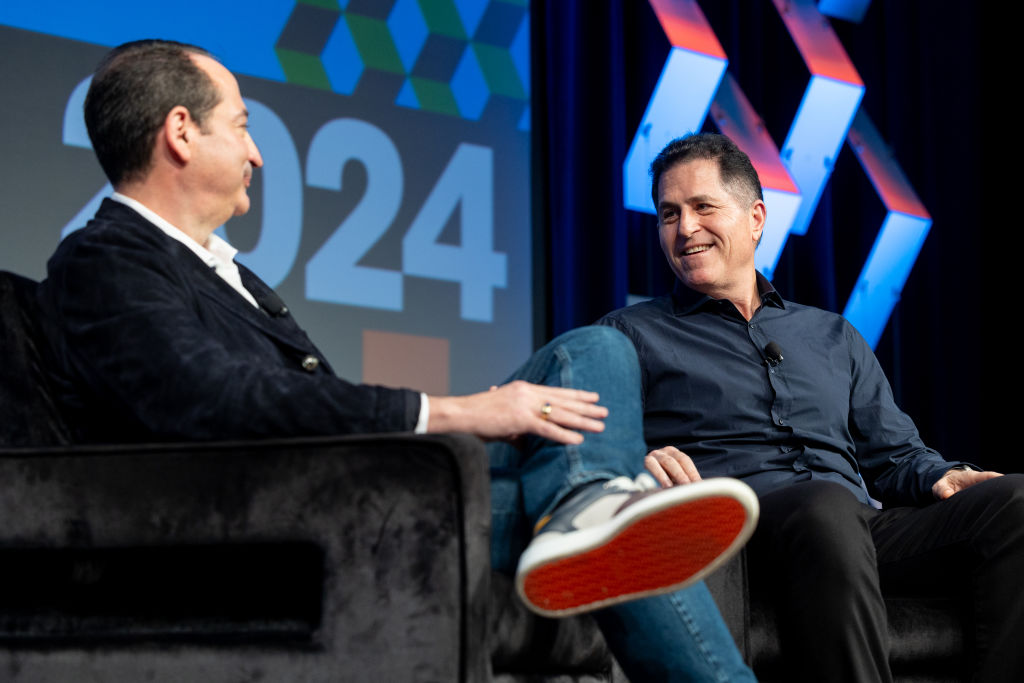
Patrick Moorhead and Dell CEO Michael Dell (Photo by Errich Petersen/SXSW Conference & Festivals via Getty Images)

Dell’s stock has risen as much as Nvidia’s, but Dell’s profits haven’t

Dell has been one of the hottest AI stocks of the last year, but is it really benefiting from the AI boom?

Jack Raines

Nvidia has been one of the biggest stock market winners over the last year, with the tech industry’s insatiable demand for AI chips sending its stock up 223%. However, another company has quietly gained 223% this year too: Dell.

Yesterday, Dell shares rose more than 11% after Morgan Stanley raised its price target and predicted the company would benefit from more demand for AI servers.

This comes two months after Nvidia CEO Jensen Huang highlighted the role that Dell is playing in the AI world, saying, “Everybody who is building these chatbots and generative AI, when you’re ready to run it, you’re going to need an AI factory. Nobody is better at building end-to-end systems of very large scale for the enterprise than Dell.”

Surprisingly, Dell’s financial performance hasn’t matched its stock returns. 

Nvidia's ascension to the $2 trillion club coincided with the company growing its revenue and net income by 200% and 800%, since ChatGPT launched in November 2022.

Dell, on the other hand, has lower revenue than it did a year and a half ago, while its earnings have remained flat over the last three years. And Wall Street analysts don't expect operating performance to meaningfully inflect higher in the short term, either: estimates for where both revenues and profits will be in one year's time, if realized, would still leave results below their post-pandemic highs, per Bloomberg.

In Dell's Q4 earnings call, COO Jeffrey Clarke noted that they were seeing increased demand for their AI servers, noting, "AI-optimized server orders increased by nearly 40% sequentially. We shipped $800 million of AI-optimized servers, and our backlog nearly doubled sequentially, exiting the fiscal year at $2.9 billion."

However, that is still a small fraction of Dell's total $22.3 billion in total quarterly revenue, and it did little to slow an 11% drop in year-over-year sales.

Dell may be one of the winners of the AI boom, but so far, the stock has run far ahead of the business.

More Markets

See all Markets
markets

SpaceX gets a wave of bullish ratings from Wall Street analysts

SpaceX received more than a dozen positive analyst calls on Tuesday — including from major Wall Street banks — as they initiate coverage on Elon Musk’s space and AI company.

SpaceX went public on June 12 at a $2.2 trillion valuation, the largest debut in history. While the company hasn’t yet posted a profit, it seems to have convinced Wall Street that it will get there and grow its valuation on the way.

Of the at least 17 analysts that gave a rating on Tuesday, all but one gave it a “buy” or “outperform” rating. MoffettNathanson was "neutral."

The ratings come as SpaceX joined the Nasdaq 100 index, a benchmark tech-heavy basket of companies that underpins millions of portfolios. The inclusion adds built-in demand for the stock from index funds and ETFs.

Still, SpaceX fell more than 5% on Tuesday amid a broader sell-off, and is currently effectively flat from its opening price of $150 a share.

markets

Nike sinks to lowest level since 2014 after warning of “challenged” sales environment in Q4 report

Did Nike do it?

Investors had a mixed reaction after the global sports apparel company reported its fourth quarter earnings on Tuesday after the bell. Shares initially rose 5% as Nike beat out Wall Street expectations amid a hefty tariff refund bonus. However, the stock then sank to its lowest level since August 2014 in postmarket trading.

Here are the Q4 numbers:

  • Revenue of $11.0 billion (estimate: $10.8 billion).

  • Adjusted earnings per share of $0.20 (estimate: $0.12).

Ahead of this report, Nike warned that results would be flattered by a one-time tariff refund (now estimated at roughly $0.52 per share for the bottom line). That gave the company an extra cushion in snapping its streak of seven quarters of year-over-year profit declines.

Over the past year, the company had been punished by tariffs on imported goods, stagnant consumer spending, and increasing competition from other footwear brands like New Balance, Adidas, and Hoka.

Outgoing CFO Matthew Friend deemed it an “increasingly challenging operating environment, where sell-through remains challenged.”

Latest Stories

Sherwood Media, LLC and Chartr Limited produce fresh and unique perspectives on topical financial news and are fully owned subsidiaries of Robinhood Markets, Inc., and any views expressed here do not necessarily reflect the views of any other Robinhood affiliate, including Robinhood Markets, Inc., Robinhood Financial LLC, Robinhood Securities, LLC, Robinhood Crypto, LLC, Robinhood Money, LLC, Robinhood U.K. Ltd, Robinhood Derivatives, LLC, Robinhood Gold, LLC, Robinhood Asset Management, LLC, Robinhood Credit, Inc., Robinhood Ventures DE, LLC and, where applicable, its managed investment vehicles.

