

Markets
markets

Even after the DeepSeek and AI meltdowns, Wall Street's still sticking with its lofty Nvidia price targets

It might only be March 17, but for Nvidia investors, the year so far might have felt like a lifetime.

Everything happens so much

First came the DeepSeek freak-out, a violent sell-off sparked by a Chinese AI model that was reportedly trained for a fraction of the cost of its Western rivals. Then came tariffs, an ongoing growth slowdown scare, and a sharp reversal in the fortunes of momentum stocks — almost all of which were heavily associated with an AI trade predicated on a continued “capex orgy” as Big Tech companies plan data centers the size of large cities.

So, given all that’s happened this year, how have Wall Street analysts changed their views on Nvidia? Well... they haven’t really. At least not in the aggregate.

Data from FactSet reveals that the average (mean) price target for Nvidia at the end of last year, before any of those headlines hit the tape, was $173.81. Today it’s $174.79, or 0.6% higher.
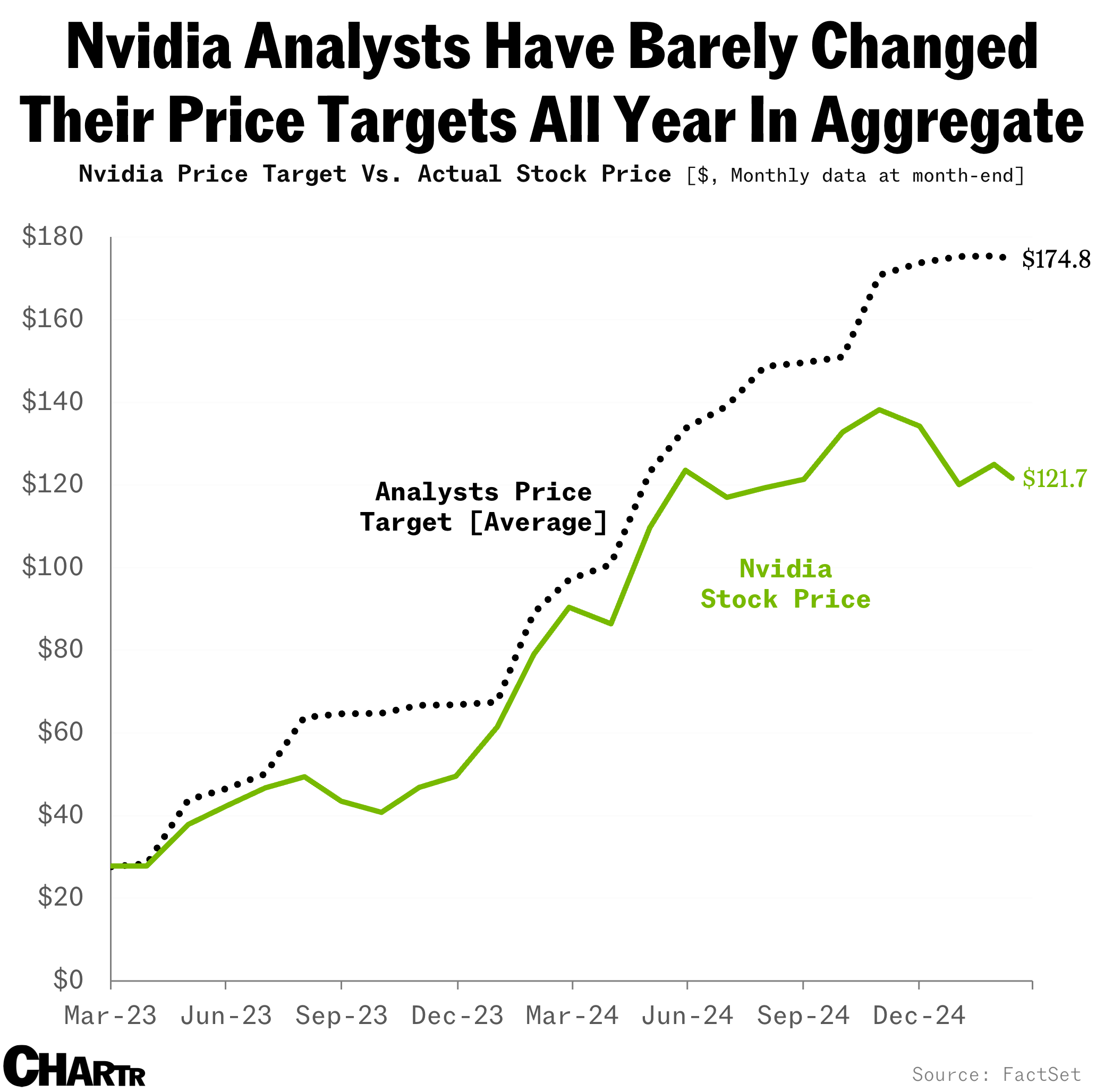
Nvidia Price Targets
Sherwood News

It’s plausible, if a little embarrassing, that some analysts simply haven’t gotten around to rerunning the numbers in the wake of this latest sell-off. But clearly many of the analysts — and there are nearly 70 of them in total — believe that the fundamental equity story remains unchanged for Wall Street’s most-watched stock, even as the world around it shifts. At the company’s full-year results, Nvidia beat on both the top and bottom lines, though, with the rollout of its Blackwell GPUs progressing steadily, gross margins might compress slightly in the short term.

After a volatile last seven days or so, the next big catalyst for the stock could come quickly, as CEO Jensen Huang takes the stage tomorrow at GTC 2025, Nvidia’s biggest conference of the year. Investors will be on the lookout for mentions of 2026 demand and any updates on its next-gen chip Vera Rubin (named after the astronomer).

Related reading: 73 Wall Street analysts cover Amazon, there are 72 on Meta, and 66 write about Nvidia — how many do we need?

More Markets

See all Markets
markets

United beats Q1 earnings and revenue estimates, lowers full-year profit guidance amid surging jet fuel prices

United Airlines reported its first-quarter earnings results after the bell on Tuesday. The carrier’s shares ticked down in after-hours trading.

For Q1, United reported:

  • Adjusted earnings of $1.19 per share, compared to the Wall Street estimate of $1.08 per share compiled by FactSet.

  • $14.6 billion in revenue, compared to the $14.39 billion consensus estimate.

In the first quarter, United’s fuel expense grew 12.6% from the same period last year to $3.04 billion.

For the second quarter, United expects adjusted earnings per share of between $1 and $2, shy of Wall Street expectations of $2.08. For the full year ahead, United said it expects earnings between $7 and $11 per share, compared to its prior guidance of between $12 and $14 per share.

“Guidance assumes United’s revenue recovers 40% to 50% of the fuel price increases in the second quarter, 70% to 80% of the fuel price increases in the third quarter and 85% to 100% of the fuel price increases in the fourth quarter 2026,” read the company’s investor update.

Earlier this month, United was among the first major US airlines to hike its bag fees amid higher fuel costs. Its shares have fallen more than 15% from a February high days before the war in Iran began.

United has also made waves this month following reports that CEO Scott Kirby had floated the idea of a merger with American Airlines to President Trump. A merger between two of the big four airlines would create a true US behemoth, controlling more than a third of the American market. American Air last week said it wasn’t interested in merging with United and hadn’t held talks on the idea. On Tuesday, Trump told CNBC that he doesn’t like the idea either.

markets

Hedge funds are following retail traders into the Magnificent 7

Hedge funds are following retail traders into the stocks the masses never stopped buying.

“As we kick off earnings for megacap tech stocks, this stood out: [hedge funds] have started buying Mag7 stocks again this month though positioning remains well below the peak levels seen in early 2016,” wrote Goldman Sachs’ Cullen Morgan.

Goldman PB Mag 7
Source: Goldman Sachs

In early April, JPMorgan strategist Arun Jain noted that retail investors had basically been selling everything but the Magnificent 7 stocks as part of a more cautious stance due to the Iran war.

(Apple has been a long-standing exception to this trend, presumably because retail traders arent fond of its hands-off approach to AI.)

JPM Retail flows

Last August, Jain discussed how retail activity tended to “crowd in” institutional buyers in meme stocks, while Goldman’s John Marshall advised clients to piggyback on stocks beloved by retail traders. Speculative, retail-geared assets proceeded to go on a tremendous run that soured in October.

But there are some early indications that a similar bout of speculative fervor is bubbling up once more.

markets

POET Technologies surges above $10 for first time in 4 years amid explosion in call volumes

POET Technologies is up nearly 40% this week as options market activity goes haywire in a faint echo of what got the stock on retail traders’ radars in October.

As of 11:12 a.m. ET, more than 10 calls have changed hands for every put traded. This bullish impulse has propelled the stock above the $10 threshold for the first time since March 2022.

Shares of the optical communications firm briefly dipped last week after Wolfpack Research said it was short the company because its investors would be exposed to an “IRS tax nightmare.”

The company responded that day saying it was taking measures for US shareholders that “should mitigate certain potential adverse US federal income tax consequences to it that could otherwise result from the Company’s status as a passive foreign investment company.”

Latest Stories

Sherwood Media, LLC produces fresh and unique perspectives on topical financial news and is a fully owned subsidiary of Robinhood Markets, Inc., and any views expressed here do not necessarily reflect the views of any other Robinhood affiliate, including Robinhood Markets, Inc., Robinhood Financial LLC, Robinhood Securities, LLC, Robinhood Crypto, LLC, Robinhood Derivatives, LLC, or Robinhood Money, LLC. Futures and event contracts are offered through Robinhood Derivatives, LLC.
