

Markets
markets

CoreWeave guidance disappoints as delays weigh on data center ramp despite blowout top and bottom line beats

CoreWeave reported a strong sales beat in Q3, with bottom-line results to match.

  • Revenue: $1.36 billion (compared to analyst estimates of $1.23 billion and guidance for $1.26 billion to $1.30 billion)

  • Adjusted operating income: $217.15 million (estimate: $177.2 million, guidance: $160 million to $190 million)

Those figures exceeded every estimate among analysts polled by Bloomberg.

More strong sales seem to be in the pipeline: CoreWeave’s revenue backlog swelled to $55.6 billion at the end of the quarter, nearly double the $30.1 billion at the end of Q2.

But they’re not imminent: in fact, despite this revenue beat, CoreWeave reduced its 2025 annual sales forecast to a range of $5.05 billion to $5.15 billion from its prior outlook for $5.15 billion to $5.35 billion.

That cut to its guidance has shares deep in the red on Tuesday morning during premarket trading.

CoreWeave seems to be having a little trouble getting as much compute up and running as Wall Street had hoped for, with active power of 590 megawatts at the end of the quarter, where analysts had anticipated nearly 625 megawatts.

On the earnings call, the company’s executives discussed a delay to one of their data centers in more detail, a problem which is weighing on its Q4 and FY25 guidance. To be clear, CoreWeave isn’t flagging access to power in particular as a critical bottleneck right now (unlike Microsoft’s and Nvidia’s leaders). Rather, it’s the other physical infrastructure supporting the data center that’s the issue.

Michael Intrator, CoreWeave’s CEO, said:

So you're going to be hearing this theme repeated again and again as you talk to not just CoreWeave, but across the space. And it is a real challenge at the powered shell level. It's not a challenge for power, right? There's plenty of power right now, and we believe that there will be ample power for the next couple of years. But really where the challenge is, is the powered shell.

Accordingly, CoreWeave’s guidance for over 850 megawatts of active power at year end would entail the company falls well short of the current consensus estimates for nearly 900 megawatts.

It’s going to take a lot of supply chain unfurling to realize its revenue backlog on schedule.
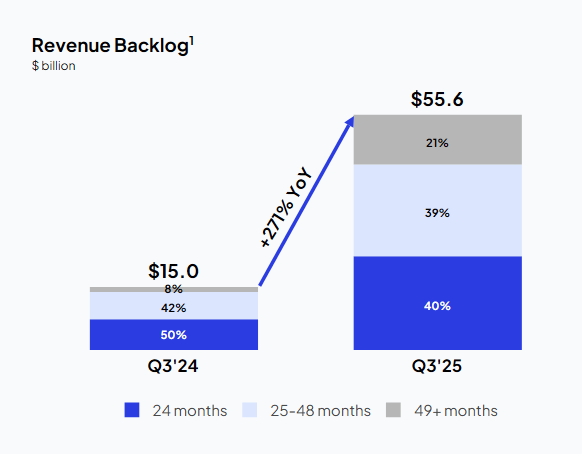
CoreWeave revenue backlog
Source: CoreWeave Q3 earnings presentation

The neocloud company had a busy quarter, reaching a $14 billion pact with Meta for AI compute, expanding its agreement with OpenAI, and signing a $6.3 billion deal with Nvidia for any unused cloud computing capacity, among others. CoreWeave’s recent attempt at vertical integration failed, as Core Scientific shareholders voted overwhelmingly against its proposed acquisition on October 30.

However, there’s a little less drama around this quarter’s results than there was for the last one. That’s because its lock-up period expired shortly after CoreWeave’s impressive Q2 results, catalyzing a wave of profit taking in the AI darling.

More Markets

See all Markets
markets

Hedge funds are following retail traders into the Magnificent 7

Hedge funds are following retail traders into the stocks the masses never stopped buying.

“As we kick off earnings for megacap tech stocks, this stood out: [hedge funds] have started buying Mag7 stocks again this month though positioning remains well below the peak levels seen in early 2016,” writes Goldman Sachs’ Cullen Morgan.

Goldman PB Mag 7
Source: Goldman Sachs

In early April, JPMorgan strategist Arun Jain noted that retail investors had basically been selling everything but the Magnificent 7 stocks as part of a more cautious stance due to the Iran war.

(Apple has been a longstanding exception to this trend, presumably because retail traders aren't fond of its hands-off approach to AI.)

JPM Retail flows

Last August, Jain discussed how retail activity tended to “crowd in” institutional buyers in meme stocks, while Goldman’s John Marshall advised clients to piggyback on stocks beloved by retail traders. Speculative, retail-geared assets proceeded to go on a tremendous run that soured in October.

But there are some early indications that a similar bout of speculative fervor is bubbling up once more.

markets

POET Technologies surges above $10 for first time in 4 years amid explosion in call volumes

POET Technologies is up nearly 40% this week as options market activity goes haywire in a faint echo of what got the stock on retail traders’ radars in October.

As of 11:12 a.m. ET, more than 10 calls have changed hands for every put traded. This bullish impulse has propelled the stock above the $10 threshold for the first time since March 2022.

Shares of the optical communications firm briefly dipped last week after Wolfpack Research said it was short the company because its investors would be exposed to an “IRS tax nightmare.”

The company responded that day saying it was taking measures for US shareholders that “should mitigate certain potential adverse US federal income tax consequences to it that could otherwise result from the Company’s status as a passive foreign investment company.”

markets

GE Aerospace falls after leaving earnings guidance unchanged

Jet engine maker GE Aerospace slid in early trading Tuesday, as its better-than-expected Q1 results were overshadowed by uninspiring guidance.

It reported:

  • Q1 adjusted revenue of $11.61 billion vs. the $10.71 billion consensus expectation.

  • Adjusted earnings per share of $1.86 vs. the $1.60 consensus estimate.

But management left full-year 2026 adjusted EPS guidance where it was at between $7.10 and $7.40, compared to a consensus expectation of $7.49 from analysts.

“Were holding our full-year guidance across the board, given the macro uncertainty, though, with our strong start to the year, we are trending toward the high end of that range,” CEO Larry Culp said on the conference call.

GE Aerospace hit an air pocket in March as the start of the US war against Iran sent energy prices soaring and hurt expectations for the profitability of commercial carriers. A rally in April had pushed the stock close to positive territory for the year, but it’s solidly in the red after the results today.

markets

Trump says he doesn’t like potential United-American merger but would “love somebody to buy Spirit”

President Trump on Tuesday told CNBC that he doesn’t like the idea of a United Airlines-American Airlines merger, but would “love somebody to buy Spirit.”

“Maybe the federal government should help that one,” Trump said on Tuesday, referring to Spirit’s attempts to emerge from bankruptcy.

Trump’s thoughts on United-American are an update from last week, when White House Press Secretary Karoline Leavitt said the potential megamerger was “not something the president or the White House have an ​opinion on or are weighing in on.”

American and United shares dipped following Trump’s comments, as did Spirit rival Frontier Airlines.

Latest Stories

Sherwood Media, LLC produces fresh and unique perspectives on topical financial news and is a fully owned subsidiary of Robinhood Markets, Inc., and any views expressed here do not necessarily reflect the views of any other Robinhood affiliate, including Robinhood Markets, Inc., Robinhood Financial LLC, Robinhood Securities, LLC, Robinhood Crypto, LLC, Robinhood Derivatives, LLC, or Robinhood Money, LLC. Futures and event contracts are offered through Robinhood Derivatives, LLC.
