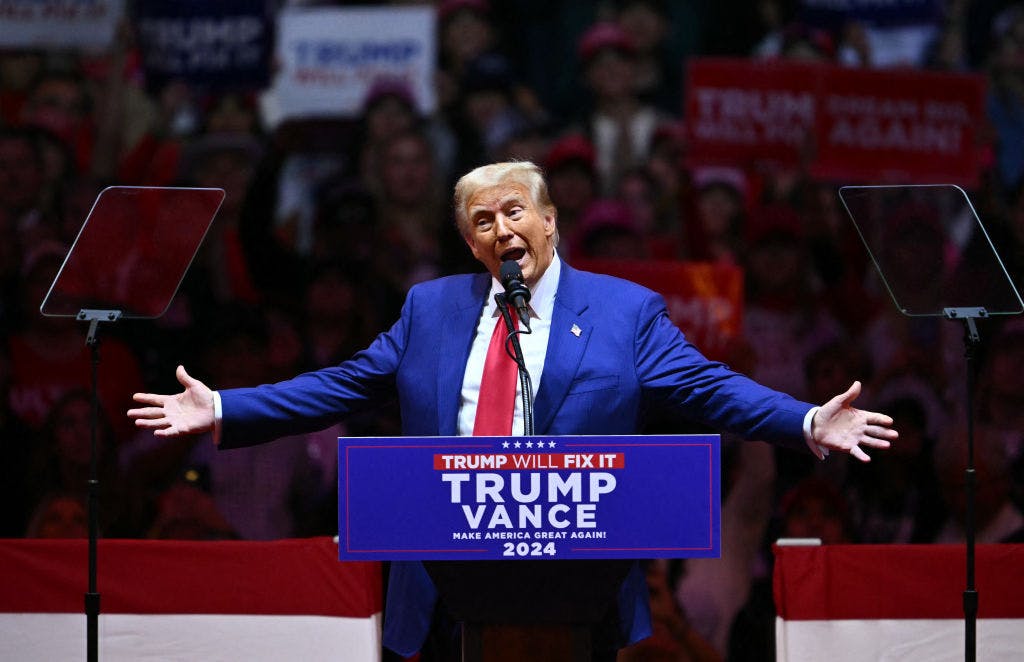
Is the bond market throwing a Trump tantrum?
The rise in Treasury yields has occurred alongside a surge in the former president’s poll numbers and betting-market-implied odds, but correlation doesn't necessarily imply causation.
There’s something unusual going on in the US bond market. The Fed delivered a jumbo rate cut in September — but the 10-year Treasury yield is up to a three-month high, breaking above 4.3% on Tuesday.
Andreas Steno Larsen, CIO at Steno Global Macro Fund, flagged how seemingly odd it is for the 10-year yield to be up decisively once the US central bank begins cutting rates.
The move in bond yields after the 50bp cut is very out of the ordinary pic.twitter.com/wWHa32rR3x
— Andreas Steno Larsen (@AndreasSteno) October 22, 2024
One of the increasingly popular answers on Wall Street: it’s the impact of all the growth, inflation, and general policy uncertainty of Trump 2.0 getting priced in.
Allow me to throw some cold water on that.
Turns out, the trend of yields rising after the Fed starts easing isn’t as uncommon as you might think. The rise in yields is well justified by the data — both domestically and globally. And while the stock traders certainly seem to be betting big on a Trump win, other more macroeconomic-linked assets aren’t really corroborating that message strongly. I’m not going to outsource my thoughts on the bond market to the internals of the stock market or the price action in DJT and Polymarket.
That being said, it’s a stretch to say there’s no Trump in the US Treasury market. Total put open interest on the iShares 20+ Year Treasury Bond ETF recently hit a record high, with the relative pricing of puts versus calls showing that bearish options are much more in demand. The same pricing dynamic is true for options on Treasury futures, too.
There’s little doubt that the flows associated with these positions are contributing to the relentless rise in bond yields we’re seeing. In my mind, that’s just the icing on the cake baked to celebrate another year for the US expansion — fresh on the heels of countless premature obituaries mourning its impending end.
’90s Redux
First off, it’s not that odd for bond yields to be rising after the opening rate cut. Turn to 1995, when the Federal Reserve reacted to what turned out to be a false signal of job-market weakness with a few cuts, or 1998, when lower policy rates were part of the solution for a market rattled by the collapse of Long-Term Capital Management and EM debt crises. Both times you’ll see 10-year yields go up after the first of three rate cuts.
What do those episodes have in common?
Investors thought Fed cuts would work; the central bank wasn’t viewed as being the firetruck that arrived after the house had turned to ashes because the near-term economic momentum wasn’t as poor as feared. And so the central bank only had to deliver a few cuts.
We don’t have an extremely long history of US business cycles (or monetary policy cycles) since the end of the Bretton Woods system, so it’s useful to search out more examples of this kind of thing happening. It’s worth including investors’ responses to the announcement of quantitative-easing programs by the Fed following the global financial crisis. Even though, in theory, buying bonds and sucking these safe assets out of the market should have pushed yields lower, they went up. Rightly or wrongly, investors thought this would work (and likely overestimated the power of monetary policy).
It is somewhat of a paradox that Fed action intended to provide more support to the economy can actually cause yields to rise if people believe that action will be a sufficient remedy — even if lower yields are actually what’s needed to boost the economy. At the lows for 10-year yields, the highest yield on the SOFR curve (that is, what the market said the Fed would hike to after policymakers were done cutting) was a little less than 3.6%. Right now, that’s about the low yield for how much the Fed is expected to cut!
It’s the economy, stupid
What, if not Trump, could have contributed to this dynamic? Well, to borrow from James Carville, it’s the economy, stupid (along with some commentary from monetary policymakers).
Looking at the eight sessions in which 10-year Treasury yields moved at least five basis points higher since mid-September, a couple are accounted for by monetary policymakers: the day the jumbo rate cut was delivered (9/18) and Fedspeak (10/21). Even more are linked to positive data surprises — lower initial claims and a strong services PMI, the robust September nonfarm payrolls report (where the losses in bonds bled over to the following Monday), and September’s better-than-expected retail sales. Sum those two categories up and that’s about 50 basis points of the nearly 70-basis point rise in yields off their lows.
US economic data is both exceeding analysts’ expectations (finally) and also getting less bad in absolute terms. The two biggest months of improvement for Citigroup’s US economic surprise index in the past year are September and October. This gauge, which tracks whether data come in better or worse than Wall Street anticipates, is now at its highest level since April — a time when there was less easing priced in for 2024 than what we’ve already had by now. At the same time, Citi’s US economic data-change index (which measures data relative to its one-year average) has also improved.
This trend is not solely domestic: economic surprise indexes for the eurozone, China, and the globe have all improved substantially since mid- to late August.
Coming to terms
The global synchronized move raising yields as economic data improved relative to expectations helps undercut the idea that the bond market is throwing a Trump tantrum due to the rise in the so-called term premium — a hand-wavy measure of uncertainty about the range of possibilities for growth and inflation.
The thinking goes that Trump’s fiscal and trade policies, under a unified Republican Congress, could either raise the medium-term trajectory for growth and inflation meaningfully, or have the potential to be so erratic that investors deserve to get paid more for owning bonds.
Term premium is an important conceptual tool that helps inform where the bond market can go with the unfortunate side effect of being effectively impossible to measure precisely (though many try). The version of the term premium that Wall Street likes to cite is often referred to as the ACM (after the initials of its creators). I have argued for years that it’s very poorly specified, and there are clear occasions when it doesn’t come close to passing the smell test.
Nonetheless, this is what Serious People look at, so I will, too. One thing I’ve noted is that term-premium shocks often have a global component. For instance, use German 10-year bonds as a proxy for global rates, and look at that relationship compared to the ACM term premium. Zooming in on times when this measure is rising, “global” yields usually are, too.
Can I get a witness?
If Trump is truly getting priced into financial markets, the signs should be everywhere and more obvious. And if you’re of the mind that past performance is no guarantee of, but likely the best guide for, future performance, then we can start to run some comparisons.
The relative performance of emerging market assets, in particular, is telling.
Even as emerging market currencies have gotten killed lately (a classic 2016 postelection reaction) — the big losers aren’t really the countries that had previously been the target of Trump’s trade ire. In particular, the Mexican peso isn’t weakening nearly as much as one would anticipate if one were running back the 2016 playbook.
Same goes for spreads on emerging market debt denominated in US dollars, which widened after Trump’s 2016 election win. Those have been falling for months now.
At the very most, if rates and FX markets are pricing in Trump, traders are pricing in the most rose-colored-glasses version of his presidency. Or at least one in which the sequencing is similar to his first term, with stimulus first to prime the pump before prosecuting a trade war.