

Bitcoin miner IREN surges on AI data center announcement
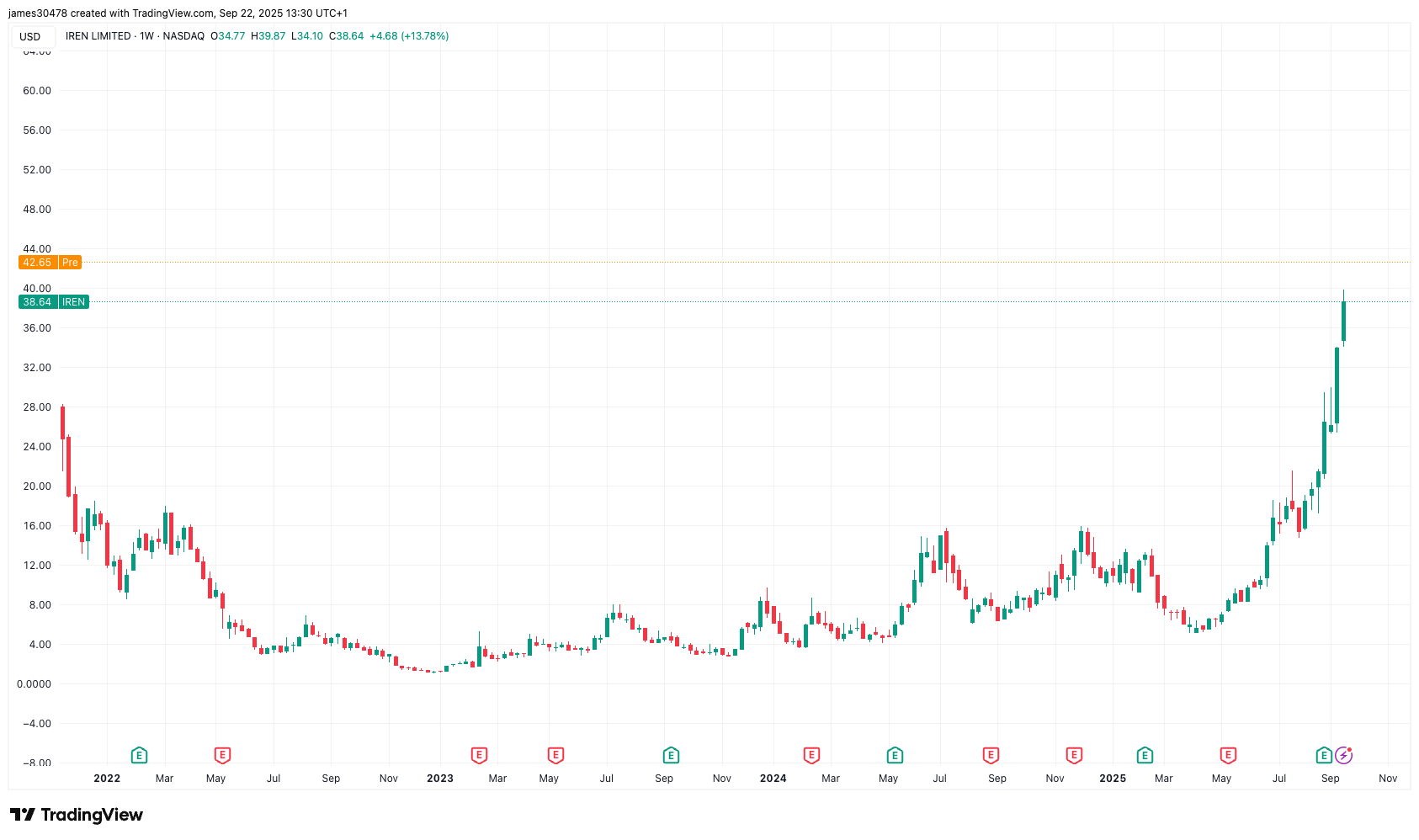
Australian midcap bitcoin miner and contract data center operator IREN jumped in early trading after announcing additional purchases of Nvidia and Advanced Micro Devices GPUs to strengthen its business as a spot provider of data center computing power for AI.
The company said Monday that it expects its AI infrastructure business to generate some $500 million in annualized sales by early next year. The stock is up roughly 300% in 2025 and 400% over the last 12 months.
Super Micro’s share price was just on the verge of filling the gap caused by the bombshell revelation that its cofounder was indicted on allegations of smuggling servers containing Nvidia AI chips into China in violation of US export controls.
Now, that very same event may be fueling the latest rug-pull in the shares.
Super Micro Computer is down sharply in early trading after BlueFin Research said that the AI server company “lost a significant contract” with Oracle worth roughly $1.1 billion to $1.4 billion, according to reporting from Bloomberg. The canceled contract “is believed to be related” to the charges brought against Super Micro’s cofounder.
This contract loss “could be a leading indicator of companies seeking to de-risk their exposure to the server maker following the indictment of its co-founder for smuggling GPUs to China,” wrote Bloomberg Intelligence analyst Woo Jin Ho, noting that this could weigh on its sales prospects next year. “We view Dell as a leading beneficiary in picking up the order slack.”
Dell, which benefited from the announcement of the allegations back in March, is modestly lower in premarket trading.
Applied Digital is soaring in early trading after the data center company announcing that it’s booked its third hyperscaler client.
This customer signed a lease for $7.5 billion in contracted value over a 15-year period covering 300 megawatts of IT load at a location expected to begin operations in mid-2027.
“This addition expands total contracted lease revenue to over $23 billion and further diversifies the company’s customer base with a third hyperscale tenant,” per the press release. “More than 50% of total contracted revenue is now backed by investment-grade customers.”
During the company’s Q2 conference call in January, CEO Wes Cummins said Applied Digital was in “advanced discussions” on deals with another investment-grade hyperscaler for three different sites. During the Q3 earnings call earlier this month, Cummins said he was “more optimistic” that leases would get signed in the near term.
A lack of rental cars was a big issue for American travelers in 2021.
A fresh supply of rental car company shares may become a big issue for fans of the Avisshort squeeze.
After the close on Wednesday, following its whopping 38% plunge, the company announced that it would be releasing its Q1 results on April 29. Why is that important?
This is not financial advice, but it would seem prudent for Avis’ management to take advantage of its richly valued shares to raise money. Its forward price-to-earnings ratio has spiked to above 135 during this parabolic advance and analysts at JPMorgan just downgraded the shares to underweight citing an “unsustainable valuation.”
A share offering would alleviate one of the presumptive factors behind the ferocity of Avis’ 427% gain from March 30 through Wednesday’s close: that its two biggest holders dominate the float, and as such, it may be difficult for short sellers to extricate themselves from their bets against the stock. That angle may have already passed its best before date, however, as trading volumes in excess of $19 billion this week somewhat undermines the argument that shorts struggling for liquidity are locked into losing positions.
Share offerings are what companies who benefit from big spikes out of nowhere tend to do (ask AMC!), unless they can’t. And if they can’t, they aim to find a way around that (ask GameStop!)
About two years ago, during the Return of Roaring Kitty meme mania 2.0, the video games and collectibles retailer was seemingly constrained from offering shares because it was in a “blackout period” ahead of earnings (which had been scheduled for June 7). As such, management released preliminary results on May 17 along with plans to sell up to 45 million shares on the open market.
It’s impossible to tell if Avis pulled forward the date of its earnings in order to capitalize on its elevated stock price. But we’d be remiss not to note that Avis has not released its Q1 results in the month of April since 2006. Typically, they’ve dropped in the first week of May (last year, on 5/7).
I’ll take this opportunity to recycle one of my favorite tweets on the subject.
@RodAlzmann / X
For any corporate entities offended, we would of course concede that one person’s "shitco" is another person’s deep value, diamond in the rough, turnaround story — and that’s what makes a market.
Texas Instruments surged more than 10% in premarket trading on Thursday after the chipmaker reported better-than-expected Q1 results and a surprisingly strong second-quarter forecast, driven by growing demand for its analog chips.
Per its press release, the company reported the following results for its fiscal first quarter:
Revenueof$4.83 billion, handily beating analyst estimates of $4.52 billion (compiled by Bloomberg).
Adjusted earnings per share of $1.68, up 31% year over year and topping Wall Street estimates of $1.37.
Texas Instruments specializes in making analog chips, which regulate power systems and convert signals like sound or light into digital data that semiconductors can process. Though far from the sexy chips that do AI compute work, like the heavily in-demand kind that Nvidia and others design, TI’s products still seem to be getting a lift from all this spending.
Noting a “continued acceleration in industrial and data center” verticals, the company’s top line seemed to get a big boost, with demand from industrial end markets up 30% and data center demand growing 90% year on year, too. CEO Haviv Ilan commented in the earnings call, “We remain well positioned with inventory and capacity that allows us to support our customers with competitive lead times through the cycle.”
While the company’s revenue is still short of its 2022 peak, Ilan also added that “there is a lot of room to grow,” and is optimistic that the run-up can continue. Indeed, for the coming second quarter, Texas Instruments expects revenue in the range of $5 billion to $5.4 billion, well ahead of current analyst expectations for $4.8 billion.
Latest Stories
Sherwood Media, LLC produces fresh and unique perspectives on topical financial news and is a fully owned subsidiary of Robinhood Markets, Inc., and any views expressed here do not necessarily reflect the views of any other Robinhood affiliate, including Robinhood Markets, Inc., Robinhood Financial LLC, Robinhood Securities, LLC, Robinhood Crypto, LLC, Robinhood Derivatives, LLC, or Robinhood Money, LLC. Futures and event contracts are offered through Robinhood Derivatives, LLC.
