
Markets
Bill Ackman
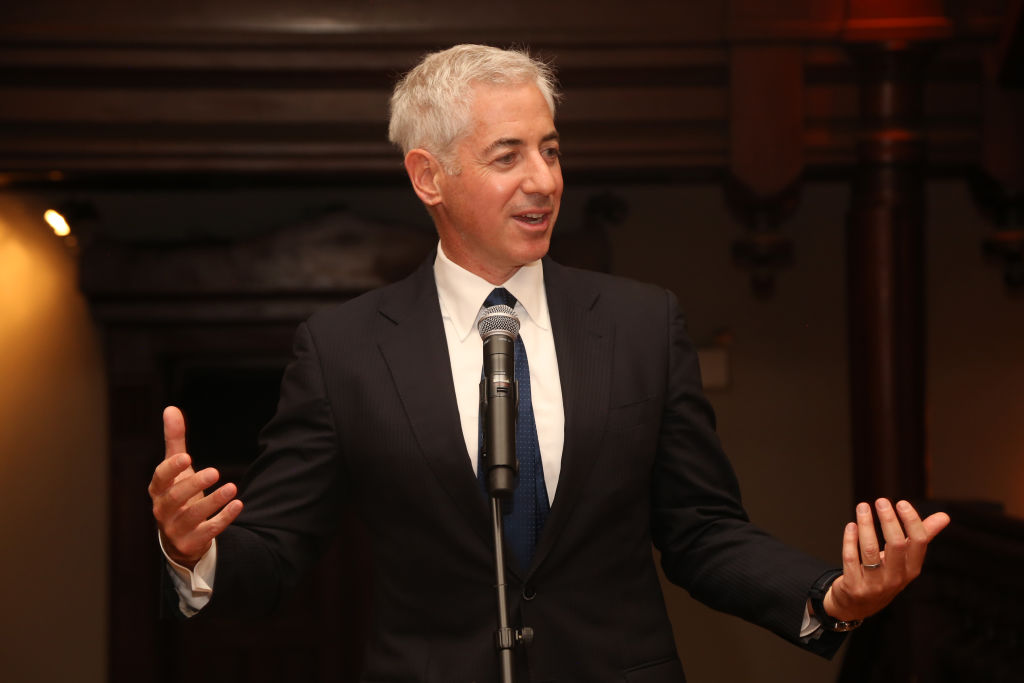
Bill Ackman (Sylvain Gaboury, Patrick McMullan/Getty Images)

Bill Ackman’s pricey IPO plan

Pershing Square’s fundraising efforts need to bear fruit for this valuation to make sense

Jack Raines

Bill Ackman made headlines this morning after The Wall Street Journal reported that he is planning to take his investment fund, Pershing Square, public in late 2025 or early 2026. As a precursor to the planned IPO, Ackman is also selling a stake in the firm to investors in a funding round that will value Pershing Square at approximately $10.5B.

It’s rare for a hedge fund to IPO in the US because the US Investment Company Act of 1940 prevents investing groups from charging retail investors expensive performance fees, such as the “2 and 20” that is common for hedge funds. Hedge funds can, however, charge “qualified purchasers” (generally high-net worth clients or institutions) higher fees, which is why hedge funds are typically private.

However, Bill Ackman isn’t looking to take a “hedge fund” public. To quote the Journal piece (emphasis ours):

Pershing Square has told potential investors to compare it to asset managers like Brookfield Asset Management and Blue Owl Capital rather than hedge funds. Brookfield’s market value is about $15 billion; it has more than $925 billion in assets under management. Blue Owl’s market value is about $28 billion and it manages more than $174 billion.

Basically, Ackman isn’t looking to take a specific investment vehicle public. He wants to IPO the holding company that happens to own several investment vehicles, which… kind of makes sense?

As of their February 2024 annual report, Pershing Square had $18.2B in assets under management (AUM), consisting of the following:

  • $14.6B in a closed-end Europe fund (PSH), which is listed on the Amsterdam and London exchanges

  • $1.6B in an investment vehicle that it used to purchase a stake of United Music Group

  • $2B in traditional hedge funds

Pershing listed its largest fund in the European markets in 2014 to skirt US regulations regarding fees: while they couldn’t charge high performance fees on a publicly traded US-listed fund, they can (and do) charge a 1.5% management fee and a 16% performance fee on their European fund.

The planned IPO would sell stakes in the parent entity controlling the funds, which wouldn’t charge high management fees, rather than a specific investment vehicle. While The Wall Street Journal reported that the $10.5B valuation looks high, (for context, Blue Owl Capital is worth $28B with $174B in AUM), the firm justified its valuation by explaining that it will soon manage much more money. From the Journal piece:

The firm justified its rich valuation to investors by explaining that it expects to manage considerably more money, and eventually earn more in fees, after Pershing Square U.S.A. and other funds launch, people familiar with the matter said.

In February, Ackman announced plans to launch a $10 billion US-based closed-end fund which, importantly, would not charge a performance fee, and just a flat 2% management fee, keeping it within US regulations. 

Additionally, Pershing also received SEC approval to raise a multi-billion dollar “special-purpose acquisition rights company,” or SPARC, to take a private company public, which would further increase its AUM.

Why is Ackman now prioritizing the American market after a decade with most of his firm’s capital in Europe? One reason is that Pershing’s Europe-listed fund is trading at a ~27% discount to its net asset value (NAV), meaning that the price per share of its fund is worth 27% less than the value of its underlying assets. If Pershing’s European fund traded at a premium to its NAV, Pershing could issue new shares and raise money until the price per share matched the underlying assets. With its share price at a discount, however, any capital raise in Europe would be below the fund’s intrinsic value.

While Pershing’s $10 billion valuation feels high for the firm right now, that number could look more reasonable in the future depending on the company’s ability to raise funds for its new US closed-end fund, its SPARC, and any other ventures that Ackman may have up his sleeve.

More Markets

See all Markets
markets
Luke Kawa

BlackBerry is on one of its hottest rallies of all time

History suggests that BlackBerry does extremely well when 1) it’s considered to be pioneering a transformative technology, or 2) there’s widespread retail enthusiasm for stocks.

If you squint (or dream), you could argue that both are going on right now.

Shares of the once-upon-a-time smartphone giant are up more than 160% over the past three months. The only times the shares have had a hotter run of form than this are at the tail end of the dot-com bubble, and in early 2021 when was it part of the meme stock craze headlined by GameStop.

Let’s start with the easy part first — here’s Scott Rubner, head of equity and equity derivatives strategy at Citadel, on retail’s significant footprint in the shares’ rally:

“Retail traders are the new price setters in the market. May volumes across our retail cash equities and options platforms are currently tracking at record levels. Daily volumes on our cash platform are setting new highs and are on pace to finish nearly ~10% above the previous record established during the January 2021 meme-stock era.”

And then there’s the harder part, part of the story that the traders bidding up BlackBerry now are dreaming about: the QNX division, which offers software that the company is positioning as an operating system for robots.

QNX’s software has early uptake in the field of autonomous driving, with BlackBerry eyeing a much more widespread role: in April, it announced a partnership to deploy this technology on Nvidia’s robotics platform. Nvidia’s Jensen Huang, for his part, has long been calling for agentic AI adoption to be followed by physical AI (i.e., robots).

In a QNX press release unveiling a report this week, the company argued that software, not hardware, is the real problem in terms of making sure robotics works.

I supposed it would be poetic, in a way, if the company at the leading edge of the smartphone revolution also plays a big role in the proliferation of robotics.

markets
Luke Kawa

Micron and Sandisk rally on new Street-high price targets from Susquehanna

Micron and Sandisk both hit fresh all-time highs in early trading after Susquehanna bestowed new Wall Street-high price targets on the two memory stocks.

Analyst Mehdi Hosseini upped his view on the former to $1,750 from $600, and to $3,250 from $2,000 for the latter.

“Supply is now expected to remain tight through 2027, sustaining elevated margins and thus warranting valuation re-rating,” he wrote, per Bloomberg.

It’s the fifth time in the past year that the average price target on Micron has gone up by more than 10% in a week. UBS’s Tim Arcuri more than tripled his price target on Micron earlier this week, and has already lost the title of “most bullish.”

But even as analysts are tripping over themselves to raise their price targets on these stocks, the ferocity of the rally in Micron has outpaced their best efforts.

The high-bandwidth memory specialist traded at a record premium to the consensus Wall Street price target this week, based on data going back to 2008.

markets

Okta soars on Q1 earnings beat, raised outlook driven by AI security demand

Okta shares are surging in early trading Friday after the identity security provider posted Q1 fiscal 2027 financial results that exceeded Wall Street estimates. The strong results are fueled by accelerating corporate demand for cybersecurity software, as well as the deployment of autonomous AI systems.

Key numbers:

  • Adjusted earnings per share of $0.91 compared to analysts estimate of $0.85.

  • Revenue of $765 million compared to an estimate of $752.7 million.

The company generated subscription revenue of $750 million, up 11% year over year. Okta also has $271 million in free cash flow, up from $238 million in the prior years quarter.

While standard cybersecurity software protects human workers, the latest catalyst sparking Oktas strong corporate performance is the rapid emergence of autonomous AI agents that can access sensitive corporate databases and interact with privileged executive accounts.

“AI agents are rapidly becoming a new workforce inside every organization, creating a wave of identities that must be secured and governed alongside human users,” said Todd McKinnon, CEO and cofounder of Okta. “We’re expanding our opportunity as the world’s leading independent and neutral identity provider and helping customers make identity the unified control plane for their secure agentic enterprise.”

Okta raised its fiscal 2027 revenue guidance to between $3.185 billion and $3.205 billion, roughly in line with estimates of $3.18 billion. The company formally dropped its long-term projected non-GAAP tax rate from 26% down to 21%. This adjustment is a direct byproduct of the federal corporate tax frameworks under the One Big Beautiful Bill Act.

Shares of Okta have risen around 9% since the beginning of this year.

markets

HPE, SMCI surge after Dell’s Q1 beat on strong AI server demand

HP Enterprise and Super Micro Computer shares are surging in premarket trading, getting a big boost from rival Dell’s strong Q1 results.

Dell’s $16.1 billion in AI-optimized server sales for the quarter alone proved that enterprise data center demand is accelerating faster than Wall Street had anticipated. The company posted revenue of $43.8 billion, exceeding Street estimates of $35.5 billion. Management now sees full-year sales of about $167 billion, well above the $142 billion expected by analysts.

The read-through is particularly relevant for Super Micro, one of the largest suppliers of Nvidia-powered AI server systems, and HPE, which has been expanding its AI infrastructure and liquid-cooling offerings through its partnership with Nvidia.

The moves suggest investors view AI infrastructure as a broad spending cycle that benefits server makers across the entire ecosystem.

Latest Stories

Sherwood Media, LLC and Chartr Limited produce fresh and unique perspectives on topical financial news and are fully owned subsidiaries of Robinhood Markets, Inc., and any views expressed here do not necessarily reflect the views of any other Robinhood affiliate, including Robinhood Markets, Inc., Robinhood Financial LLC, Robinhood Securities, LLC, Robinhood Crypto, LLC, Robinhood Money, LLC, Robinhood U.K. Ltd, Robinhood Derivatives, LLC, Robinhood Gold, LLC, Robinhood Asset Management, LLC, Robinhood Credit, Inc., Robinhood Ventures DE, LLC and, where applicable, its managed investment vehicles.

