
Markets
TOPSHOT-FRANCE-ART-ECONOMY-COMSUMPTION
Actor and director Dorian Chavez pushes a ball covered in clothes as part of a performance called “Sisypholia” (Charly Triballeau/Getty Images)

Bank of America warns that a $1 trillion source of support for stocks may be fading

Valuations, interest rates... and just the hidden cost of the AI boom are weighing on buybacks.

Luke Kawa

A near $1 trillion source of support for the stock market is starting to dim.

Last year, S&P 500 companies spent a record $942.5 billion buying back their own stock. Now, Bank of America strategists led by Jill Carey Hall are wondering, “Have buybacks finally peaked?”

She wrote:

“Corporate client buybacks slowed and were below typical seasonal levels for the 4th week. While the late start to 2Q results (given timing of July 4th) may be one factor in why buybacks haven’t picked up as much as usual so far, we have actually seen a deceleration in buybacks as a % of market cap since early March, suggesting elevated rates/valuations may finally be having some impact.”
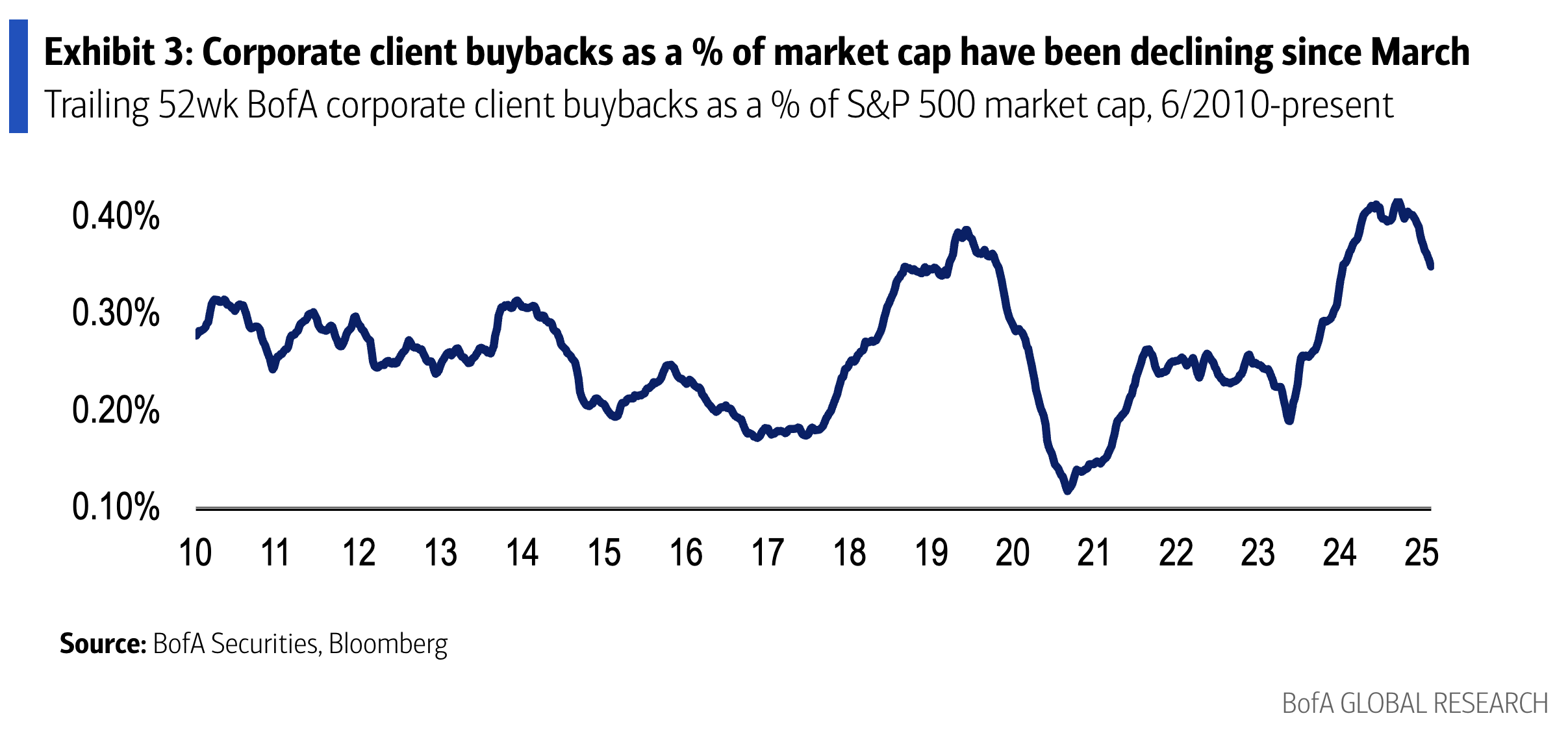
BofAbuybacks

As my colleague Matt Phillips has often written, valuations are high. Corporates are a lot more willing to buy back stock during weaker markets or when valuations are lower — that increases the odds that this capital is being used efficiently.

Right now, some of the biggest US companies already have a very well-publicized use for their capital: on the AI boom, where the risk, in the eyes of the market, is seemingly spending too little rather than too much. Implicit in the rallies in the likes of Meta, Microsoft, Alphabet, and Oracle as they invest hundreds of billions is the idea that these expenditures will lead to even higher shareholder returns down the road.

But in the meantime, the AI capex binge has entailed that buybacks among this cohort as a share of market cap have been dwindling.

More Markets

See all Markets

Airlines, cruise lines rise as oil prices ease

Travel stocks are climbing on Tuesday, with West Texas Intermediate crude futures down more than 3.4% as of 3 p.m. ET, largely on traders’ hopes for an improving situation with Iran.

The New York Times reported that American officials think Iran could agree to a 15-year suspension of uranium enrichment. Crude futures had spiked briefly on Tuesday following President Trump’s Truth Social post that the US must respond to the downing of a US Apache helicopter by Iran, but prices remain lower on the day, boosting US travel stocks.

Shares of Delta Air Lines, United Airlines, American Airlines, Southwest Airlines, and JetBlue were all up at least 4% an hour before market close. Cruise lines Carnival, Norwegian, and Royal Caribbean were similarly up. Travel companies have been rocked by higher fuel costs in the months since the war in Iran began.

markets

DraftKings soars after reporting $1.3 billion in trading volume on its prediction markets

It’s soccer summer, Knicks in five, baseball’s back, and everyone watching the game is looking down at their phone. After launching a prediction market platform in December, DraftKings is ready to ride this wave. And on Tuesday, the traditional sports betting company announced it actually had something to show for it.

Consumer trading volume in the month of May grew 24% to $1.3 billion and total trading volume increased 34% to $3.1 billion, according to a DraftKings SEC filing. Investors responded by lifting the stock 10% on Tuesday.

FanDuel parent company Flutter Entertainment was also trading higher.

Both sports betting companies reported upbeat earnings last quarter, besting Wall Street expectations, and have gained over the past month following declines of 49% and 23% since January, respectively.

DraftKings and FanDuel have both struggled as Kalshi and Polymarket encroach on their customers. Sports betting has been key to the growth of prediction markets, making up 39% of total trading volume on Kalshi and 80% on Polymarket since July 2024.

markets

Rivian dips on R2 launch day as shoppers point out “out of control” lease prices

Rivian is sinking on Tuesday, the launch day of its highly anticipated R2 SUV.

The EV maker’s shares are down more than 7% on Tuesday afternoon, erasing a chunk of the gains they raked in during their recent 10-day winning streak.

Aside from a broad market sell-off and some selling the R2 launch news, online chatter also reveals some customer disappointment with lease prices for the new model. The performance trim lease prices are listed at $829 a month on Rivian’s site, close to the monthly price of the more expensive R1S. A Reddit post referred to those rates as “out of control” and “a huge disappointment.”

The R2 was announced as a lower-cost $45,000 SUV but is launching at higher-trim levels priced closer to $60,000. Rivian’s larger R1S starts at around $77,000. Rivian has implied annual R2 deliveries of between 20,000 and 25,000 units this year.

markets

Chip stocks and high-flying tech shares plunge, sending the Nasdaq, S&P 500 lower

Chipmakers, artificial intelligence giants, and other highly valued tech stocks plunged Tuesday, dragging major US stock indexes deep into the red as the recent chip and AI complex comeback abruptly fizzled.

The Invesco QQQ Trust, which tracks the Nasdaq 100, is off around 3% on the day, and S&P 500 is down almost 2%.

The iShares Semiconductor ETF is also sinking, effectively giving up all the gains it saw yesterday as it surged to one of its best days of the year.

Wall Street initially opened in positive territory, but enthusiasm rapidly deteriorated midday as investors seemed to aggressively lock in profits on volatile, high-growth semiconductor stocks that, until recently, had been shooting upward.

This pivot follows a brutal trading day last Friday when momentum stocks collided with a rosy jobs report, profit-taking, and perhaps some very belated pessimism triggered by disappointing guidance from Broadcom, sending a host of previously bid-up names falling.

Many of those same shares are tumbling on Tuesday:

  • Micron completely flipped its intraday trajectory, plummeting over 9% at one point after gaining in early-morning trading. The memory provider has still more than tripled its valuation since the beginning of 2026. AMD shares also plummeted.

  • Marvell Technology jumped nearly 10% yesterday and advanced further soon after the opening bell, but reversed course midday and was down double digits, on pace for its second-worst day this year. The company was recently selected to join the S&P 500 Index effective June 22.

  • Intel is sinking after jumping in yesterdays session on a report that Google and Nvidia are considering turning to the chipmaker as a backup supplier to TSMC.

  • Apple’s shares are selling down following the kickoff of its Worldwide Developers Conference yesterday, where it showcased the new AI-powered version of Siri and the trust and safety features of iOS 27.

The tech-driven slide overshadowed a positive macroeconomic buffer from the energy sector, with oil prices sliding. The relief in crude costs came after ongoing negotiations signaled that shipping traffic through the crucial Strait of Hormuz is normalizing, according to Reuters, though this drop was tempered by a threat from President Trump to retaliate against Iran for an attack on a US helicopter in the strait.

Latest Stories

Sherwood Media, LLC and Chartr Limited produce fresh and unique perspectives on topical financial news and are fully owned subsidiaries of Robinhood Markets, Inc., and any views expressed here do not necessarily reflect the views of any other Robinhood affiliate, including Robinhood Markets, Inc., Robinhood Financial LLC, Robinhood Securities, LLC, Robinhood Crypto, LLC, Robinhood Money, LLC, Robinhood U.K. Ltd, Robinhood Derivatives, LLC, Robinhood Gold, LLC, Robinhood Asset Management, LLC, Robinhood Credit, Inc., Robinhood Ventures DE, LLC and, where applicable, its managed investment vehicles.

