
Culture
Getty Images
Getty Images
MODERN FAMILIES

Who do Gen Z and Millennials live with in America?

A growing number of young people are living with parents or other relatives, leaving fewer “empty nesters”

David Crowther

As we enter the peak summer months, many students and newly-minted college graduates are taking their first steps into the big bad world of work. In decades gone by, a wave of weddings often followed and young newlyweds shacked up to leave a huge cohort of “empty nesters” behind. That is no longer the case.

In the late 1960s, nearly 40% of 18-24 year-olds lived with their spouse. Last year, just 6% did.

Indeed, data plotted from the Census Bureau (and inspired by reddit user u/theimpossiblesalad) reveals how dramatically the living arrangements of America’s youngest adults have changed in the last 50+ years.
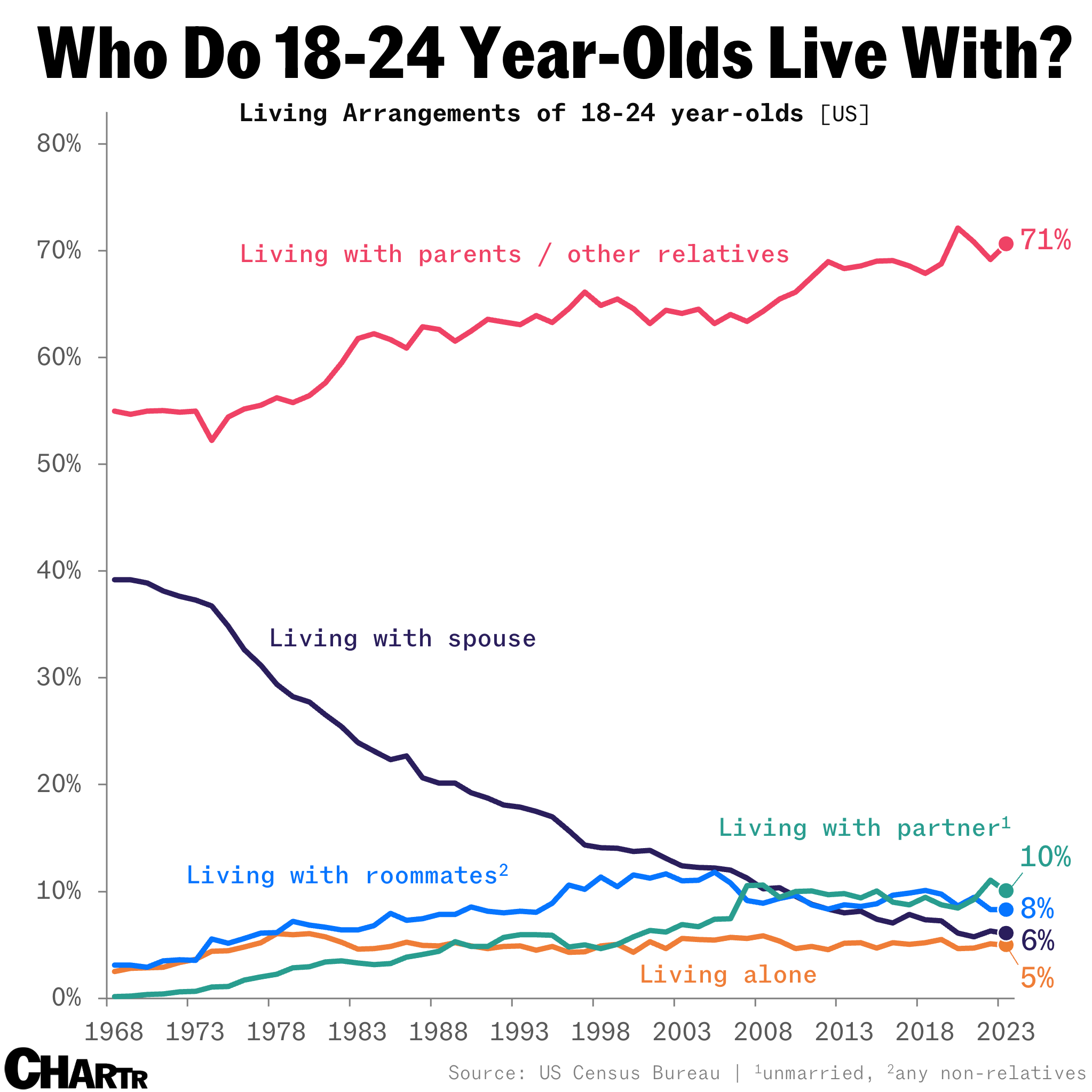
Living arrangements of 18-24 year-olds

71% reported living with either their parents (56%) or other relatives (15%), making it the most common living arrangement by far.

Parent trap

For both cultural and financial reasons, young people are waiting longer to take those big traditional steps in life: the average age of a first marriage is rising, and the median homebuyer age has risen by a decade, to 49, in the last 20 years. If the current trend continues, more 18-24 year-olds will soon live alone than live with a spouse.

And, of course, a growing group of young adults continue to live with parents and other relatives well into their 20s and 30s.

Living arrangements 25-34 year-olds

Indeed, some 28% of America’s 25-34 year-olds also reported living with parents or other relatives in 2023.

Part of the reason, of course, is the crisis in housing affordability, as home-price-to-income ratios have increased in almost every single Metropolitan area in America since 1990.

More Culture

See all Culture
Family in front of TV

Hollywood may have its best year at the box office since 2019, but streaming audiences are still obsessed with old content

Viewers are opting for catalog content over new shows and movies across (pretty much) every major streamer.

Tom Jones6/29/26
culture
Tom Jones

The BBC has become the world’s top news website... by collapsing a little less than its competition

Press Gazette just published its annual look at the biggest news sites in the world across all languages; for the most part, it doesn’t make for particularly pretty reading.

The journalism industry publication’s latest update, which is based on estimates provided by Similarweb for May, found that 37 of the world’s 50 most visited news sites saw their reach shrink. Press Gazette highlighted that American outlets have been hit particularly hard by declining Google traffic compared to European counterparts, owing to the platform’s AI features rolling out earlier in the US.

Even the BBC, having climbed the rankings from last year to top the 2026 chart — reportedly in part thanks to Similarweb’s decision to combine the “.co.uk” and “.com” versions of the URL, given that the sites redirect to each other depending on the user’s location — showed a 1.9% decline from last year.

Latest Stories

Sherwood Media, LLC and Chartr Limited produce fresh and unique perspectives on topical financial news and are fully owned subsidiaries of Robinhood Markets, Inc., and any views expressed here do not necessarily reflect the views of any other Robinhood affiliate, including Robinhood Markets, Inc., Robinhood Financial LLC, Robinhood Securities, LLC, Robinhood Crypto, LLC, Robinhood Money, LLC, Robinhood U.K. Ltd, Robinhood Derivatives, LLC, Robinhood Gold, LLC, Robinhood Asset Management, LLC, Robinhood Credit, Inc., Robinhood Ventures DE, LLC and, where applicable, its managed investment vehicles.