

Culture
Woman Wearing Sunglasses
Woman wearing sunglasses, maybe from Shein? (Getty Images)

Younger generations aren’t a climate-conscious monolith

What actions are Zoomers and Millennials taking to curb their environmental impact?

Tom Jones, David Crowther

Checking in

Deloitte’s Global 2024 Gen Z and Millennial Survey, the latest annual report that dropped in May this year, revealed a lot about how the youngest generations of adults are doing, with insights into everything from how they feel about their socio-economic prospects (mostly better), to their view of GenAI (mostly uncertain).

However, one element of the report caught our eye. Deloitte asked over 14K zoomers (those born between 1995 and 2005, according to the survey) and more than 8K millennials (1983-1994) about what they’re actually doing to drive climate action. More than 1 in 4 millennials and Gen Zers reported following vegetarian or vegan diets, for example, while over a third of respondents from each cohort said they’re avoiding fast fashion.
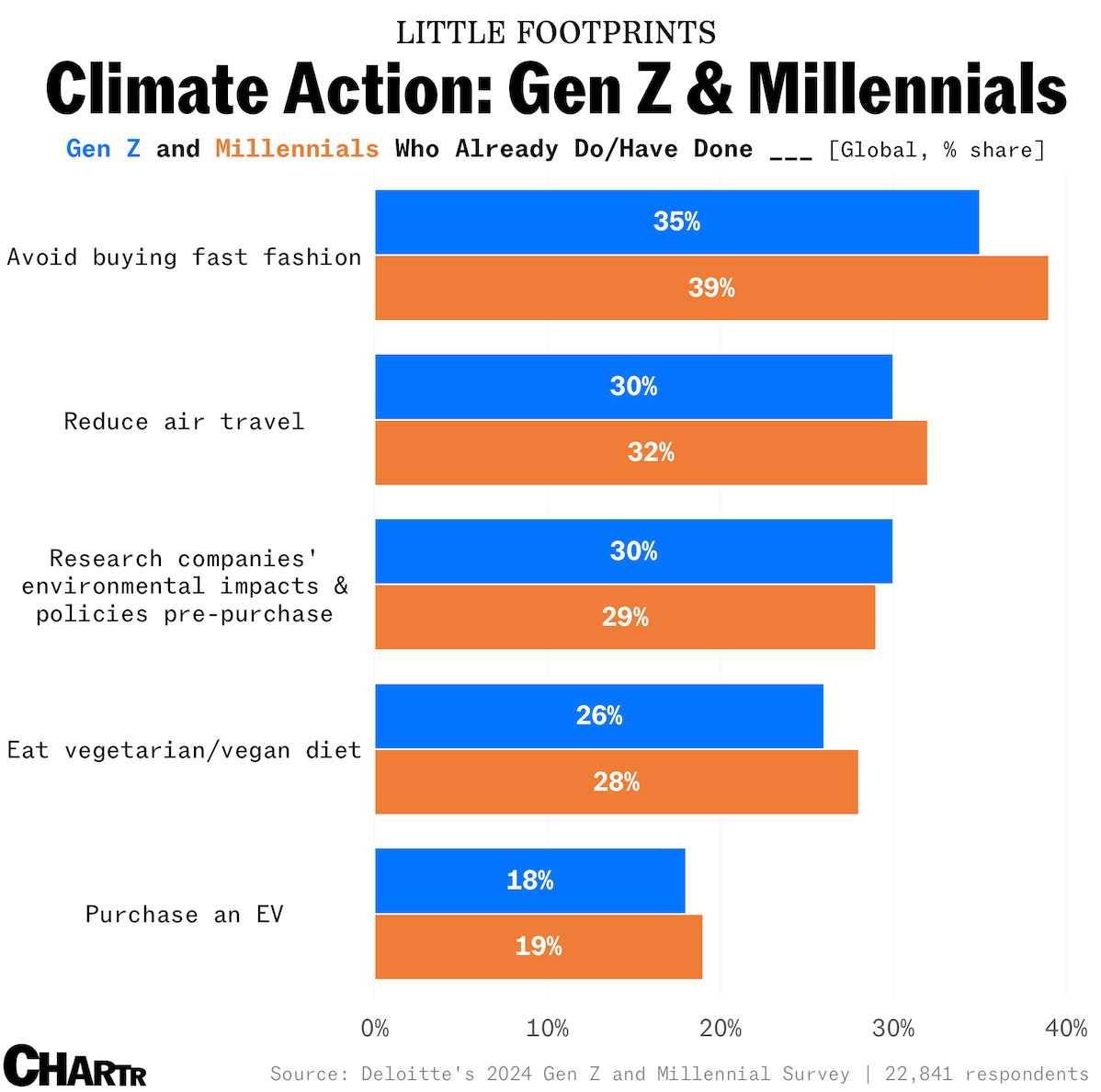
Gen Z and Millennials

However, what the survey implied was almost more important. If 35% of Gen Z respondents said they already actively avoid fast fashion, that’s interesting, but it also suggests that 65% of Gen Z aren’t yet onboard… which goes a long way in explaining why Shein and other low-cost, youth-focused fast fashion brands have exploded.

It’s often easier to think of generations as monoliths — that, of course, isn’t the reality. Gen Z are almost certainly the most sustainability conscious generation ever, and some members of that demographic are climate activists, but many are not. Shein wouldn’t be an $80B+ behemoth shifting $5 t-shirts if it wasn’t selling something millions of people wanted.

More Culture

See all Culture
Family in front of TV

Hollywood may have its best year at the box office since 2019, but streaming audiences are still obsessed with old content

Viewers are opting for catalog content over new shows and movies across (pretty much) every major streamer.

Tom Jones6/29/26
culture
Tom Jones

The BBC has become the world’s top news website... by collapsing a little less than its competition

Press Gazette just published its annual look at the biggest news sites in the world across all languages; for the most part, it doesn’t make for particularly pretty reading.

The journalism industry publication’s latest update, which is based on estimates provided by Similarweb for May, found that 37 of the world’s 50 most visited news sites saw their reach shrink. Press Gazette highlighted that American outlets have been hit particularly hard by declining Google traffic compared to European counterparts, owing to the platform’s AI features rolling out earlier in the US.

Even the BBC, having climbed the rankings from last year to top the 2026 chart — reportedly in part thanks to Similarweb’s decision to combine the “.co.uk” and “.com” versions of the URL, given that the sites redirect to each other depending on the user’s location — showed a 1.9% decline from last year.

Latest Stories

Sherwood Media, LLC and Chartr Limited produce fresh and unique perspectives on topical financial news and are fully owned subsidiaries of Robinhood Markets, Inc., and any views expressed here do not necessarily reflect the views of any other Robinhood affiliate, including Robinhood Markets, Inc., Robinhood Financial LLC, Robinhood Securities, LLC, Robinhood Crypto, LLC, Robinhood Money, LLC, Robinhood U.K. Ltd, Robinhood Derivatives, LLC, Robinhood Gold, LLC, Robinhood Asset Management, LLC, Robinhood Credit, Inc., Robinhood Ventures DE, LLC and, where applicable, its managed investment vehicles.