
Culture
Classical comebach: Apple has launched a classical music streaming app

Classical comebach: Apple has launched a classical music streaming app

A classical comebach?

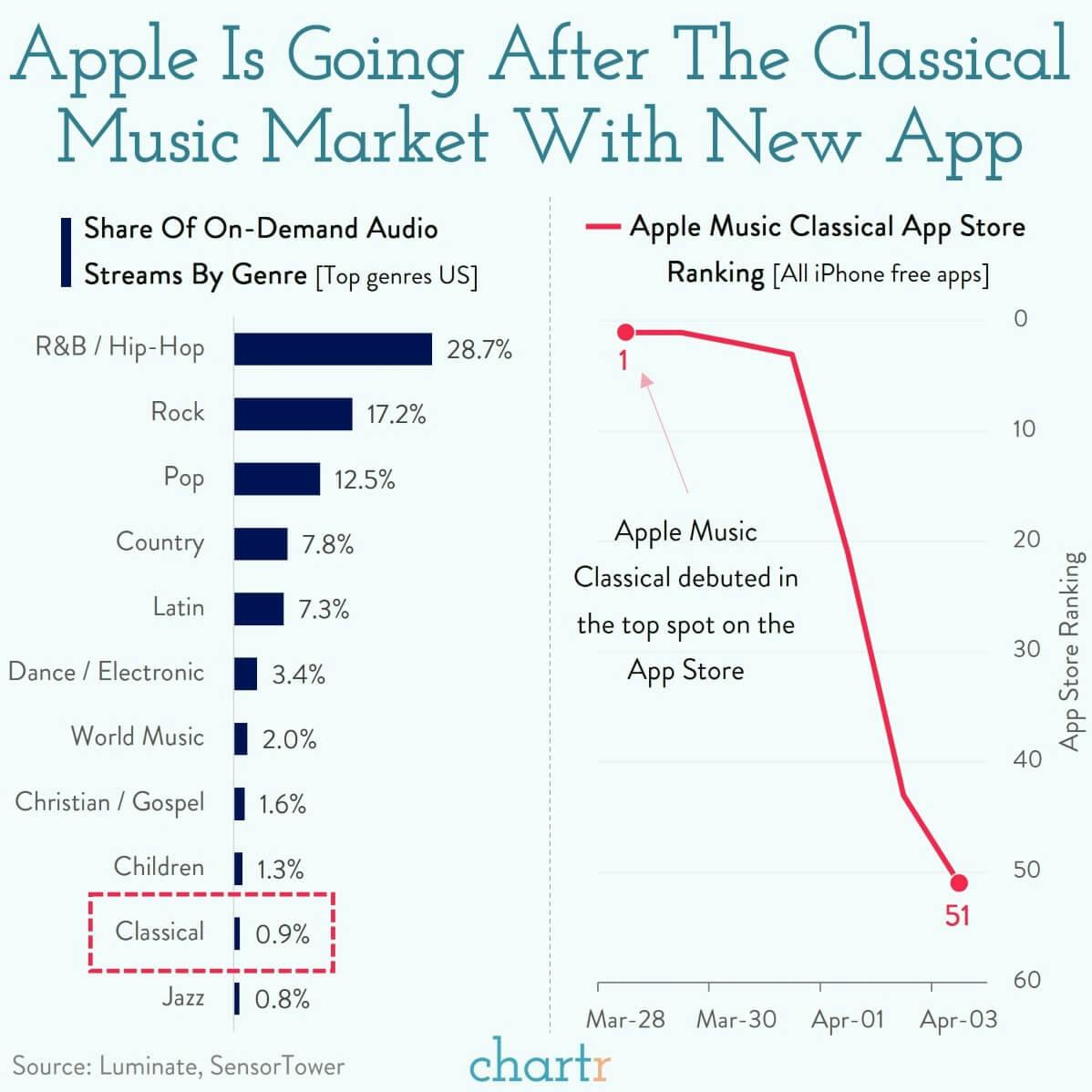
Last week, Apple released Apple Music Classical — a stand-alone streaming app designed for concerto connoisseurs. After its release, the app shot straight to #1 in the App Store, as fans of classical music — who've long been left behind in the switch to streaming — swiped and tapped through the 5 million tracks.

The initial popularity of the app is surprising — data from Luminate reveals that classical music captures just 0.9% of on-demand audio streams. That's way behind Rock, Pop, Country, Latin and nowhere near the broadly-defined “R&B / Hip-Hop” genre, which accounted for almost 30% of streams.

Classical music may never truly be "pop", but it's also clear that as a genre it's been poorly served by the streaming revolution... and it's all because of metadata.

Metadata just means “data about other data” — which in this context refers to the music's supplementary information, where a song file typically includes the song name, artist name, length and album, to mention but a few.

That taxonomy works for most music, but for classical the system breaks down. Bach’s concertos have been recorded many times, by different orchestras, with different soloists, arrangements, conductors, publishers and producers. Indeed, even the simplest piece of metadata, the track name, can be confusing. Take Beethoven’s popular Moonlight Sonata. That piece comes in 3 movements, and was originally marked “Sonata quasi una fantasia”, but the full name is technically “Beethoven's 14th piano sonata, Opus 27, Number 2”.

Apple’s app is hoping to cut through that complexity with more metadata for easier searchability.

More Culture

See all Culture
Family in front of TV

Hollywood may have its best year at the box office since 2019, but streaming audiences are still obsessed with old content

Viewers are opting for catalog content over new shows and movies across (pretty much) every major streamer.

Tom Jones6/29/26
culture
Tom Jones

The BBC has become the world’s top news website... by collapsing a little less than its competition

Press Gazette just published its annual look at the biggest news sites in the world across all languages; for the most part, it doesn’t make for particularly pretty reading.

The journalism industry publication’s latest update, which is based on estimates provided by Similarweb for May, found that 37 of the world’s 50 most visited news sites saw their reach shrink. Press Gazette highlighted that American outlets have been hit particularly hard by declining Google traffic compared to European counterparts, owing to the platform’s AI features rolling out earlier in the US.

Even the BBC, having climbed the rankings from last year to top the 2026 chart — reportedly in part thanks to Similarweb’s decision to combine the “.co.uk” and “.com” versions of the URL, given that the sites redirect to each other depending on the user’s location — showed a 1.9% decline from last year.

Latest Stories

Sherwood Media, LLC and Chartr Limited produce fresh and unique perspectives on topical financial news and are fully owned subsidiaries of Robinhood Markets, Inc., and any views expressed here do not necessarily reflect the views of any other Robinhood affiliate, including Robinhood Markets, Inc., Robinhood Financial LLC, Robinhood Securities, LLC, Robinhood Crypto, LLC, Robinhood Money, LLC, Robinhood U.K. Ltd, Robinhood Derivatives, LLC, Robinhood Gold, LLC, Robinhood Asset Management, LLC, Robinhood Credit, Inc., Robinhood Ventures DE, LLC and, where applicable, its managed investment vehicles.