

Sleep year
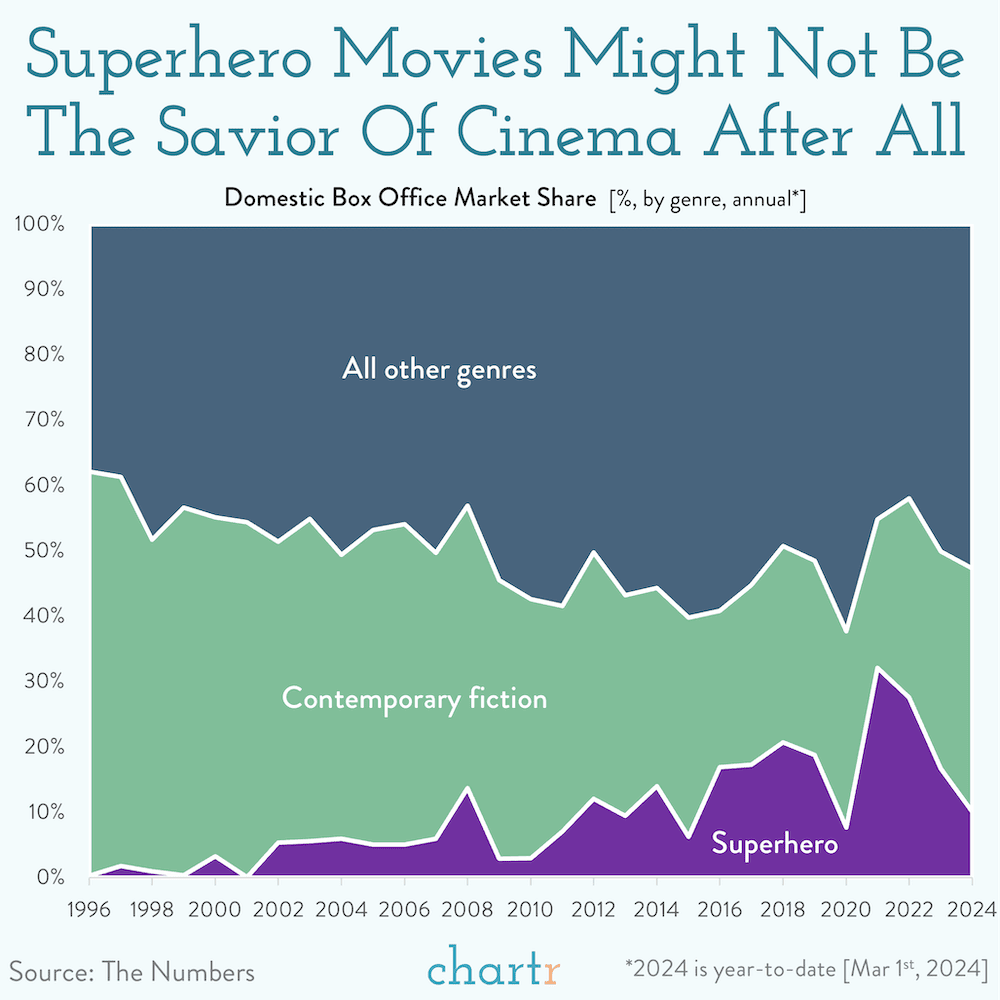
Covid era aside, 2024 has been one of the drowsiest starts to a cinematic year for almost 3 decades: January faltered, and theaters are just about crawling away from last month — enthused by the promise of Dune 2 — with hopes of leaving one of the weakest months in modern box office history firmly in the rear view mirror. Indeed, if you exclude the pandemic years (2020-2022), then February 2024 was the lowest-grossing month at the US box office since September 1997 — and that’s not even accounting for inflation.
RIP the golden age of cinema
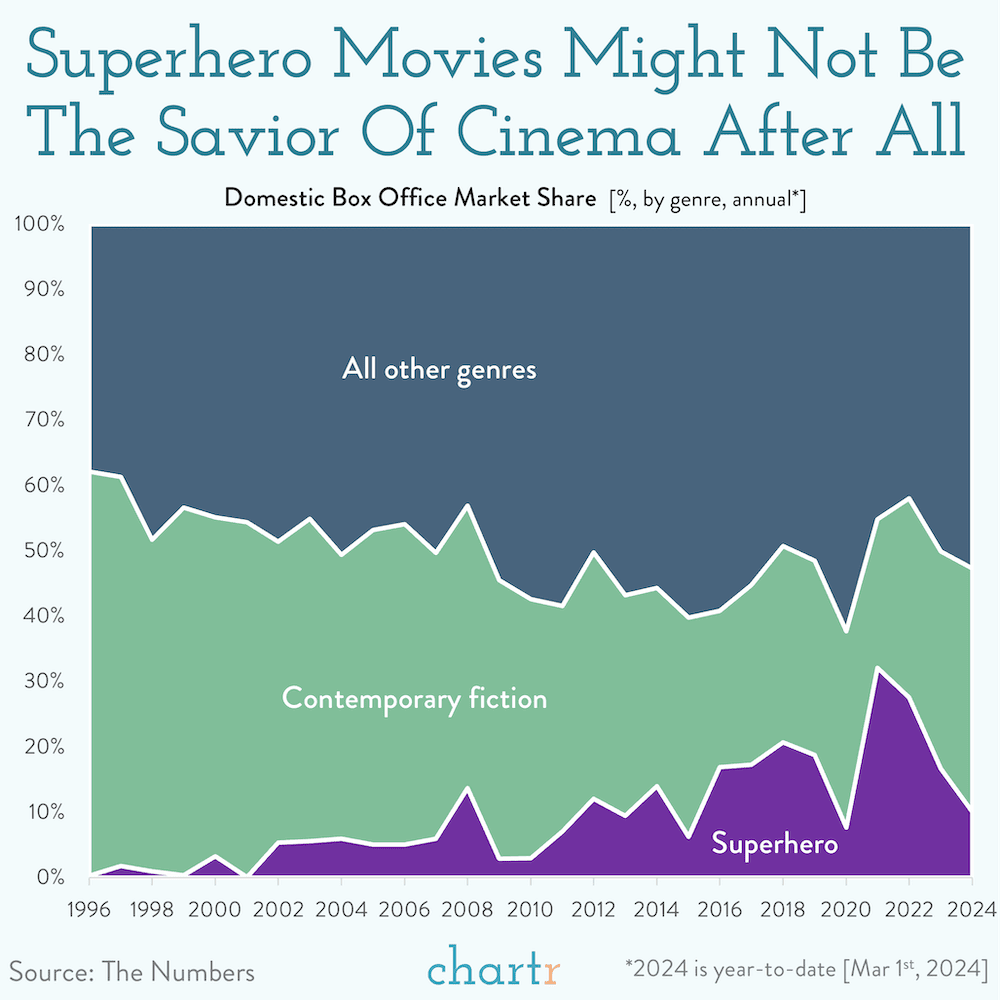
While Jan and Feb have long been known as The Dump Months — a period when Hollywood studios clean house and release some of their less choice offerings — last month’s $362 million total domestic gross figure could be a reflection not only of a quieter slate, but of a more troubling fact: that the box office is never going back to what it once was.
Even the old reliable superhero genre hasn’t been enough to boost this year’s lackluster takings. Sony’s latest installment in its ever-tangling series of Spiderman-adjacent movies, Madame Web, has so far served only as a cultural and critical punching bag following 2 disappointing weekends that saw it recoup just $79 million around the world — some way off its estimated $150-200 million break-even threshold. Dune 2 has a lot of pressure on its shoulders.
Fantastic fall
Whether you, like Martin Scorsese, think that Marvel’s gargantuan cast of characters and other superhero films have devoured the concept of “cinema” as we know it, spitting out a vague blob where one of the most beloved art forms once stood, or you think they’re frankly just a lot of fun for a couple of hours, there’s no denying that supers have lost some of their powers.
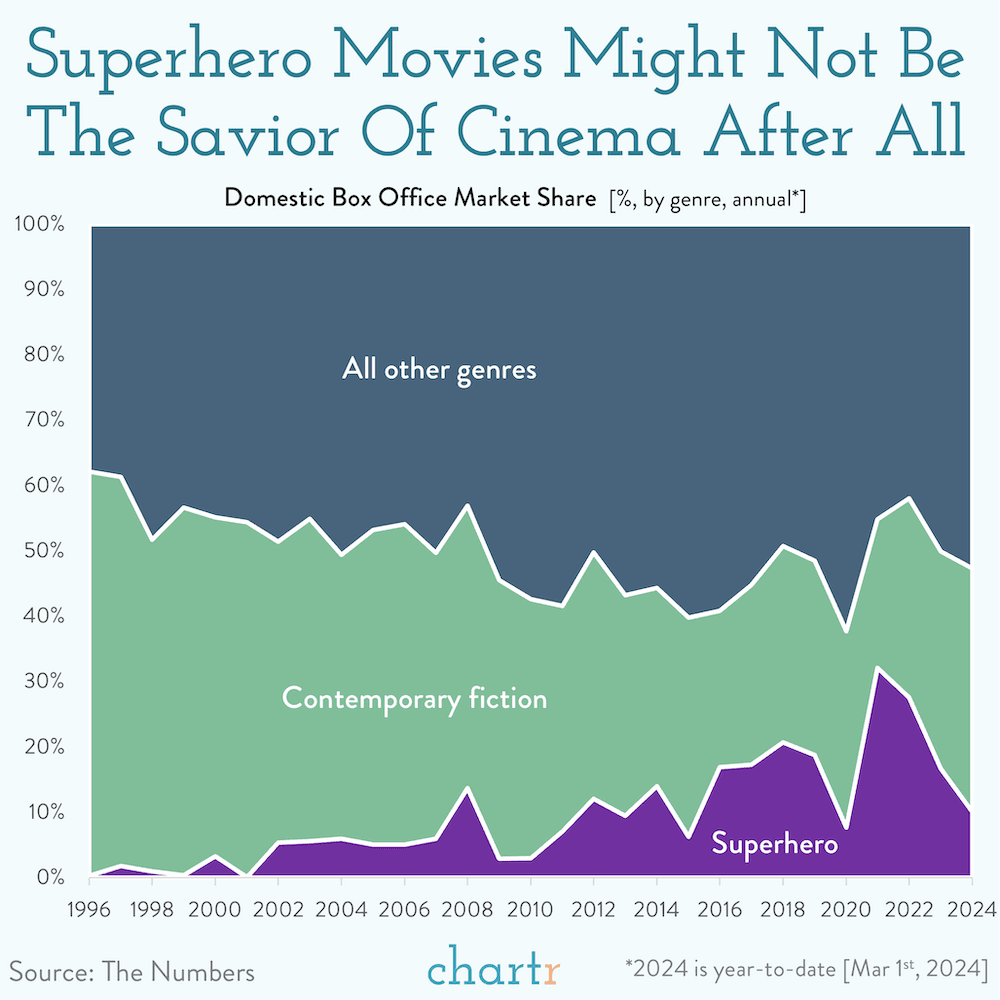
In 2021, superhero films took a record-breaking 32% share of the domestic box office, more than any other single genre, according to box office data site The Numbers. That year, Marvel had just kicked off its multi-billion dollar Multiverse saga, releasing 4 films which ended up grossing a staggering ~$3.1 billion worldwide, some $1.4 billion of which was in North America alone, while Sony’s Venom sequel did $214 million at home and $507 million around the globe.
Déjà vu
Since then, however, the fortunes of the genre — whose films have been criticized for boiling down to “keep glowy thing away from bad guy” — haven’t burned as brightly. Take 2023, for example, when Marvel released The Marvels; an effort that ended up being its lowest-grossing picture of all time and the only one not to make $100 million domestically. All told, superhero movies accounted for just under 17% of the domestic box office last year, as critics continued to explore the death of the genre with increasing fervor.
This year, mostly owing to the aforementioned disaster that is Madame Web, the figure has slumped further to just ~10% at the time of writing — however, with some big-name sequels and threequels lined up in 2024, that is likely to tick up a little before the year is out. While it’s yet to be seen if a fleet of follow ups in the super space will be enough to reinvigorate the genre, pitching sequels and reboots remains a reliable strategy for studios.