Pepe, once a fringe meme coin, goes mainstream
With popular exchanges now listing pepe, the price of the crypto is hopping up, though it’s still worth less (much, much less) than one cent.
Can Pepe, the frog-faced crypto, turn into the prince of meme coins thanks to the kiss of the impending crypto-friendly administration, or will its sudden upward trajectory be short-lived?
Pepe is leaping to new heights partly because of the postelection crypto rally. But another key driver is the coin’s recent listings on both Robinhood and Coinbase, which have pushed its price even higher as many experts say this will cement its legitimacy and could position it to enjoy a dogecoin-like trajectory. (Sherwood Media is an independent subsidiary of Robinhood Markets, Inc.)
You've long wanted the frog. Well, soon you'll get the frog. @coinbase is adding PEPE to our listing roadmap with the goal of listing later today. Thanks for your patience.
— paulgrewal.eth (@iampaulgrewal) November 13, 2024
For a token with zero utility, the numbers are startling: pepe’s price has increased 1,763.1% in the past year and 151.5% in the past two weeks. Following its listings, the coin reached an all-time high of $0.000024 on November 13 — still just a tiny fraction of a penny, but add enough of them up and you’ll find pepe’s market cap now stands at $8.7 billion, with a total supply of 420.69 trillion coins. Yes, the circulating maximum supply of the coin is a joke on 420 and 69, a joke the meme coin taps into. Pepe has shot up to the third spot in terms of meme-coin market cap, positioning itself just behind fellow animal-themed coins dogecoin and shiba inu, and now ranks 21th overall in market cap of all cryptocurrencies, CoinGecko data shows.
Whether this momentum can continue remains to be seen. Not all meme coins are equal, and many crypto ephemera crash and burn (remember NFTs and the metaverse?) once the enthusiasm — and prices — wind down.
Pepe’s strange history
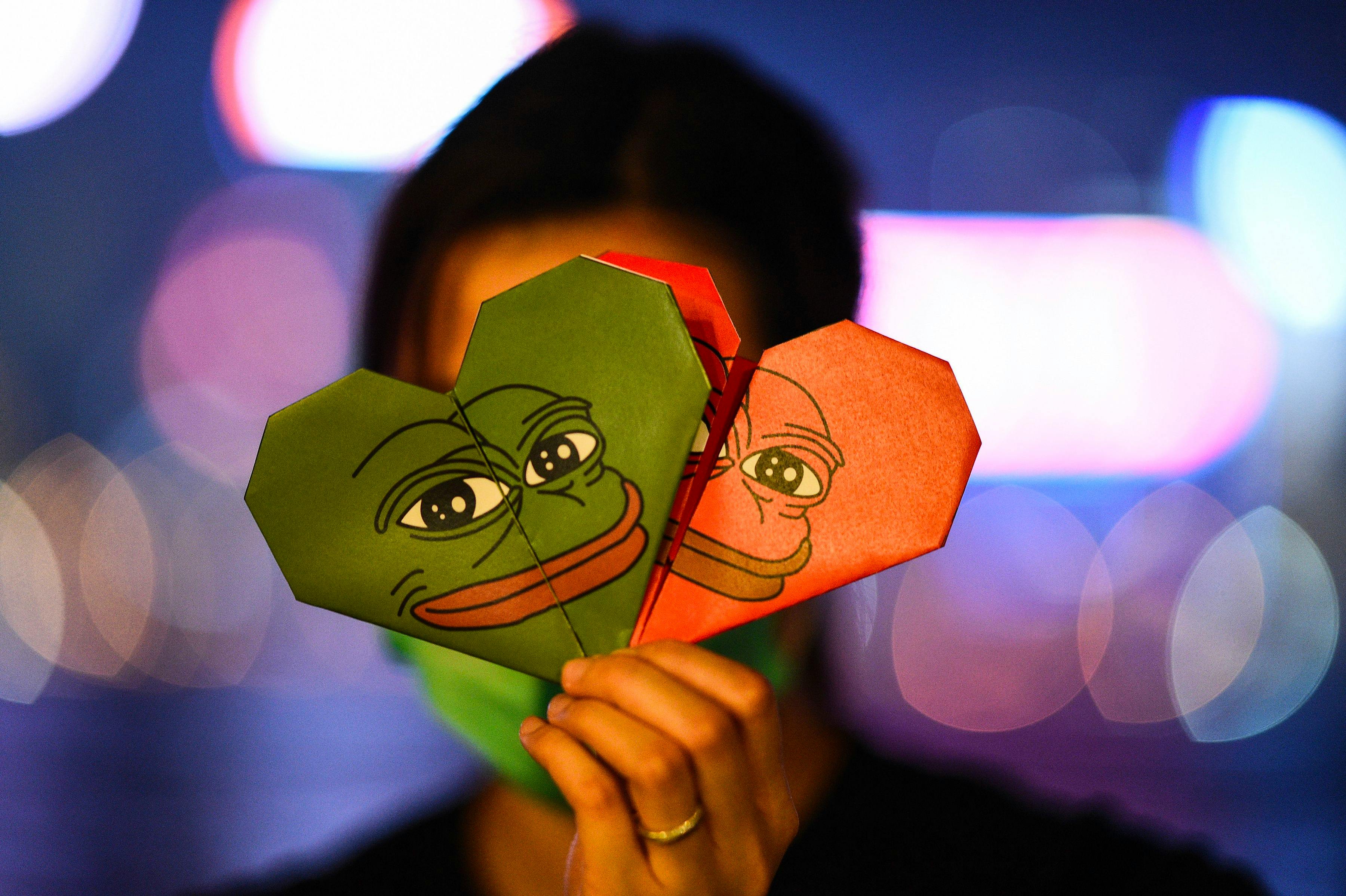
Pepe, launched in 2023, was an homage to artist Matt Furie’s “Pepe the Frog” internet meme, which he created in the 2000s. Unfortunately, during the 2016 US presidential election, the character became a hate symbol, shocking its creator.
Via online platforms like 4chan, the alt-right movement appropriated the frog character to disseminate antisemitic and racist imagery, prompting the Anti-Defamation League to “designate the frog as a calling card of racists in its online database of visual hate symbols.” In turn, the ADL teamed up with Furie “in an effort to take back the popular internet meme from racists and use the frog’s likeness as a force for good.”
“A chill frog-dude named Pepe who I created a decade ago became a hate symbol… but there is still hope,” Furie wrote in a 2016 Time article. He continued:
“Before this election, Pepe the Frog spent years mutating online into the many-faced Mickey Mouse God of the Internet. The frog face has gone through thousands of user-made Internet incarnations, expressing rage, smugness, violence, happiness, coolness and, most notably, sadness. To zillions of people, mostly kids, teens and college-dwellers, it meant many things, but mostly it was a big joke. I have a stack of Pepe fan art sent to me by school children.”
Unfortunately, Furie and the ADL could not, at the time, reclaim the innocence of the frog, and Furie killed his character in May 2017 in a final comic strip that showed the “blissfully stoned frog” laid to rest in a casket.
Pepe the Frog is officially dead https://t.co/qxZ0RvBVCH pic.twitter.com/pAnIcbnWaO
— The Verge (@verge) May 8, 2017
Pepe’s association with the alt-right movement still lingers, but many fans of the coin are not aware of its history. And counter to its alt-right history, Pepe was also adopted by pro-democracy protesters in Hong Kong in 2019, who were unaware of its earlier associations and saw the character as a cute symbol like Hello Kitty. Experts told Sherwood that despite its history, most pepe followers “are ‘cool frog bro’ fans — nothing more.”
“Pepe’s legitimacy is always going to be limited, as it’s fundamentally just a meme that capitalizes on human reaction,” Mohamed Allam, a Messari research analyst, said.
Will the listings of pepe attract the attention of institutional and even more retail investors?
Pepe’s price has been skyrocketing, but experts say it’s doubtful whether that will be sufficient to drive institutional interest. First, its alt-right connotation makes it a risky bet.
“Pepe didn’t start off as an alt-right meme, even though some in the alt-right ended up adopting it,” Ogle, the pseudonymous cofounder of Glue, told Sherwood News. “It’s really just a meme of a funny character. That said, I do think some institutions might shy away from investing in pepe because of this connection.”
The other factor is that very few meme coins can transcend their meme status. Dogecoin, for instance, could do so largely thanks to Elon Musk’s relentless touting of the coin. Most recently this was seen via his nomination to the yet-to-be-formed Department of Government Efficiency, aka DOGE.
“In my opinion, doge is no longer a meme. It’s established itself as the king in that space and has become almost ‘too big to fail,’” Allam said.
Allam said that while dogecoin will see volatility with new highs and lows, it’s been widely accepted and has too much momentum to simply disappear.
Pepe, on the other hand, is still just a meme.
“It may go up, but staying up is another question, and no one can predict its future. Pepe is in a sort of purgatory. Whether it makes it to ‘heaven’ like doge or ends up in ‘hell’ is yet to be seen,” he said.
Pepe derivatives: the mania around meme coins spawning meme coins
The crypto ecosystem is not immune to the saying “imitation is the sincerest form of flattery,” and pepe spin-offs are legion. For instance, pepe unchained (pepu) and fwog coins are also gaining traction.
🐸HUGE ANNOUNCEMENT!🐸
— Pepe Unchained (@pepe_unchained) November 13, 2024
In exactly 30 days, I repeat 30 DAYS! The presale for Pepe Unchained ends.
This is your LAST CHANCE to grab $PEPU before it hits Major exchanges!
Buy $PEPU in presale here: https://t.co/onpYoXlnyG pic.twitter.com/UtM95mrAvM
As Allam said, all it takes is “enough hype and the right influencer.” But will these new spin-offs last? Not so fast.
“These are quick plays on human impulse,” Allam said. “Everyone wants to see a 1000x return, right? People should always be cautious. Allocating a small part of your portfolio to memes is fine, but there’s a high chance you’ll lose most of that investment.”
Chris Hermida, cofounder of Switchboard, said that while pepe spin-offs like pepe 2.0 and wojak coin are garnering attention, investors should be careful — not just because of market volatility but also because most of these coins have no real utility beyond riding the hype train.
“At the end of the day, this isn’t a fundamental investment strategy but rather a cultural phenomenon,” Hermida said. “The market has spoken: as long as people want to make memes and make jokes with real money, meme coins are here to stay. Enjoy the ride if you’re in it, but know the risks always.”
Meme coins: the “attention economy”
The meme-coin phenomenon is tied to the powerful “attention economy,” and as these coins move fast, they can be precarious investments.
But while meme coins seem like spur-of-the-moment creations, there’s a high level of marketing and sophistication behind many of them. For instance, Two Prime CEO Alexander Blume told Sherwood that marketers with experience running pay-per-click ads know how to run sales funnels that convert and grow the token.
Blume said he would be wary of investing in any of those coins, as there’s a lot of wash trading and deceptive marketing behind the scenes that don’t reflect the fundamental demand of any of these projects.
“Their actual liquidity and trading is vastly overstated,” Blume said. “Perhaps coins that do get listed on tier 1 exchanges reach a certain escape velocity and become liquid products, but it is rare.”
Yaël Bizouati-Kennedy is a financial journalist who’s written for Dow Jones, The Financial Times Group, and Business Insider, among others.