Crypto
Bored Ape
(Photo by Noam Galai/Getty Images)
CONSENSUS2024

Crypto VCs still love NFTs

NFTs are back, and VCs are looking for more "real world value" this time around.

Jack Raines

Crypto is a cyclical industry that works something like this:

When the prices of “blue chip” coins, such as bitcoin and ethereum, increase, more money flows to the sector. Some of this money, chasing higher yield, flows to different, riskier assets, ranging from speculative “meme coins,” such as DOGE and SHIBA, to alternative blockchains like Avalanche and Solana. One group of investors always looking for the next big opportunity in crypto is venture capitalists.

Two years ago, the hottest trend in crypto was nonfungible tokens (NFTs), with Yuga Labs, the creator of the “Bored Apes Yacht Club” NFT collection, raising a monster $450 million venture funding round, led by Andreesen Horowitz, at a $4 billion valuation.

The value proposition of NFTs, at the time, was a combination of exclusivity and transparency. There are only 10,000 Bored Apes, for example, and ownership of these Apes could be tracked on the ethereum blockchain. Owners of Bored Apes gained access to exclusive, members-only events, and, more importantly, ownership of an Ape was a status symbol owned and displayed by celebs. Basically, a Bored Ape was a luxury asset that investors believed would continue to appreciate in value.

For context, around this time, some “investors” also paid hundreds of thousands of dollars for “EtherRocks,” which were, quite literally, animated pictures of rocks.

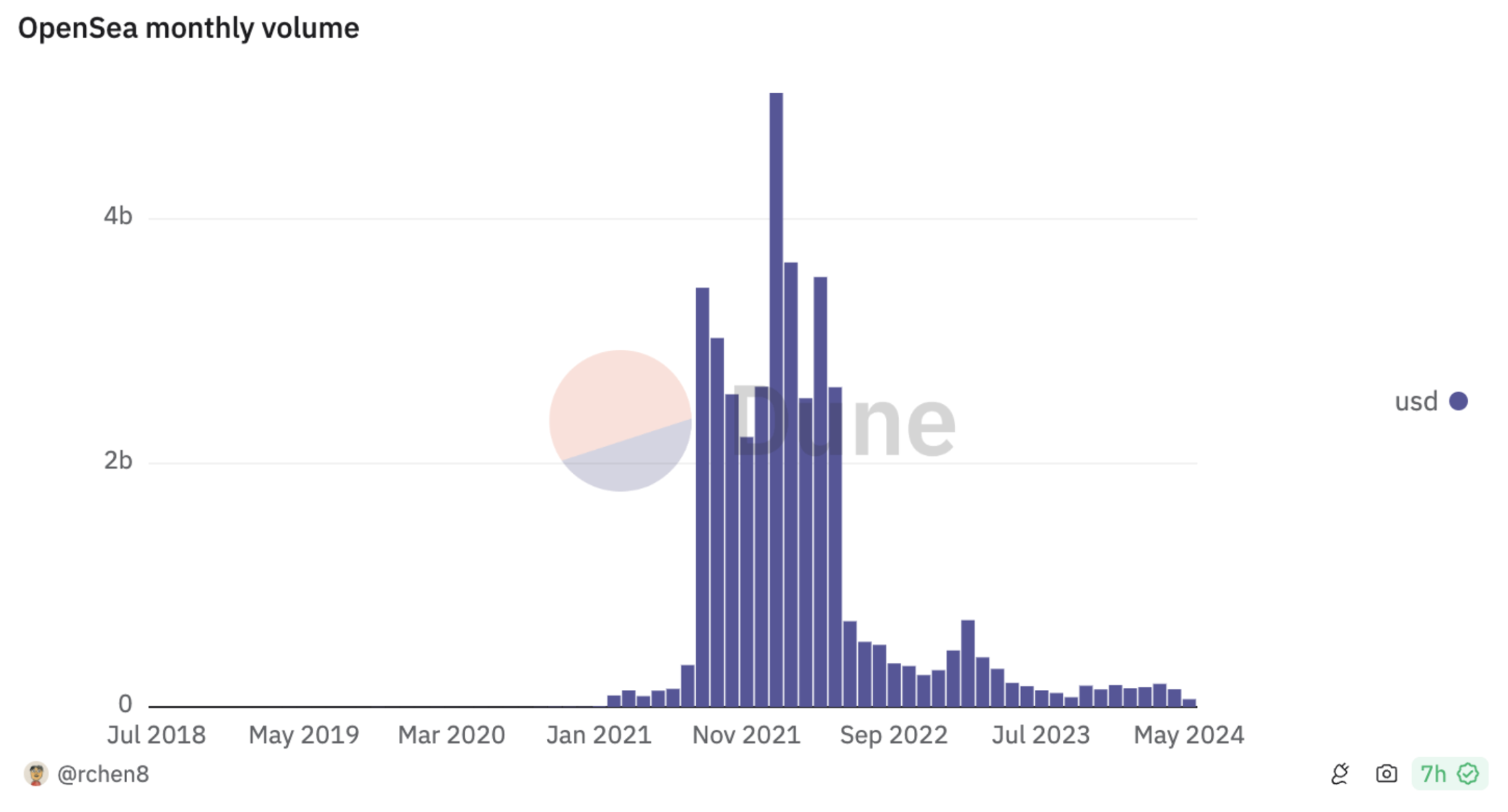
However, during the last crypto bear market, NFTs prices plummeted, with monthly trading volume on OpenSea, the largest NFT marketplace, declining from $5 billion in early 2022 to just $145 million in April 2024, according to Dune Analytics.
OpenSea Volume
Source: Dune Analytics

Now, two years later, the crypto market is hitting all-time highs, and VCs are once again bullish on NFTs. But this time, investors aren’t interested in pixelated primate JPEGs.

In a panel yesterday, Kate Laurence, founder and CEO of crypto investing firm Bloccelerate VC, said that we’re reaching an inflection point where “real assets,” such as real estate, will soon be on chain. Fellow panelist David Nage, a venture portfolio manager for digital asset investment firm Arca, also noted that NFTs are wrappers of intellectual property, and Laurence agreed, stating that NFTs for scientific research could “change the world.”

While it was not immediately clear what “NFTs for scientific research” would look like or how they would make a huge impact, one would hope that they have a bit more longevity than 2022’s NFT bubble. For what it’s worth, Laurence stated that she tried to “stay away from hype cycles,” citing the current AI boom as an example.

More Crypto

See all Crypto
crypto

Sui blockchain halts transactions for second day in a row

The sui blockchain is stalled again on early Friday, with the last transaction occurring more than two hours ago, data from blockchain explorer Suiscan shows.

“The Sui Core team is actively investigating. Updates and incident review will be shared as soon as they are available,” the team wrote on X.

The ongoing pause comes immediately after experiencing a halt the day before “due to a crash bug in the gas charging logic introduced by the 1.72 release,” the team said on Thursday.

SUI, the network’s native cryptocurrency, has dropped around 20% in the past seven days, according to CoinGecko.

crypto

SoFi continues to surge following launch of its stablecoin to 15 million customers

SoFi Technologies announced Wednesday that its 15 million members can now use its stablecoin, SoFiUSD, marking the first time a US national bank-issued stablecoin is available on a banking app, but the markets seem to have really taken notice Friday, sending shares up over 7% in early trading.

Options data as of 9:42 a.m. ET also shows a bullish tilt from traders, with a put/call ratio around 0.16 vs a 20-day average of 0.39.

SoFi’s move is the first step to integrate SoFiUSD into the firm’s broader ecosystem, with plans to allow members to convert the stablecoin into tokenized deposits and roll out SoFiUSD on centralized exchange Bullish.

The stablecoin is currently on ethereum and solana, but the firm aims to add more blockchains to the list.

“We believe we can combine the speed and versatility of the blockchain with the trust of a bank to improve how money moves around the world,” SoFi CEO Anthony Noto said in a statement. “People no longer have to choose between blockchain technology and regulated banking products.”

Since President Trump signed stablecoin legislation GENIUS Act in July last year, the market capitalization of stablecoins has increased nearly 24% to $320.8 billion, data from DefiLlama shows.

crypto

Ethereum drops to a 2-month low under $2,000

Ethereum has dropped 4% in the last 24 hours to trade as low as $1,967 on Thursday morning, a mark not seen since March.

Selling pressure is weighing on the token as “traders are actively opening short positions,” CryptoQuant Head of Research Julio Moreno told Sherwood News. “US spot demand for ETH has weakened, as seen by an extremely negative Coinbase price premium approaching levels not seen since February.”

The price action has spurred $237.2 million in liquidations, with the majority of them, $225.1 million, coming from long positions, data from CoinGlass shows. Elsewhere, ethereum ETFs have notched their longest outflow streak this year at 12 days, with Wednesday recording almost $67.2 million in outflows, per SoSoValue.

“ETH’s break below the psychologically important $2,000 level reflects a deterioration in near-term crypto risk sentiment rather than a collapse in Ethereum fundamentals,” according to Coinbridge cofounder and CIO Kelly Ye.

Ye said the drop under $2,000 was amplified by rising volatility and geopolitical tensions amid renewed US-Iran escalation and broader de-risking across high-beta assets.

Sentiment surrounding the cryptocurrency has also softened after David Hoffman, a known ethereum advocate, publicly disclosed offloading his entire ETH position and questioned whether the network’s growth translates to meaningful value accrual to ethereum as an asset, Ye pointed out.

“Still, ETH has continued to hold a broader pattern of higher lows since the April 2025 tariff-driven selloff near $1,500, with the February 2026 low around $1,800 now emerging as the next key level to watch,” Ye told Sherwood News.

“Importantly, on-chain activity has not shown significant deterioration, and Ethereum TVL [total value locked] measured in ETH terms has started trending higher again since May, suggesting underlying network usage remains relatively resilient despite weaker price action,” Ye added.

Some ethereum treasury firms have not stopped their strategy, such as Bit Digital, which announced on Thursday purchasing 8,568 ethereum tokens for $20 million, bringing its total holdings to 158,461.75 tokens.

Meanwhile, other altcoins are also in the red, with solana and dogecoin dropping over 3% in the last 24 hours.

Latest Stories

Sherwood Media, LLC and Chartr Limited produce fresh and unique perspectives on topical financial news and are fully owned subsidiaries of Robinhood Markets, Inc., and any views expressed here do not necessarily reflect the views of any other Robinhood affiliate, including Robinhood Markets, Inc., Robinhood Financial LLC, Robinhood Securities, LLC, Robinhood Crypto, LLC, Robinhood Money, LLC, Robinhood U.K. Ltd, Robinhood Derivatives, LLC, Robinhood Gold, LLC, Robinhood Asset Management, LLC, Robinhood Credit, Inc., Robinhood Ventures DE, LLC and, where applicable, its managed investment vehicles.