Crypto
crypto

Crypto firm Ripple applies for a national banking license

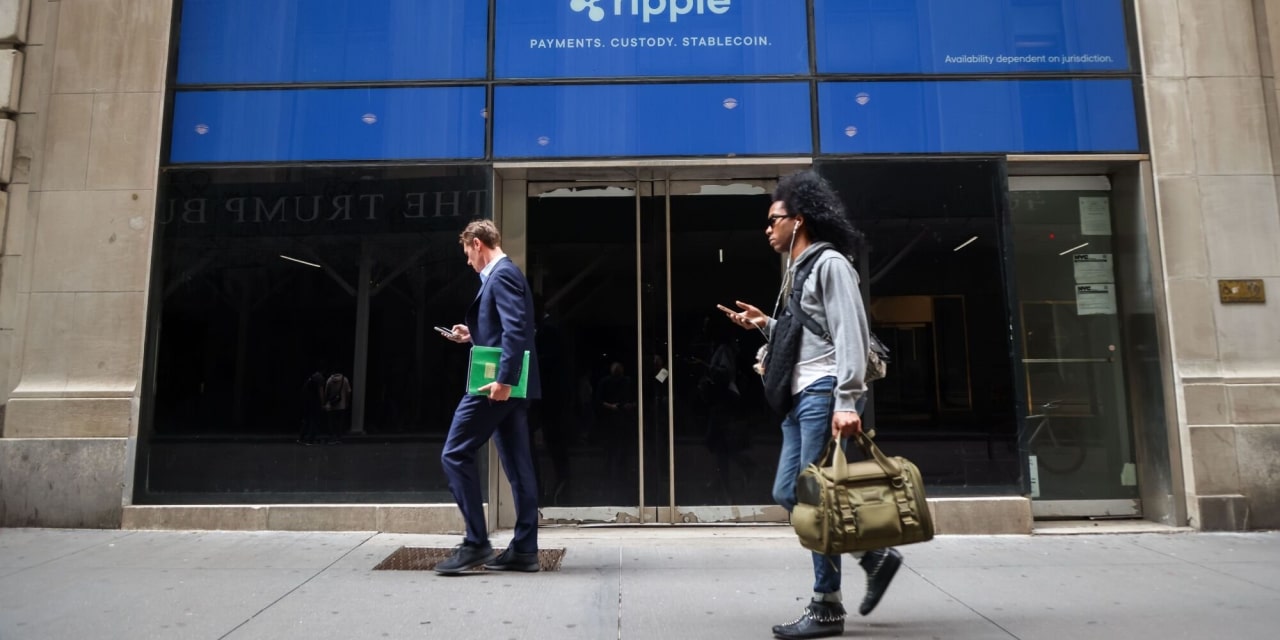
Ripple, a firm focused on cross-border payments using blockchain technology, applied for a national banking license Wednesday, according to The Wall Street Journal

The company is known for two cryptocurrencies: dollar-backed stablecoin RLUSD and the fourth-largest token by market capitalization, XRP.

Ripple filed its application with the US Office of the Comptroller of the Currency, which regulates and supervises national banks and federal savings associations. With a national bank charter, the firm’s RLUSD stablecoin would be regulated under the OCC in addition to the New York Department of Financial Services. The NYDFS approved the public rollout of RLUSD last year. 

“True to our long-standing compliance roots, @Ripple is applying for a national bank charter from the OCC. If approved, we would have both state (via NYDFS) and federal oversight, a new (and unique!) benchmark for trust in the stablecoin market,” Ripple CEO Brad Garlinghouse posted on X.

The national banking license application comes in the same week as Ripple’s subsidiary Standard Custody & Trust Company applied for a Federal Reserve master account. “This access would allow us to hold $RLUSD reserves directly with the FED and provide an additional layer of security to future proof trust in RLUSD,” Garlinghouse said. 

Meanwhile, stablecoin giant Circle, the firm behind the second-largest stablecoin, USDC, submitted a national bank charter application with the OCC on Monday. Ripple and Circle’s applications highlight an ongoing convergence between the traditional finance world and the on-chain economy. 

Anchorage Digital is currently the only crypto bank in the US to receive a charter from the OCC. 

Ripple filed its application with the US Office of the Comptroller of the Currency, which regulates and supervises national banks and federal savings associations. With a national bank charter, the firm’s RLUSD stablecoin would be regulated under the OCC in addition to the New York Department of Financial Services. The NYDFS approved the public rollout of RLUSD last year. 

“True to our long-standing compliance roots, @Ripple is applying for a national bank charter from the OCC. If approved, we would have both state (via NYDFS) and federal oversight, a new (and unique!) benchmark for trust in the stablecoin market,” Ripple CEO Brad Garlinghouse posted on X.

The national banking license application comes in the same week as Ripple’s subsidiary Standard Custody & Trust Company applied for a Federal Reserve master account. “This access would allow us to hold $RLUSD reserves directly with the FED and provide an additional layer of security to future proof trust in RLUSD,” Garlinghouse said. 

Meanwhile, stablecoin giant Circle, the firm behind the second-largest stablecoin, USDC, submitted a national bank charter application with the OCC on Monday. Ripple and Circle’s applications highlight an ongoing convergence between the traditional finance world and the on-chain economy. 

Anchorage Digital is currently the only crypto bank in the US to receive a charter from the OCC. 
More Crypto

See all Crypto
crypto

Hyperliquid reclaims all-time high

HYPE, the native token powering perpetuals exchange Hyperliquid and its underlying blockchain, rebounded to reclaim its all-time high previously set at the start of the month.

Treasury firms Hyperliquid Strategies and Hyperion DeFi have also rallied as the token increased double digits in the last 24 hours to trade as high as $76.70, rising past its record price set nearly two weeks ago, according to CoinGecko. In the interim between all-time highs, HYPE pulled back to around $53.

The token has several tailwinds, the first coming from ETF flows. Since their inception in May, HYPE ETFs have yet to record negative weekly outflows, posting a cumulative total net inflow of $171.8 million, per SoSoValue.

The second comes from Hyperliquid spending basically everything it earns in fees to buy HYPE, a mechanism embedded into the protocol’s codebase.

The venue’s buyback funding mechanism is set to add a new source of yield. Validators of the network activated “AQAv2,” which means stablecoin deployers will share about 90% of reserve yield revenue on their supply within the protocol.

Around $6.1 billion of Circle’s USDC resides in Hyperliquid, per DefiLlama. Accrual begins on August 26 and the first payment is made on October 3, the network announced in its Discord channel last week.

A substantial amount of capital is riding on different positions of HYPE. In total, a move down to under $53 would result in the liquidation nearly 1.8 million HYPE worth of leveraged long positions on the on-chain perps venue, or $131.7 million, data from CoinGlass shows. For the upside, a climb above $100 results in the liquidation of more than 3 million worth of leveraged HYPE short positions, or $221.5 million.

HYPE’s rebound to all-time high comes after Michael Selig, chair of the Commodity Futures Trading Commission, defended his agency’s decision to approve regulated perpetuals, or futures contracts without expiration dates, CNBC reported on Monday.

Last month, the CFTC approved bitcoin perpetual futures trading in the US through regulated prediction markets firm Kalshi and an affiliate of centralized exchange Coinbase.

“Perps are highly likely to become lightly regulated and thus approved in the US,” said David Pakman, head of venture investments at CoinFund.

“We expect to see perps for many different types of assets, from commodities to equities,” Pakman told Sherwood News.

crypto

Crypto market snaps back as sentiment lifts, with altcoins from ethereum to XRP soaring

The market capitalization of the crypto industry has jumped around $83.2 billion in the last 24 hours, with privacy-focused token Zcash and worldcoin, the native cryptocurrency of the network backed by OpenAI CEO Sam Altman, leading market gains, jumping over 22%.

But the last 24 hours have been good across the board:

Investors have been eager to see some positive signs around the Iranian conflict ending, coupled with hopeful outlooks around the CLARITY act, both breathing some life into assets, Kairos Research cofounder Ian Unsworth told Sherwood News.

Simon Shockey, a crypto strategist at crypto wallet infrastructure firm Privy, said the upswing stems from several things converging. He pointed to how alt markets broadly were very oversold following the bug found in Zcash that shook confidence.

Friday, Zcash founder Zooko Wilcox said Anthropic didn’t find any more serious bugs with the Zcash protocol after Shielded Labs requested the AI firm run a security audit of the network with Mythos.

Shockey added that the pool of willing sellers has dwindled. Even if structurally, AI is a much more compelling and asymmetric bet in the eyes of allocators, many of these crypto assets have simply run out of marginal sellers despite some shorter-term narrative-driven pumps. The only people left to sell at this point are the teams themselves and VCs.

Net-net: oversold conditions plus exhausted seller bases plus a macro backdrop thats stabilized equals a snapback, especially in names that have real usage or community conviction behind them,” Shockey told Sherwood.

Latest Stories

Sherwood Media, LLC and Chartr Limited produce fresh and unique perspectives on topical financial news and are fully owned subsidiaries of Robinhood Markets, Inc., and any views expressed here do not necessarily reflect the views of any other Robinhood affiliate, including Robinhood Markets, Inc., Robinhood Financial LLC, Robinhood Securities, LLC, Robinhood Crypto, LLC, Robinhood Money, LLC, Robinhood U.K. Ltd, Robinhood Derivatives, LLC, Robinhood Gold, LLC, Robinhood Asset Management, LLC, Robinhood Credit, Inc., Robinhood Ventures DE, LLC and, where applicable, its managed investment vehicles.