Crypto
bitcoin symbol
Bitcoin logo (Pierre Teyssot/Getty Images)

Bitcoin stuck in the $70,000 range after $1.26 billion left bitcoin ETFs last week

Several analysts warn that bitcoin ETF outflows are a key driver to monitor.

Bitcoin is stuck in the $70,000 range yet again, unable to break above $78,000 in the past week. While optimism around a looming Iran deal is buoying the overall market on Tuesday morning, it has failed to help bitcoin, which is hovering just below $77,000. 

Daniela Hathorn, a senior market analyst at Capital.com, said that investors are no longer pricing an imminent escalation into a full regional war. Still, they aren’t pricing in a clean resolution either; instead, she said the market seems to be settling on a “messy stalemate.”

“So the current setup is less ‘risk-off’ and more ‘risk-sensitive.’ Markets are still leaning optimistic, but the tolerance for negative headlines is shrinking,” Hathorn said.

One worrying signal for bitcoin is that bitcoin ETFs, which have been a strong support since the war began, saw $1.26 billion in outflows last week, the second consecutive weekly billion-dollar exit. It also represents the largest weekly outflow since the week of January 30, according to SoSoValue.

Bitfinex analysts said that bitcoin risks a $72,000 to $82,000 range without fresh institutional demand. Having spent the past week below the Short-Term Holder Realized Price near $78,600, this leaves an increasing share of recent buyers underwater and likely to sell into rallies.

“Aggressive expansion in Bitfinex margin longs during the recent drawdown also points to growing leverage entering a weakening market structure. That is creating heavy breakeven-driven resistance around $79,000, while the November–February cohort cost basis near $85,900 remains the market’s major structural ceiling,” they said, adding that absent a fresh demand catalyst, the path of least resistance tilts toward price being limited to this range.

They noted, however, that despite these headwinds, the broader supply picture remains constructive, as the activity is driven by “profit taking from transient cohorts, rather than forced distribution by high conviction holders.”

Meanwhile, several analysts have warned that bitcoin ETF outflows are one of the key drivers to monitor, as a sustained exodus could hinder any rally or fail to jump-start a bump.

Timothy Misir, head of research at Blockhead Research Network, said that bitcoin needs renewed institutional sponsorship to reclaim $82,000 and make the next leg higher credible.

“Until then, rallies should be treated as tests of demand rather than confirmation of trend,” he said.

Other metrics suggest a more balanced landscape, including the ratio of short-term holders to long-term supply, which Glassnode analysts said points to a market characterized by higher conviction and lower speculative activity, indicating a phase of consolidation.
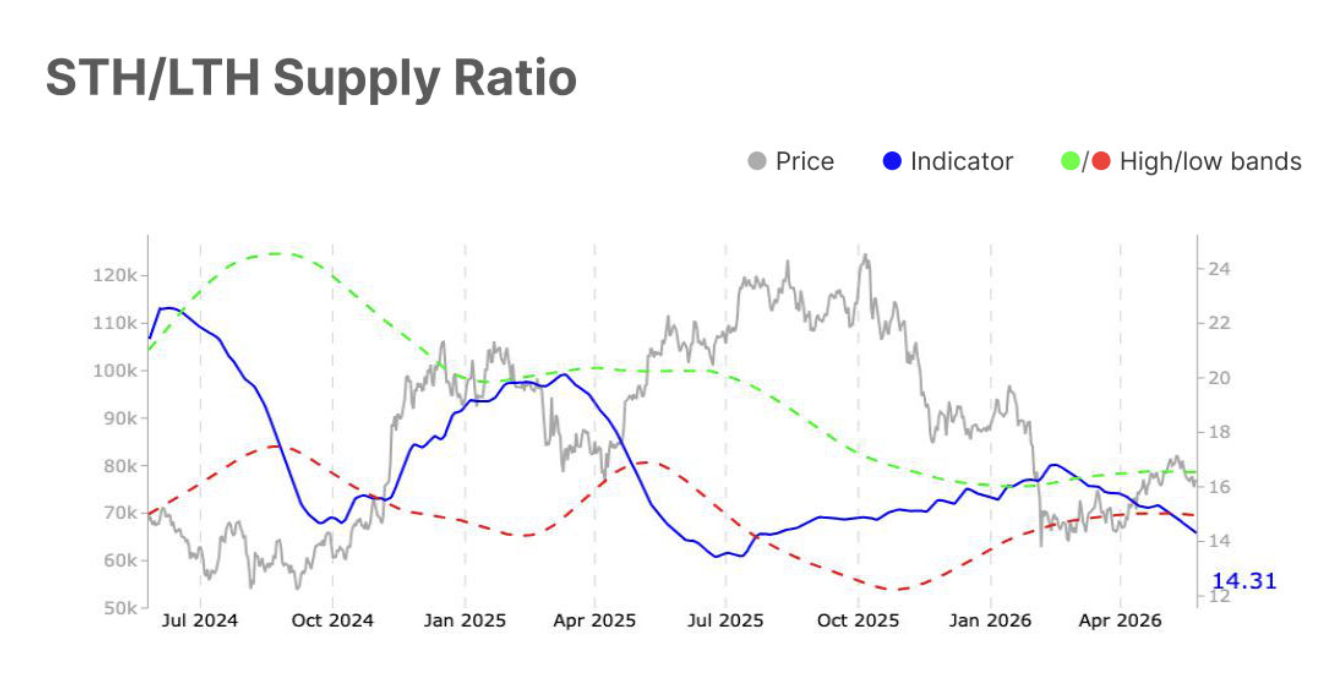
STH/LTH ratio
(Glassnode)

At the same time, caution still rules, as profitability metrics suggest a potentially bearish market sentiment, the analysts said.
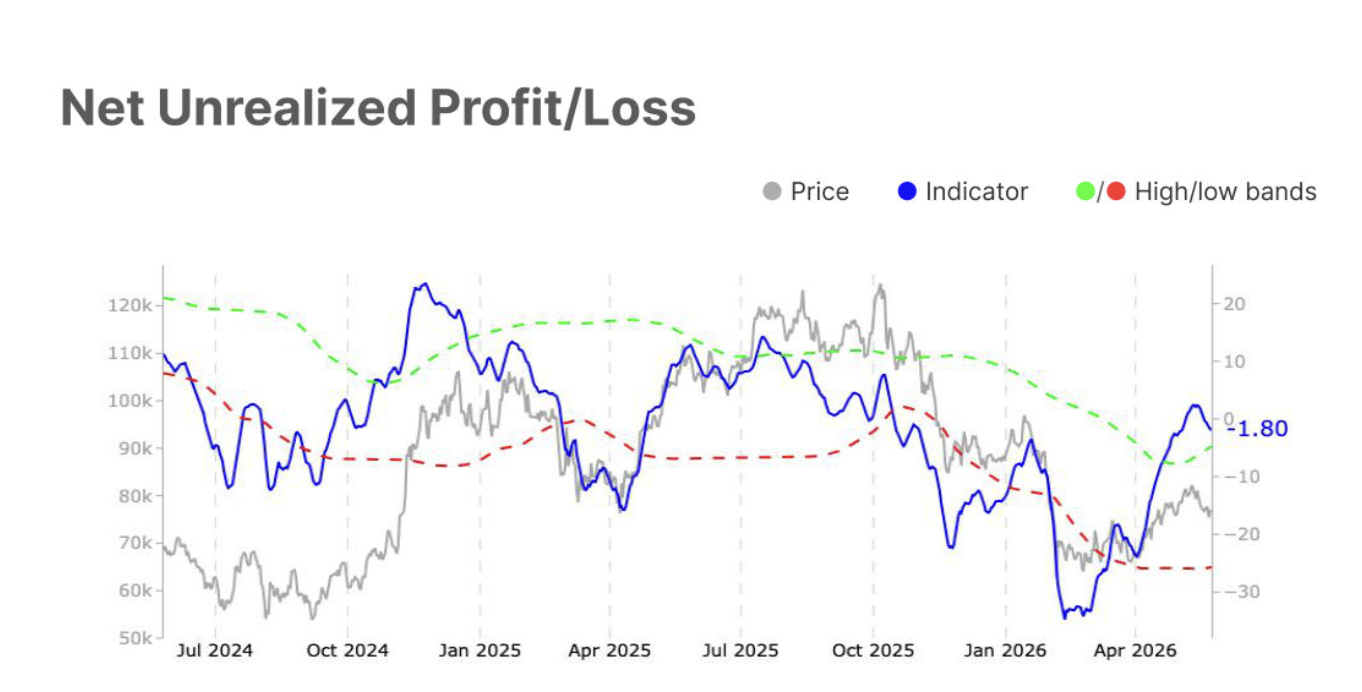
Net unrealized profit loss btc May 2026
(Glassnode)

“In summary, the market is exhibiting signs of moderation and consolidation, characterized by reduced activity, cautious sentiment, and a mix of risk appetite,” they said.  

More Crypto

See all Crypto
crypto

Ethereum trades sideways as Foundation bleeds members

Ethereum has been stuck between $2,000 and $2,150 in the past week amid ongoing scrutiny toward the Ethereum Foundation, which has seen its talent pool thin out.

“ETH continues to show weakness... ETH/BTC keeps grinding lower, at a 10-month low,” Jasper De Maere, a desk strategist and OTC trader at Wintermute, posted on X. “The marginal risk dollar went into equities, not crypto. When AI semis are working and yields are easing, crypto should follow. It didn’t.”

De Maere continued, “Based on our OTC flow, we see that institutional buying pressure, which was responsible for the recent +ve price action, is now fading quickly, indicating that institutional investors might be at capacity or are re-assessing risk/reward at these new levels.”

Data from SoSoValue shows ethereum ETFs have seen 10 consecutive days of outflows, totaling more than $471.1 million.

Meanwhile, the blockchain’s cofounder Vitalik Buterin, who sits on the board of the Ethereum Foundation, addressed the controversy surrounding the nonprofit over the weekend. Holding around 0.16% of ethereum’s total supply, the foundation is not the center of blockchain network, but rather “one node, with a defined purpose alongside other nodes,” according to Buterin, who says nearly 90% of his net worth is in ethereum.

“EF is still in a transition period, and we expect its new long-term form to stabilize over the next few months,” Buterin said, adding that the EF will sell ethereum less and focus on remaining censorship-resistant, open-source, private, and secure.

“The most high-value ‘product’ of the ethereum blockchain, financially speaking, is ETH the asset. Ethereum secures $250 billion of ETH,” Buterin continued. “That said, there are aspects of supporting ETH the asset — *necessary* aspects even — that are outside the scope of the EF. This is where we need other heroes (some of whom hold more ETH than the EF does) to step in and help.”

Carlos Guzman, vice president of research at crypto trading firm GSR, said Vitalik’s response is a bet on credible neutrality as ethereum’s durable competitive advantage, which attracts liquidity, users, and apps, because “builders and institutions gravitate toward platforms they can trust won’t be captured or co-opted. This is what builds network effects, and network effects are what create durable moats,” Guzman wrote on X.

And yet, Guzman argued credible neutrality is just one piece of the puzzle:

“The risk is that a nimbler chain builds sufficient network effects by executing well on fees, throughput, and UX today while promising credible neutrality tomorrow. Vitalik’s vision is arguably the right one. Whether the ecosystem can execute on it before that window closes remains uncertain.”

Traders are increasingly bearish: prediction market-implied odds of ethereum dropping below $1,750 in 2026 stand at 64%, a jump from 57% at the start of May.

Loading...
 

(Event contracts are offered through Robinhood Derivatives, LLC — probabilities referenced or sourced from KalshiEx LLC or ForecastEx LLC.)

Traders are increasingly bearish: prediction market-implied odds of ethereum dropping below $1,750 in 2026 stand at 64%, a jump from 57% at the start of May.

Loading...
 

(Event contracts are offered through Robinhood Derivatives, LLC — probabilities referenced or sourced from KalshiEx LLC or ForecastEx LLC.)

crypto

Crypto exchange Blockchain.com confidentially files for IPO

Blockchain.com, one of the oldest crypto firms, announced it confidentially submitted a draft registration statement on Form S-1 with the US Securities and Exchange Commission, a step toward conducting an initial public offering.

The number of offered shares and price range has yet to be determined, according to a Thursday press release. If the company completes its IPO, Blockchain.com would join Circle and Bullish as crypto companies that have gone public in the year.

Simultaneously, a number of other companies, namely ethereum development firm Consensys, security hardware firm Ledger, and rival crypto exchange Kraken, have paused their plans to IPO due to rough market conditions.

The exchange started in 2011 as a bitcoin search engine before expanding to providing wallets and powering bitcoin transactions. The company raised funds through a series of funding rounds, with a Series D funding round in 2022 giving the firm a $14 billion valuation at the time.

crypto

Hyperliquid ETFs top inflows as HYPE soars

While investors are opting out of ETFs focused on the two largest cryptocurrencies, some are adding ETFs of alternative coins, chief among them being hype, the native token for Hyperliquid. 

Digital asset managers 21shares and Bitwise rolled out hype ETFs last week and have yet to notch any outflows. Tuesday saw the highest level of inflows so far at over $11 million, outpacing XRP and solana ETFs’ combined inflow of nearly $5.3 million. Meanwhile, bitcoin and ethereum saw $393 million exit their funds yesterday, according to SoSoValue.

Bloomberg senior ETF analyst Eric Balchunas noted the 21shares Hyperliquid ETF “is growing volume each day since launch in the tens of millions now, 8x over day one, which is [a] really good sign of organic interest.”

The ETF flows coincide with the token’s outperformance, jumping 5.7% in the last 24 hours, 29.5% in the past seven days, and more than 100% year to date, data from CoinMarketCap shows. Bitcoin, ethereum, solana, and XRP are all down double digits in 2026.

Hype began trading a week after former SEC Chairman Gary Gensler announced ending his tenure, and has an all-time high price of $59.30, set in September 2025.

Hyperliquid, the perpetual futures exchange built on its own blockchain, gained traction among users who wanted to trade assets such as commodities, cryptocurrencies, and equities with leverage in hours when traditional venues are closed. 

Treasury firm Hyperliquid Strategies has also rallied on news the SEC will soon greenlight trading tokenized versions of stocks.

Bitwise CIO Matt Hougan thinks investors are underestimating Hyperliquid’s impact and value. “The market is valuing Hyperliquid as a perpetual crypto futures exchange that happens to be growing quickly. But it should be valued as a global super-app covering all assets,” Hougan said in a Tuesday memo.

“Its addressable universe is not the $3 trillion crypto market, but the $600 trillion market for global assets. Those are two completely different businesses,” Hougan continued. “Today’s prices suggest you’re being offered the second at the cost of the first.”

Last week, Coinbase and Circle announced a new agreement with Hyperliquid. Coinbase became Hyperliquid’s official treasury deployer of Circle’s USDC on Hyperliquid, a move that translates to sharing around 90% of stablecoin reserve yield with the protocol.

99% of fees generated on Hyperliquid are dedicated to token buybacks, which, annualized, comes to $618 million, data from DefiLlama shows. The market capitalization of hype stands at $12.3 billion. 

Latest Stories

Sherwood Media, LLC and Chartr Limited produce fresh and unique perspectives on topical financial news and are fully owned subsidiaries of Robinhood Markets, Inc., and any views expressed here do not necessarily reflect the views of any other Robinhood affiliate, including Robinhood Markets, Inc., Robinhood Financial LLC, Robinhood Securities, LLC, Robinhood Crypto, LLC, Robinhood Money, LLC, Robinhood U.K. Ltd, Robinhood Derivatives, LLC, Robinhood Gold, LLC, Robinhood Asset Management, LLC, Robinhood Credit, Inc., Robinhood Ventures DE, LLC and, where applicable, its managed investment vehicles.