Crypto
Sad Saylor
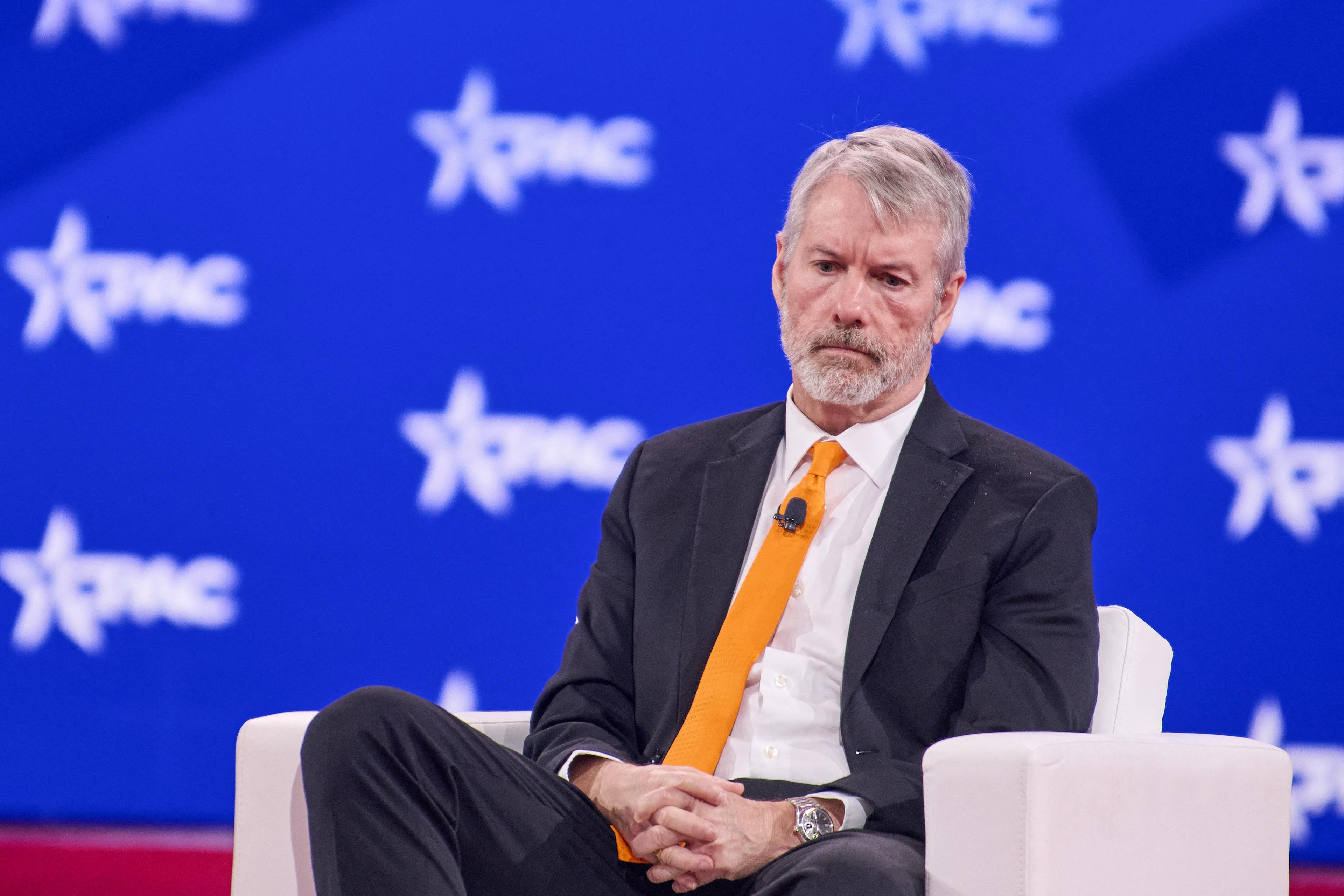
Michael Saylor is blue (Dominic Gwinn/Getty Images)

Bitcoin is down in Q4 but not as bad as its largest corporate treasury firms

Strategy’s market capitalization relative to its bitcoin holdings has also dipped below 1 for the first time since January 2024.

Sage D. Young

Bitcoin treasury firms are having a harder time than their underlying asset in Q4, as the once magic dust of “pivoting to bitcoin” wears thin.

The price of bitcoin has dropped from the $118,500 level at the beginning of October to below $101,300 as of Thursday morning, a 14.5% decrease. 

In comparison, Strategy, Metaplanet, and Twenty One Capital — three of the top four bitcoin digital asset treasuries (DATs), holding a cumulative 716,029 tokens worth $73.3 billion — have seen each of their shares drop about 30% and 35% in the period, data from blockchain analytics firm Artemis shows.

Meanwhile, Nakamoto-merged KindlyMD has slumped 43%, while Strive Inc. has slid 50% in the same time frame.

The price decline comes as Strategy, the first public company to stockpile bitcoin in 2020, and other treasury firms have seen their basic mNAV dip below 1. This means the market price of a company’s shares is less than the total value of its bitcoin holdings. The last time Strategy’s mNAV was under 1 occurred in January 2024, per Blockworks Research

When the wind turns

The sentiment surrounding bitcoin treasury firms “is just horrible,” according to Kevin Li, former DAT lead at Artemis. “Markets are volatile, and bitcoin hasn’t been going up.” 

Omer Goldberg, the founder and CEO of risk management firm Chaos Labs, said, “Every flywheel can become a death spiral when the wind turns the other way.” 

“Some bitcoin/crypto treasury firms are mobilizing their underlying to peg the stocks at 1 mNAV: this will set their path for their shrinking to zero capitalization; at the same time with no certainty on 1 mNAV enforcement, there is no reason why the stocks should stop here,” Goldberg told Sherwood News. 

Le Shi, managing director at crypto trading firm Auros, outlined different scenarios that will likely play out over the coming months, with several bitcoin DATs now trading at a 1 or lower mNAV.

If bitcoin’s price strengthens, the mNAVs of treasury firms will rebound as doubts about their ability to service debt obligations dissipate. If the price of bitcoin weakens, some DATs with stronger balance sheets may initiate stock buybacks to boost confidence, while other DATs trading at discounts may become targets for mergers or acquisitions. 

If the markets stay stagnant, consolidation among DATs is “likely to become a recurring theme for the sector, with some even being forced to divest their assets to repay debts and subsequently, become targets for acquisition,” Shi said.

Bitcoin is the safest, but still limited 

Jaewon Kim at blockchain research firm Four Pillars added that bitcoin DATs are structurally limited by what the asset can do: even though BTC is the safest and most in-demand asset for institutions, it’s not programmable money from a treasury operator perspective.

“For a DAT, that matters because a major path to push mNAV > 1 is to generate incremental return on assets,” Kim said. Premiums are justified when tokens enable treasuries to use their holdings to earn on-chain income through staking, liquidity provisioning, and earning protocol fees, Kim told Sherwood. 

“Bitcoin treasuries have limited flexibility… Unless the company has a very strong brand, a unique narrative (like [Strategy cofounder Michael] Saylor), or a business vision built around BTC, I think it’s only natural the structure naturally gravitates toward NAV,” Kim argued.

Despite the current climate, Li, who began investing in Strategy last year and holds about 30% of his portfolio in the firm, recently bought more shares at $240 each.

Strategy having an mNAV under 1 doesn’t impact Li’s investment thesis, which relies on Strategy being able to increase bitcoin per share by issuing preferred equity to “capture the spread between BTC CAGR [compound annual growth rate] and its cost of capital.”

More Crypto

See all Crypto
crypto

Hyperliquid reclaims all-time high

HYPE, the native token powering perpetuals exchange Hyperliquid and its underlying blockchain, rebounded to reclaim its all-time high previously set at the start of the month.

Treasury firms Hyperliquid Strategies and Hyperion DeFi have also rallied as the token increased double digits in the last 24 hours to trade as high as $76.70, rising past its record price set nearly two weeks ago, according to CoinGecko. In the interim between all-time highs, HYPE pulled back to around $53.

The token has several tailwinds, the first coming from ETF flows. Since their inception in May, HYPE ETFs have yet to record negative weekly outflows, posting a cumulative total net inflow of $171.8 million, per SoSoValue.

The second comes from Hyperliquid spending basically everything it earns in fees to buy HYPE, a mechanism embedded into the protocol’s codebase.

The venue’s buyback funding mechanism is set to add a new source of yield. Validators of the network activated “AQAv2,” which means stablecoin deployers will share about 90% of reserve yield revenue on their supply within the protocol.

Around $6.1 billion of Circle’s USDC resides in Hyperliquid, per DefiLlama. Accrual begins on August 26 and the first payment is made on October 3, the network announced in its Discord channel last week.

A substantial amount of capital is riding on different positions of HYPE. In total, a move down to under $53 would result in the liquidation nearly 1.8 million HYPE worth of leveraged long positions on the on-chain perps venue, or $131.7 million, data from CoinGlass shows. For the upside, a climb above $100 results in the liquidation of more than 3 million worth of leveraged HYPE short positions, or $221.5 million.

HYPE’s rebound to all-time high comes after Michael Selig, chair of the Commodity Futures Trading Commission, defended his agency’s decision to approve regulated perpetuals, or futures contracts without expiration dates, CNBC reported on Monday.

Last month, the CFTC approved bitcoin perpetual futures trading in the US through regulated prediction markets firm Kalshi and an affiliate of centralized exchange Coinbase.

“Perps are highly likely to become lightly regulated and thus approved in the US,” said David Pakman, head of venture investments at CoinFund.

“We expect to see perps for many different types of assets, from commodities to equities,” Pakman told Sherwood News.

crypto

Crypto market snaps back as sentiment lifts, with altcoins from ethereum to XRP soaring

The market capitalization of the crypto industry has jumped around $83.2 billion in the last 24 hours, with privacy-focused token Zcash and worldcoin, the native cryptocurrency of the network backed by OpenAI CEO Sam Altman, leading market gains, jumping over 22%.

But the last 24 hours have been good across the board:

Investors have been eager to see some positive signs around the Iranian conflict ending, coupled with hopeful outlooks around the CLARITY act, both breathing some life into assets, Kairos Research cofounder Ian Unsworth told Sherwood News.

Simon Shockey, a crypto strategist at crypto wallet infrastructure firm Privy, said the upswing stems from several things converging. He pointed to how alt markets broadly were very oversold following the bug found in Zcash that shook confidence.

Friday, Zcash founder Zooko Wilcox said Anthropic didn’t find any more serious bugs with the Zcash protocol after Shielded Labs requested the AI firm run a security audit of the network with Mythos.

Shockey added that the pool of willing sellers has dwindled. Even if structurally, AI is a much more compelling and asymmetric bet in the eyes of allocators, many of these crypto assets have simply run out of marginal sellers despite some shorter-term narrative-driven pumps. The only people left to sell at this point are the teams themselves and VCs.

Net-net: oversold conditions plus exhausted seller bases plus a macro backdrop thats stabilized equals a snapback, especially in names that have real usage or community conviction behind them,” Shockey told Sherwood.

Latest Stories

Sherwood Media, LLC and Chartr Limited produce fresh and unique perspectives on topical financial news and are fully owned subsidiaries of Robinhood Markets, Inc., and any views expressed here do not necessarily reflect the views of any other Robinhood affiliate, including Robinhood Markets, Inc., Robinhood Financial LLC, Robinhood Securities, LLC, Robinhood Crypto, LLC, Robinhood Money, LLC, Robinhood U.K. Ltd, Robinhood Derivatives, LLC, Robinhood Gold, LLC, Robinhood Asset Management, LLC, Robinhood Credit, Inc., Robinhood Ventures DE, LLC and, where applicable, its managed investment vehicles.