Weird Money: GameStop's best-selling product is its own stock
GameStop likes to sell its stock, Brookfield's favorite PE customer is itself, Trump is an excellent crypto trader, and some thoughts on SoftBank's valuation discount
Welcome to Weird Money, a column written by me, Jack Raines, where I discuss the most interesting and, more importantly, weirdest stories I've seen in business and markets.
GameStop is in the business of selling GameStop’s stock
What is GameStop’s business model? You might say, “Sell video games.” This would match the company’s most recent 10-K, which states that GameStop “offers games and entertainment products through its stores and ecommerce platforms.” OK, sure, but GameStop hasn’t done a great job selling games and entertainment products lately. The company released earnings this morning, and its sales were only $882 million in Q1 2024, down from $1.2 billion in Q1 of last year.
You could, however, also make the argument that GameStop’s primary business model is not selling video games, but selling GameStop stock. On May 12th, Keith Gill, aka “Roaring Kitty,” an investor-turned-Wall Street Bets hero, tweeted for the first time in three years, and GameStop’s stock jumped more than 200%, climbing from ~$15 per share to ~$55. Five days later, GameStop’s management issued 45 million new shares at an average price of approximately $20.70, raising $933 million, or ~$50 million more than its quarterly revenue!
By May 24, the stock had fallen back below $18 per share, but then, on June 2, Gill tweeted a picture of an Uno reverse card, and GameStop’s stock shot back up to $32. And yesterday, Gill’s followers saw that he would be livestreaming on YouTube at noon today, and GameStop’s stock climbed even higher, hitting $47.50. So what did GameStop’s management do? It issued more stock, obviously. This time, the company filed an even larger offering to sell 75,000,000 shares. As my colleague Luke Kawa pointed out this morning, depending on the average selling price of these shares, GameStop could add another $2.5 billion, on top of the $933 million from May, to its balance sheet.
With GameStop poised to make 4x more than its Q1 revenue by selling its stock over the last three weeks, I think it’s fair to say that the company is, quite literally, in the business of selling its own stock. GameStop’s management isn’t even trying to pretend otherwise at this point; the first three “risks” related to today’s offering don’t even mention the business itself!
I do love that in the "risks related to the offering" for GameStop, things relating to the actual condition of the business start at #4 on the list.
— Luke Kawa (@LJKawa) June 7, 2024
Real. pic.twitter.com/7ehAXjAov1
CEO Ryan Cohen’s primary responsibility at this point, I guess, is to figure out 1) when to sell more stock and 2) how much stock to sell. This is a really tough job when the biggest influence on the stock price is a social media personality with no connection to the business itself!
Think about it: Cohen successfully raised $933 million in May, but had he moved a couple of days quicker when the stock price was higher, GameStop could have either raised more money or diluted shareholders less. Then he got another chance when Gill tweeted a picture of the Uno card five days ago. I imagine the conversation between Cohen and the rest of GameStop’s management team went something like this:
Management: So, our stock doubled again because the cat guy tweeted a picture of an Uno card. We should sell more shares.
Cohen: Yes but what if he keeps tweeting and the stock goes higher? More hype = higher stock price = less dilution, and we want to minimize dilution, right? Let’s hold off a few days.
Then the stock kept climbing, hitting $60 per share after hours yesterday in the lead up to Gill’s YouTube livestream.
Management: So now even more people are buying our stock because the cat guy is going to livestream on YouTube. His video could send the stock to, like, $100, or it could fall 50%. What should we do?
Cohen: The stock price is what, like $40 right now? And the trading volume was 190 million shares today? We’re not missing our window again. Let’s issue 75 million shares tomorrow, we could raise a couple of billion. Let me know if he tweets again.
Selling to Yourself Is an Excellent Business Model
Is private equity cooked? I guess it depends on which fund manager you ask.
On Wednesday, at the SuperReturn 2024 private equity conference in Berlin, Anuj Ranjan, the CEO of Brookfield Asset Management, told Bloomberg’s Dani Burger that his firm could triple (!!!) the size of its $129 billion private equity unit in the next five years.
Also on Wednesday, at the same conference, Scott Kleinman, the co-president of Apollo Global Management, which has a $74.2 billion PE arm, told Bloomberg’s Dani Burger that “everything is not going to be OK.”
More from Kleinman’s interview with Bloomberg:
Kleinman: I think the reality is that private equity loaded up at the top of the market using very inexpensive debt, and the valuation environment has fundamentally changed. And as a result, private equity sponsors are just going to have to hold companies longer, have to grow into those capital structures, are going to need to take on equity to get some refinancings done, and all that means, it’s just math, is that returns are going to be lower over the next few years.
Burger: Well I’m sure investors who hear the idea that they need to hold on for companies longer are not going to be happy with that. They’ve been clamoring to get their cash back. So how do they do both at the same time?
Kleinman: Uh, they generally don’t.
When you look at market trends, Ranjan’s prediction sounds crazy.
It was impossible not to make money in PE over the last ~15 years or so because 1) interest rates were really low, so raising debt was easy and interest expenses didn’t burden portfolio companies, 2) the economy was growing, 3) valuations were expanding, 4) the IPO market was booming, and 5) fundraising was easy.
Now, interest rates are higher, deal flow is slower, the IPO market is quiet, and, as Kleinman mentioned, a lot of private equity sponsors top-ticked the market. Now, these firms are stuck holding their companies longer and longer because they don’t want to sell for a loss, meaning that distributions to investors are at their lowest level since 2009. So, yes, I find it hard to believe that one of the world’s largest PE firms will triple in size over the next five years. However, Ranjan’s confidence in Brookfield’s future growth is not totally unwarranted: Brookfield’s private equity business bucked the market trend, delivering its highest distributions in three years last year!
There’s just one catch: Brookfield’s biggest exit of the year was its sale of Westinghouse, where the primary purchaser was… Brookfield Renewable Partners. I guess, if you can sell your portfolio companies to other subsidiaries of your parent company for favorable prices while the rest of the PE market is frozen, then, yeah, it makes sense to assume that you can triple your AUM in five years. Why not?
Donald Trump Is a Crypto Whale
In the wake of the FTX collapse, while crypto was suffering through its worst bear market in years, one unlikely person was still making money from NFTs: former president Donald Trump. In December 2022, “NFT INT LLC” launched an NFT collection called “Trump Digital Trading Cards.” The collection of 45,000 NFTs, each priced at $99, sold out in a day, netting its creators ~$4.5 million, and after Trump’s 2023 arrest, they launched new “Mugshot Edition” NFTs as well.
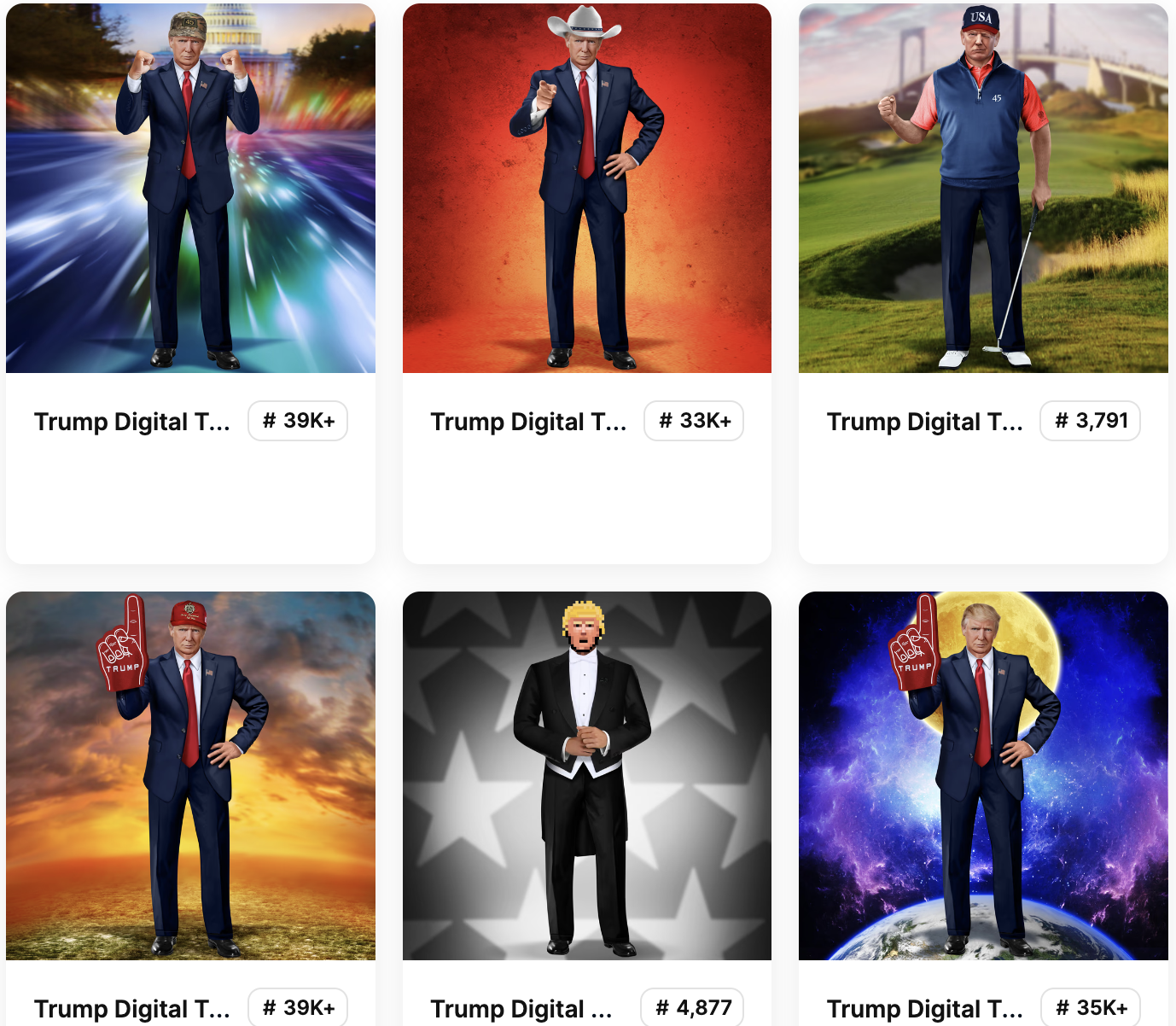
Anyway, Trump apparently earned royalties from these NFTs, to the tune of 1,900 ETH, of which he sold 1,075 last December. HOWEVER, ethereum is only a small fraction of his crypto portfolio. From Yahoo Finance:
Nearly all of the portfolio comprises two memecoins: MAGA Coin (TRUMP) and Trog (TROG). These tokens sent a portion of the token supply to Trump as part of a marketing scheme, and their value has skyrocketed in 2024.
MAGA Coin was the first large project to gift Trump tokens. The project started in August 2023 and sent Trump a few thousand dollars worth of tokens when it began trading. For several months, the value of these tokens stayed relatively low until 2024, when the price of TRUMP began to increase dramatically. Events like Trump's primary election successes and recent felony convictions caused the token's price to go from less than $0.01 on launch to over $17.50. At the same time, Trump's position went from a few thousand dollars to a high of over $10 million.
Surprisingly, TRUMP is just one of the meme coins that Trump has received. Project founders and supporters have given him over 50 other meme coins. Trog (TROG), short for Trump Frog, became Trump's largest holding in June 2024. The project gave Trump half of the supply, equating to 210 billion tokens. While the project has remained fairly small since launch, ranking outside the top 2,500 tokens by market cap, because Trump owns so much of the supply, his position has become very large in relation to the rest of his portfolio. The price of TROG has increased nearly 1,000% over the past week, allowing Trump's tokens to reach a high of over $24.6 million.
When TROG hit highs on June 5, Trump's portfolio was worth over $33 million. His holdings have since fallen to around $20 million as the price of TROG fell. However, the fact that Trump held more than $30 million in meme coins is beyond surprising.
Crypto really is an incredible market. Someone decided to make a memecoin called Trog, short for Trump Frog, because…why not? And they sent the former president 210 billion Trump Frog tokens because… why not? And now, Trump’s stake in Trump Frog is worth tens of millions of dollars, up 1,000% in a week because… why not?
Is it a stretch to say that Trump may be the greatest trader of the 2020s? His media company that lost $327 million on $770,500 in revenue went public at an ~$8 billion valuation, and now the TROG whale is up 1,000% in the last week.
SoftBank’s Arm Problem
Activist hedge fund Elliott Management has invested more than $2 billion into SoftBank, and the fund, which thinks the Japanese tech conglomerate is undervalued, wants it to launch a hefty share buyback. From The Financial Times:
“Elliott Management has rebuilt a substantial stake in SoftBank and is pushing the Japanese tech conglomerate founded by Masayoshi Son to launch a $15bn share buyback. The US-based activist fund’s position is worth more than $2bn and it has engaged directly with SoftBank’s senior management over the past two to three months, according to people familiar with the matter. The fund has swooped on SoftBank at a time when the gap between the combined value of the company’s assets and its market valuation has never been wider.
After a self-declared period in “defence mode”, SoftBank has a strong balance sheet and billions of cash on hand, which its founder wants to use in pursuit of artificial intelligence deals. Son has built his current growth strategy around a roughly 90 per cent stake in UK chip designer Arm, whose surging stock market price has lifted SoftBank’s net asset value to a record $180bn. While the conglomerate’s shares have risen more than 50 per cent this year, its current market capitalisation stands at around $90bn.”
Doing some basic math here, Arm is worth approximately $143 billion, so SoftBank’s 90% stake in Arm is worth approximately $128 billion, making its stake in this one company worth more than SoftBank itself! My initial reaction to these numbers was the same as Elliott’s: “Your company is way too cheap, buy back the stock!”
However, that $128 billion is just the paper valuation of its stake in Arm. To put it differently, how much of that $128 billion could SoftBank actually realize if it wanted to sell its Arm position on the open market? SoftBank owns more than 900 million shares of Arm, and Arm’s average trading volume is around 10 million shares. Yes, its assets are worth twice as much as the company itself, but SoftBank would never be able to offload a stake that big at its current price. And let’s not forget about the huge capital gains taxes that would be owed on a stock that has gone sky-high. Functionally, it’s no different than Trump’s memecoin portfolio. Like, yes, on paper it’s worth $20 million or whatever, but how much money could Trump actually get from selling those meme coins? $5 million? $2 million? Yes, SoftBank looks cheap compared to its assets, but part of that discount may be pricing in liquidity risk.