
Business
2023 Supercars Championship - Boost Mobile Gold Coast 500
Red Bull planes perform during the Gold Coast 500 (Daniel Kalisz/Getty Images)

Red Bull is proof: the world is still obsessed with energy drinks

Beverage giant Keurig Dr Pepper is spending $1 billion to buy energy-drink upstart Ghost, as Red Bull rivals try to catch up.

On Thursday, Keurig Dr Pepper — one of the world’s leading beverage businesses, with a portfolio of more than 125 brands including 7UP and Folgers Coffee — announced it was set to acquire 8-year-old energy-drink-maker Ghost in a deal worth more than $1 billion. With so many energy-drink varieties on the market, Ghost has set itself apart with sugar-free, caffeinated offerings that come in candy-inspired flavors like Sour Patch Kids and Swedish Fish.

Marking Keurig’s biggest deal since buying Dr Pepper Snapple Group in 2018, the company will put down an initial investment of ~$990 million for a 60% ownership stake, before acquiring the other 40% in 2028. While only a small dent in Keurig’s huge ~$50 billion market value, the move positions the company’s US refreshment-beverages segment to capitalize on the global demand for energy drinks — which has soared over the past two decades and grew a further ~10% in 2023, per Nielsen estimates.

Gives you wings (and competitors)

Top global brand Red Bull sold ~12 billion cans worldwide last year, notching sales of €10.6 billion (~$11.4 billion). However, success breeds competition, and Red Bull now has a crowd of rivals snapping at its heels. Data from research firm Mintel shows that the number of energy drinks on the market has increased by 21% in the last three years, and while Red Bull’s biggest competitor by some way is Monster, burgeoning brands like newcomer Prime have also made a dent: the YouTube-hyped drink sold $1.2 billion worth of its product last year.
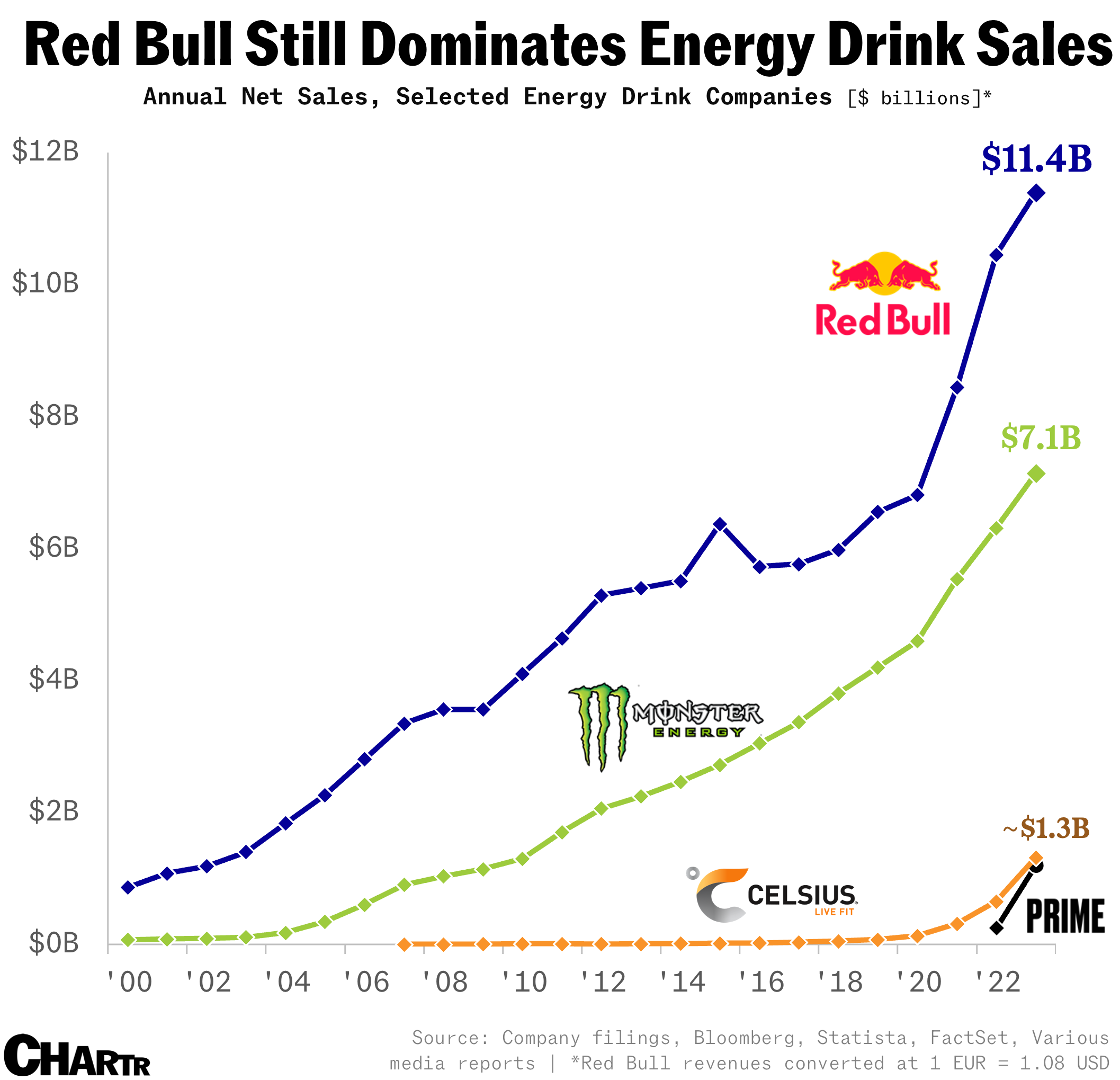
Red Bull competition
Sherwood News

Still, with an F1 team, a music festival, a host of marketing stunts, and even a soapbox race in its roster, Red Bull has firmly kept its crown in the energy-drinks space as a private, independent company by expanding its reach far beyond convenience-store shelves… leaving the rest of the sector to play a game of caffeine-opoly

Prior to the Ghost deal, Keurig had bought a stake in Nutrabolt, owner of C4 Energy, in 2022. That same year, PepsiCo paid $550 million for an 8.5% stake in wellness-oriented energy drink Celsius, only two years after acquiring Rockstar Energy for a massive $3.85 billion. And, despite having made more than $7 billion in sales last year, it seems Monster — itself backed by Coca-Cola and the sponsor of several major sporting events — is also trying to froth up to Red Bull’s level through some strategic investments, buying Bang Energy last year for $362 million.

More Business

See all Business
business
Tom Jones

Prime Day is here again and Amazon’s subscription service has never been more popular

Well, it’s that time of year again: many have made their wish lists, people are scraping together the money they’ve saved to pick out a perfect gift, some are presumably leaving out refreshments for the weary delivery drivers and, more and more, drones.

It’s Amazon Prime Day — meaning that it’s the second day of the four-day promotional event that Amazon still calls Prime Day — of course, and it’s even come early this year, with the company bringing the period into late June from July, when it’s been traditionally held for the last five years.

The Prime Age

Alongside the eyes and endless clicks that the arbitrary stream of listicles on “The Best Prime Day Deals” that almost every media outlet pours into, Amazon will also be cheering the fact that there’s now more Prime users than ever before to devour the retailer and its sellers’ sometimes-contested “discounts.” Indeed, according to the latest annual estimates from Consumer Intelligence Research Partners (CIRP), there were just over 200 million American shoppers using Amazon’s massive subscription service at the end of 2025.

business

Electronic Arts launches a platform to put more ads in its games

Video game publishing giant EA launched a new platform on Monday designed to make the process of selling immersive ad space in its popular games easier.

The company says the platform, called EA Advertising, allows brands to “integrate directly into gameplay through dynamic, real-time placements, from stadium signage to custom in-game content.”

More so than other studios, EA has incorporated advertising into its most popular titles. As Kotaku points out, the company’s ad efforts stretch as far back as 2006. Several of its sports franchises already feature partnerships with brands like Visa, Lowe’s, Red Bull, and PepsiCo.

In-game advertising hasn’t exactly been embraced by fans, but industry experts expect it to ramp up as companies seek more revenue to offset higher games budgets and surging memory costs. EA rival Take-Two has taken a different approach, with CEO Strauss Zelnick recently saying the company was “not at risk of doing brand partnerships” in the forthcoming “Grand Theft Auto VI,” and that ads in full-price games seems “unfair.”

The $55 billion deal to take EA private, led by Saudi Arabia’s Public Investment Fund, is set to close at the end of this month. Being the largest leveraged buyout in history, EA will likely look for more ways to boost revenue to cover interest payments.

More so than other studios, EA has incorporated advertising into its most popular titles. As Kotaku points out, the company’s ad efforts stretch as far back as 2006. Several of its sports franchises already feature partnerships with brands like Visa, Lowe’s, Red Bull, and PepsiCo.

In-game advertising hasn’t exactly been embraced by fans, but industry experts expect it to ramp up as companies seek more revenue to offset higher games budgets and surging memory costs. EA rival Take-Two has taken a different approach, with CEO Strauss Zelnick recently saying the company was “not at risk of doing brand partnerships” in the forthcoming “Grand Theft Auto VI,” and that ads in full-price games seems “unfair.”

The $55 billion deal to take EA private, led by Saudi Arabia’s Public Investment Fund, is set to close at the end of this month. Being the largest leveraged buyout in history, EA will likely look for more ways to boost revenue to cover interest payments.

business

JM Smucker says it sold $1 billion worth of Uncrustables in FY2026

After years of booming sandwich sales, JM Smucker has finally earned a billion-dollar crust.

On Tuesday, the company reported results for fiscal year 2026, highlighting better-than-expected profits driven by higher prices for coffee and sweet baked goods. However, at another point on the earnings call, CEO Mark Smucker pointed to one particularly jammy figure: in line with previous forecasts, the company sold $1 billion worth of its (almost always) crustless sandwiches, Uncrustables, in the last year alone.

business

Paramount reportedly offers concessions to resolve multistate antitrust investigation

Paramount has reportedly offered up some concessions in an effort to prevent an antitrust lawsuit by California and about 10 other states, according to Bloomberg reporting on Monday.

Reuters first reported on the potential suit from a group of unnamed states last week, which could throw a wrench in Paramount’s plans to buy rival Warner Bros. Discovery in a Hollywood megamerger.

The list of concessions is unknown, though Bloomberg previously reported that Paramount is open to divesting some of its kids TV assets to appease EU regulators.

Late last month, reports said US regulators appeared likely to approve the $110 billion merger, following a meeting between Paramount CEO David Ellison and DOJ antitrust staffers.

The list of concessions is unknown, though Bloomberg previously reported that Paramount is open to divesting some of its kids TV assets to appease EU regulators.

Late last month, reports said US regulators appeared likely to approve the $110 billion merger, following a meeting between Paramount CEO David Ellison and DOJ antitrust staffers.

$98B ⛽

The IATA released its latest financial outlook for the airline industry over the weekend, forecasting a $98 billion jump in the sector’s collective fuel bill. The world’s largest trade group representing airlines expects the oil spike to halve profits by 49% from last year to $23 billion.

The group also expects profit margins to halve year over year, falling from 2025’s 4.2% to 2%. Still, revenue is expected to climb to $1.17 trillion from $1.07 trillion.

A surge in the cost of jet fuel has rocked US and global airlines this year, leading Delta Air Lines, United Airlines, American Airlines, Southwest Airlines, JetBlue, and others to raise fares and ancillary charges like bag fees. Low-cost carriers, which operate on smaller margins, have been squeezed the hardest, resulting in Spirit’s shutdown.

“It’s a tough year for all airlines, especially those whose balance sheets had not yet recovered from COVID. And, of course, for those operating in the Gulf,” said IATA Director General Willie Walsh, who added that demand is holding up and about half of passengers expect to spend more on travel this year. “That bodes well for a strong northern summer peak season. The big unknown is how long travelers and shippers can tolerate the higher costs of connectivity.”

Latest Stories

Sherwood Media, LLC and Chartr Limited produce fresh and unique perspectives on topical financial news and are fully owned subsidiaries of Robinhood Markets, Inc., and any views expressed here do not necessarily reflect the views of any other Robinhood affiliate, including Robinhood Markets, Inc., Robinhood Financial LLC, Robinhood Securities, LLC, Robinhood Crypto, LLC, Robinhood Money, LLC, Robinhood U.K. Ltd, Robinhood Derivatives, LLC, Robinhood Gold, LLC, Robinhood Asset Management, LLC, Robinhood Credit, Inc., Robinhood Ventures DE, LLC and, where applicable, its managed investment vehicles.
