Business
2021 Times Square New Year's Eve Celebration planet fitness
Alexi Rosenfeld / Getty Images
No Lifts

Planet Fitness' business only works out if its members don't

The most popular gym in the US doesn't actually have enough gym space for all of its members to get fit.

Jack Raines

Each year, “getting in shape” is one of America’s most popular New Year’s resolutions, but one unlikely company’s business model relies on most of these resolutions falling flat: Planet Fitness .

Planet Fitness is America’s most popular gym, with 18.7 million members spread across 2,575 locations. It made $1.1 billion in revenue in 2023, up 14.4% from the year before.

One reason that Planet Fitness is so popular is its low price. A membership at one of Planet Fitness’ Manhattan locations is only $14.99 per month, but many national locations offer plans as cheap as $10. Even its Black Card membership, which gives customers access to all locations worldwide, is only $24.99 per month. In contrast, a membership at upscale gym Life Time Fitness NoHo Manhattan location costs $299.

At first glance, it appears that Planet Fitness should have an overcrowding problem, and its low prices don’t make sense. With a total membership of 18.7 million across 2,575 gyms, the company averages 7,262 members for each location. Most gyms are open 113 hours per week, a typical gym is around 20,000 square feet, and maximum occupancies range from ~200 to 350 people1

For all 18.7 million Planet Fitness members to work out for just one hour per week, gyms would need an average of 64 people (7,262 members per store/113 hours per week) exercising during all operating hours (which is from 5 am to 11 pm at most locations).

For each of its members to work out at a more regular cadence, such as 4x per week, each gym would need to average 257 people working out at all times. This is more than the maximum occupancy of some locations, and it ignores traffic spikes during gyms’ peak hours that would send attendance even higher.

We can model this out. The table below looks at what different scenarios of attendance and workout cadence would have on Planet Fitness.

The rows of the table correspond to different turnout levels of the Planet Fitness membership base, so if all of the members worked out weekly, or if 50% work out weekly, and so on. The columns of the table correspond to the number of hours those members actually spend in the gym, from one hour per week up to one hour per day.

So for instance, if 50% of Planet Fitness customers work out weekly, and they for 3 hours per week, the company's gyms would have to be used by an average of 96 customers every hour.

While the Mayo Clinic recommends a minimum of 2.5 hours of exercise per week, and up to 5 hours if you’re looking to lose weight, Planet Fitness lacks the capacity for all of its members to hit these benchmarks.

However, Planet Fitness doesn’t have to accommodate all 18.7 million users because its business model is predicated on most of its members 1) not working out, while 2) continuing to pay for their memberships.

Representatives from Planet Fitness locations in Atlanta and New York told Sherwood that at their busiest hours, gym attendance typically peaks around 50-60 people working out at a time. Referring to the table above, if Planet Fitness were to maintain its peak attendance of 50-60 attendees all day, only 20%, or 3.7 million, of its members would be working out 4x per week. If you account for declining traffic in non-peak hours, it’s obvious that Planet Fitness attendance levels are even lower.

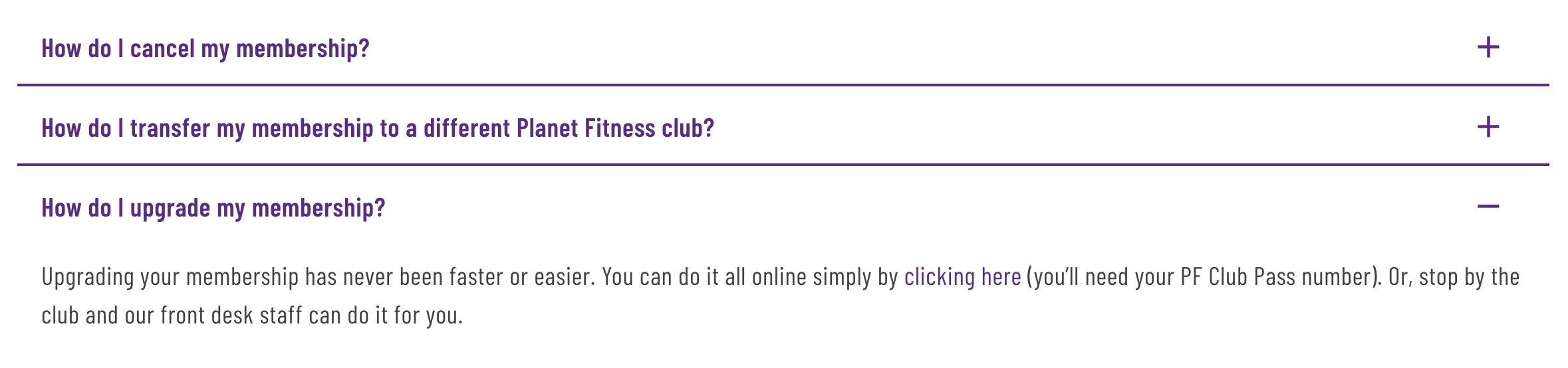
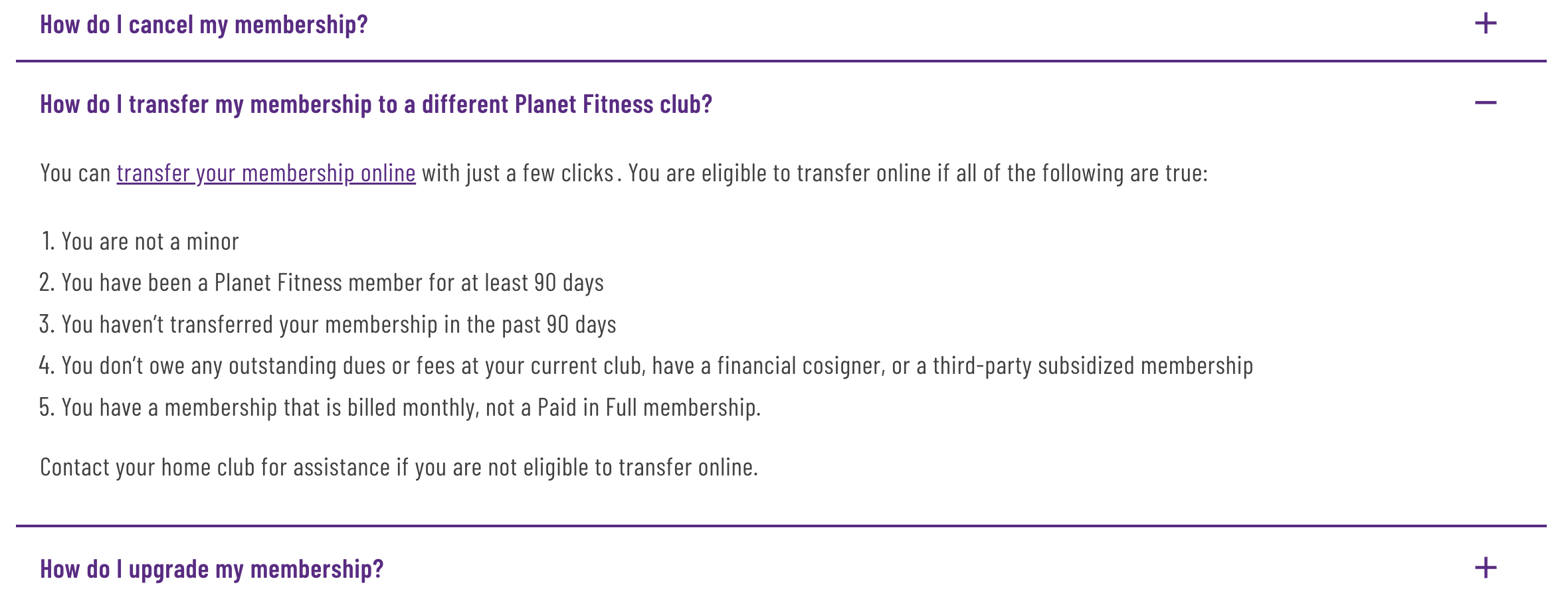
Planet Fitness has also made it notoriously difficult to cancel your membership. If you want to sign up, upgrade, or transfer your membership to a new location, the process is seamless: A few clicks on the website and a few online forms to fill out and you’re good to go.

Canceling your membership, however, is a different story. Planet Fitness allows new members to pay the enrollment fee and an annual fee by credit card, but only accepts checking account payments for their recurring membership fees, in order to “be able to continue your membership without interruption or the hassle of updating your payment information if your credit cards are lost/stolen, invalid or expired.” This also, conveniently, makes it impossible to dispute charges or end your membership by closing a credit card.

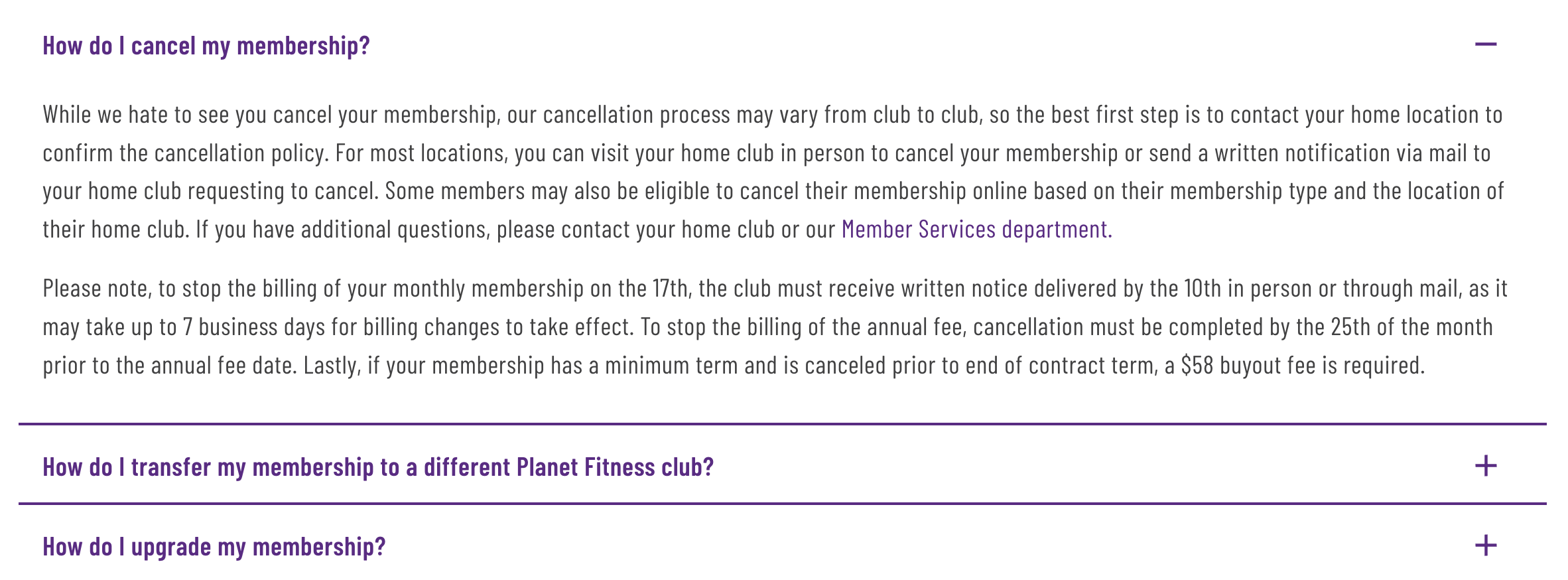
If you would like to cancel your membership, you either have to go to the gym, in person, or by sending a written notification via mail. Yes, a gym that uses a mobile app for sign-ins requires cancellation by mail in 2024. And whether you go in person or via snail mail, make sure you deliver your cancellation by the 10th of the month, as it may take them “7 business days” to process a billing change. The screenshots below come from Planet Fitness’ membership FAQ:
Given the arduous cancellation policies, $10 per month really is the perfect price point: it’s just cheap enough that it’s not worth your time (or embarrassment) to visit in-person or stop by the local post office. Low prices + high friction to cancel have created an excellent recurring revenue model.

While all gyms have some portion of members that don’t regularly use their memberships, Planet Fitness appears to be an extreme outlier. Life Time Fitness, for example, has 1.5 million members across 208 clubs, its typical gym is 100,000 square feet, 5x larger than Planet Fitness locations, and gyms are open roughly 122 hours per week. If all 1.5 million members worked out for four hours per week, Life Time’s gyms would still only average a 19% occupancy rate2. Meanwhile, Planet Fitness doesn’t have room for all of its members to exercise at that cadence.

While other gym chains sell access to fitness, Planet Fitness sells the idea of fitness, but doesn’t really want every member to get fit, at least not inside its doors.

Planet Fitness did not respond to Sherwood's request for comment.

Footnotes:

1: Max occupancy rates were provided by representatives at Planet Fitness locations in Atlanta and New York City.
2: Because the typical Life Time gym is 5x larger than the typical Planet Fitness, I increased Planet Fitness’ occupancy limits (250, in this case) by a factor of five to estimate Life Time’s max occupancy.

More Business

See all Business
business

The Trump administration is reportedly planning a 50% made-in-America requirement for USMCA tariff relief

Qualifying for USMCA-related lower tariffs may soon require more US-made vehicle components, according to reporting by The Wall Street Journal.

The Trump administration is reportedly planning to introduce a 50% US content requirement for vehicles covered by the trade pact to receive lower tariffs. The content would be measured by cost, according to the WSJ.

There currently isn’t any US-specific requirement for those lower tariff rates, but in order to receive preferential tariffs, vehicles are must contain at least 75% regional content (components made in North America). Per Reuters reporting, the Trump admin is seeking to raise the regional requirement to 82%.

These reported plans are subject to change as the US negotiates USMCA terms with Mexico over the next few months.

Overall, Tesla will likely have the easiest time qualifying for any stricter requirements. The automaker’s vehicles contained the highest amount of US/Canadian content in 2025, according to American University research. Ford, GM, and Stellantis all scored lower.

Notably: the underlying government data that many domestic content measurements rely on intentionally combines US and Canadian components, so it’s difficult to know exactly how much of any given vehicle is specifically US-made.

There currently isn’t any US-specific requirement for those lower tariff rates, but in order to receive preferential tariffs, vehicles are must contain at least 75% regional content (components made in North America). Per Reuters reporting, the Trump admin is seeking to raise the regional requirement to 82%.

These reported plans are subject to change as the US negotiates USMCA terms with Mexico over the next few months.

Overall, Tesla will likely have the easiest time qualifying for any stricter requirements. The automaker’s vehicles contained the highest amount of US/Canadian content in 2025, according to American University research. Ford, GM, and Stellantis all scored lower.

Notably: the underlying government data that many domestic content measurements rely on intentionally combines US and Canadian components, so it’s difficult to know exactly how much of any given vehicle is specifically US-made.

business

The $640,000 Luce makes the average Ferrari look like a bargain

Put aside the shape; put aside the smoothing out of Ferrari’s iconic sharp edges; put aside, even, the calls from former Chairman and President Luca Cordero di Montezemolo to “take the Prancing Horse off.” On the grounds of price alone, Luce detractors might have a point.

By now, many of us will have read the criticisms of Ferrari’s first fully electric vehicle, as the Luce — which was unveiled to the world earlier this week and promptly saw the company’s shares crash out in New York and Milan — gets subtly shaded by competitors online and not-so-subtly shaded by basically everyone else.

What makes all of this worse for Ferrari is that, even by the luxury car maker’s notoriously high standards, they’ve slapped a pretty hefty price tag on the Luce, and the company’s CEO, Benedetto Vigna, has already been forced to defend the €550,000 ($640,000) price point, saying yesterday that it’s “fair to pay for innovation,” per Reuters.

While Ferrari’s cars have been getting more expensive of late, as recently as 2022, Ferrari’s average revenue per car sold was around $340,000. At nearly twice that price, this new electric model is obviously proving a little much (visually, conceptually, and financially) for many loyal and long-standing fans of the Prancing Horse to stomach.

Ferrari Luce cost chart
Sherwood News

By now, many of us will have read the criticisms of Ferrari’s first fully electric vehicle, as the Luce — which was unveiled to the world earlier this week and promptly saw the company’s shares crash out in New York and Milan — gets subtly shaded by competitors online and not-so-subtly shaded by basically everyone else.

What makes all of this worse for Ferrari is that, even by the luxury car maker’s notoriously high standards, they’ve slapped a pretty hefty price tag on the Luce, and the company’s CEO, Benedetto Vigna, has already been forced to defend the €550,000 ($640,000) price point, saying yesterday that it’s “fair to pay for innovation,” per Reuters.

While Ferrari’s cars have been getting more expensive of late, as recently as 2022, Ferrari’s average revenue per car sold was around $340,000. At nearly twice that price, this new electric model is obviously proving a little much (visually, conceptually, and financially) for many loyal and long-standing fans of the Prancing Horse to stomach.

Ferrari Luce cost chart
Sherwood News

Latest Stories

Sherwood Media, LLC and Chartr Limited produce fresh and unique perspectives on topical financial news and are fully owned subsidiaries of Robinhood Markets, Inc., and any views expressed here do not necessarily reflect the views of any other Robinhood affiliate, including Robinhood Markets, Inc., Robinhood Financial LLC, Robinhood Securities, LLC, Robinhood Crypto, LLC, Robinhood Money, LLC, Robinhood U.K. Ltd, Robinhood Derivatives, LLC, Robinhood Gold, LLC, Robinhood Asset Management, LLC, Robinhood Credit, Inc., Robinhood Ventures DE, LLC and, where applicable, its managed investment vehicles.