Business
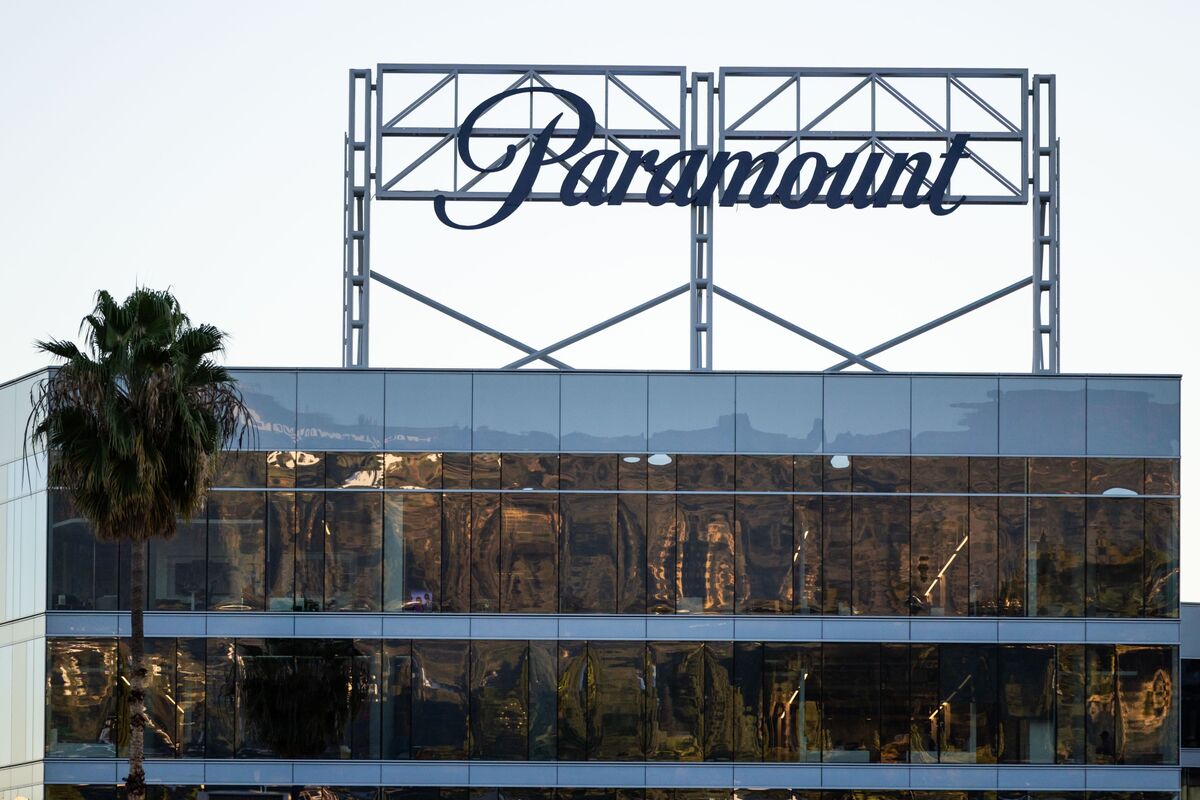
Paramount Pictures studio lot at 5555 Melrose Ave.
Paramount Pictures studio lot (Brian van der Brug / Getty Images)

A definitely real company with zero footprint made a jaw-dropping $43 billion offer to buy Paramount

Then the press release disappeared.

On July 7th, after six months of back and forth negotiations that, as recently as June, looked poised to collapse, David Ellison’s Skydance Media and Paramount Global signed a definitive agreement for Skydance to acquire the media company.

The deal was complicated. Paramount has two classes of shares: Class A voting shares and Class B common shares, and Shari Redstone’s National Amusements (NAI) owned 77.4% of the voting class shares.

Ultimately, Skydance and investing group RedBird Capital Partners agreed to invest $2.4 billion to acquire NAI for $2.4 billion, $4.5 billion (in cash and stock) to acquire other Class A and Class B shares, and add $1.5 billion in additional capital to Paramount’s balance sheet.

However, before the deal closes, Paramount has a 45-day “go-shop” window, allowing the company to evaluate other takeover offers until August 21. On July 31, a press release came across Business Wire that said a company called “Apex Capital Trust” made an upsized offer to acquire Paramount, but later that afternoon, Business Wire pulled the bid announcement, raising questions about the legitimacy of Apex’s offer.

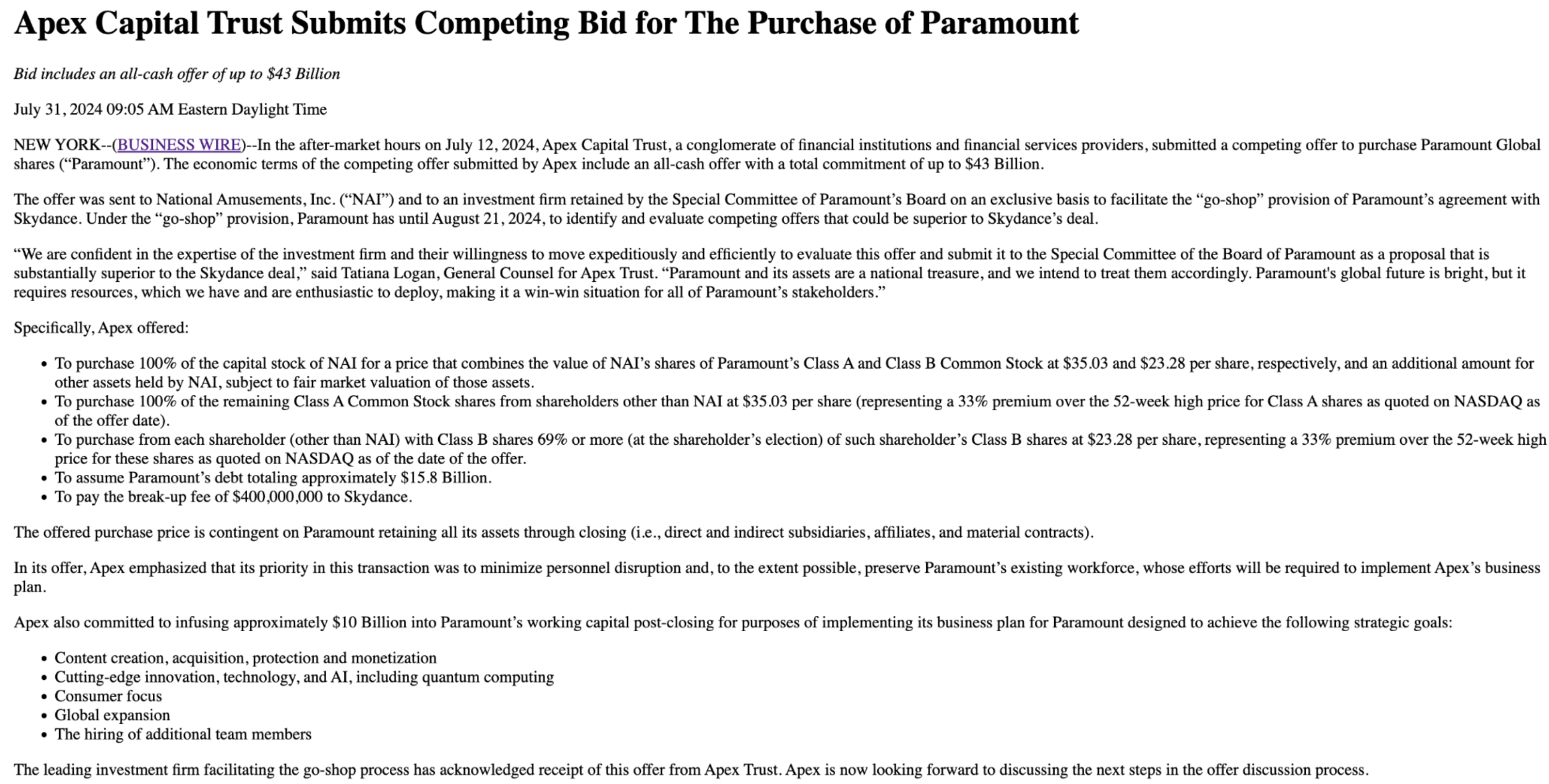
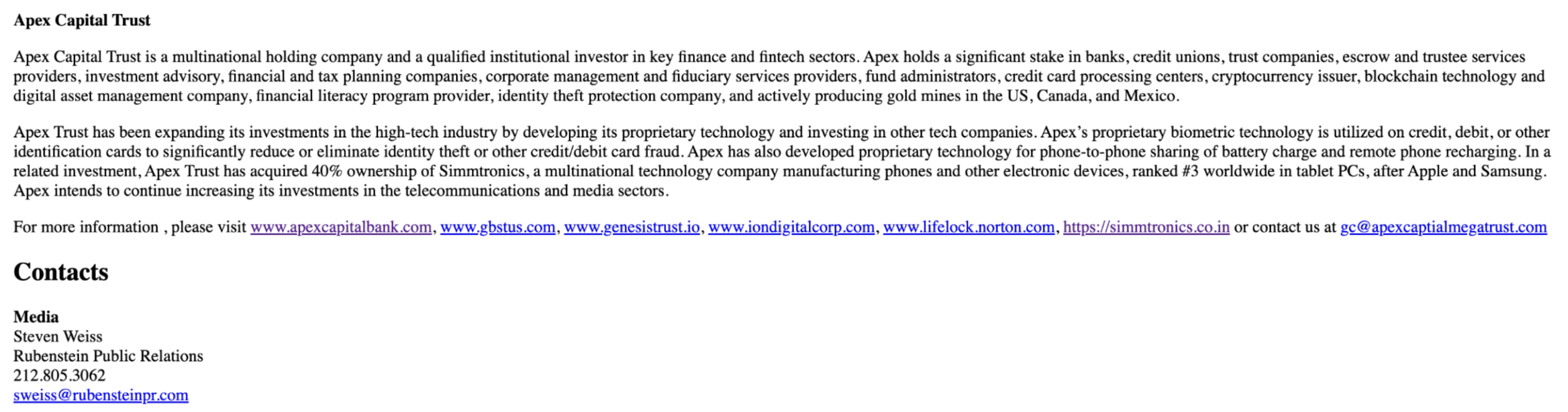
Lucky for you, we were able to secure a screenshot of the supposed bid, and it is certainly… interesting. Here’s the full release from Business Wire:
Screenshot 2024-08-01 at 3.18.25 PM
Screenshot 2024-08-01 at 3.19.18 PM
Apex's press release, per Business Wire

To highlight some of the more interesting points from this “proposal”:

First, Apex submitted an all-cash offer of up to $43 billion (!!!), which is 54% higher than Paramount’s $28 billion enterprise value in the Skydance deal. Specifically, Apex offered $35.03 and $23.28 per share for Paramount’s Class A and B shares, 52% and 55% higher than Skydance’s offers, as well as infusing $10 billion to Paramount’s balance sheet (vs the $1.5 billion from Skydance).

Why is Apex willing to upsize Skydance’s offer by $15 billion?

“We are confident in the expertise of the investment firm and their willingness to move expeditiously and efficiently to evaluate this offer and submit it to the Special Committee of the Board of Paramount as a proposal that is substantially superior to the Skydance deal,” said Tatiana Logan, General Counsel for Apex Trust. “Paramount and its assets are a national treasure, and we intend to treat them accordingly. Paramount's global future is bright, but it requires resources, which we have and are enthusiastic to deploy, making it a win-win situation for all of Paramount’s stakeholders…”

Apex also committed to infusing approximately $10 Billion into Paramount’s working capital post-closing for purposes of implementing its business plan for Paramount designed to achieve the following strategic goals:

  • Content creation, acquisition, protection and monetization

  • Cutting-edge innovation, technology, and AI, including quantum computing

  • Consumer focus

  • Global expansion

  • The hiring of additional team members…

So, this Apex Capital Partners is willing to pay a 50%+ premium, as well as Skydance’s breakup fee, and inject $10 billion to Paramount’s balance sheet to, among other things, help the struggling entertainment company make a push into quantum computing. It’s an ambitious move, if nothing else.

Second, $43 billion is a lot of money, especially for a company that we’ve never heard of.  So what, exactly, is Apex? Well, Reuters spoke to Apex’s general counsel, Tatiana Logan (who, according to LinkedIn, took that position in July of this year):

Logan alleged Apex Capital Trust holds multiple subsidiaries, including operating gold mines whose reserves were valued at $256 billion and credit card processing centers that she said had billions of dollars a month in transactions.

"Nobody knows about these companies because they are not consumer facing, but that does not make them less real," Logan said. She declined Reuters’ request for documentation to support her claims about valuation of these subsidiaries and did not provide the location of the businesses…

Logan declined to identify the individual or individuals behind the Apex Capital Trust Transaction or if it had partners, saying, “our owners want to be able to go to Whole Foods, pick up children and pick up their grandkids” without being recognized.

Third, Apex Capital Bank’s website, linked at the bottom of the press release, is bare bones. It’s basically a WordPress site with a few stock images of people sitting in front of computers, as well as bulleted lists detailing the company’s services, such as checking, savings, private wealth, and private client. Apex Capital Bank also claims to be a “sovereign bank” that charges customers a “one-time fee of $350,” but it declines to say what that fee is for. You also can’t click anything on the website except for a contact form. However, Logan’s explanation for this is that “the website was created for the bank recently as part of Apex Capital Trust’s desire to make its offer public.” Basically, the website isn’t relevant to the company’s business.

Fourth, Apex claimed to own 40% of Indian electronics manufacturer Simmtronics, “a multinational technology company manufacturing phones and other electronic devices, ranked #3 worldwide in tablet PCs, after Apple and Samsung.” While it appears that Simmtronics did sell a tablet called the “XPad” in 2013 and 2014, it’s no longer available on Amazon or Indian e-commerce site Flipkart, and it certainly isn’t “#3 worldwide in tablet PCs.”

My intuition suggests that there’s just no way this is real, but Reuters reached out to Steven Weiss of Rubenstein Public Relations (a legitimate communications agency), whose contact information was included at the bottom of the Business Wire piece, and he confirmed via email that, “Yes, this is real,” and Logan said that Apex was willing to place $50 billion in escrow to show that it has the means to complete the transaction.

The most likely outcome is that this is, in fact, an illegitimate offer. However, there is a non-zero chance that a shadow entity named “Apex Capital Partners,” which operates credit card processing centers and mines with more gold reserves than Switzerland and Germany combined and has a “sovereign bank” with a broken website, actually decided to make a $43 billion offer for a debt-saddled entertainment company. And if Apex were to deposit $50 billion in escrow to prove it had the capital, it would be hard for Shari Redstone to turn down the $15 billion increase, no?  To be clear, I don’t think any of this will happen, and it’s probably vaguely tied to a crypto project, but I do hope the entire thing is legit.

More Business

See all Business
business
Tom Jones

Prime Day is here again and Amazon’s subscription service has never been more popular

Well, it’s that time of year again: many have made their wish lists, people are scraping together the money they’ve saved to pick out a perfect gift, some are presumably leaving out refreshments for the weary delivery drivers and, more and more, drones.

It’s Amazon Prime Day — meaning that it’s the second day of the four-day promotional event that Amazon still calls Prime Day — of course, and it’s even come early this year, with the company bringing the period into late June from July, when it’s been traditionally held for the last five years.

The Prime Age

Alongside the eyes and endless clicks that the arbitrary stream of listicles on “The Best Prime Day Deals” that almost every media outlet pours into, Amazon will also be cheering the fact that there’s now more Prime users than ever before to devour the retailer and its sellers’ sometimes-contested “discounts.” Indeed, according to the latest annual estimates from Consumer Intelligence Research Partners (CIRP), there were just over 200 million American shoppers using Amazon’s massive subscription service at the end of 2025.

business

Electronic Arts launches a platform to put more ads in its games

Video game publishing giant EA launched a new platform on Monday designed to make the process of selling immersive ad space in its popular games easier.

The company says the platform, called EA Advertising, allows brands to “integrate directly into gameplay through dynamic, real-time placements, from stadium signage to custom in-game content.”

More so than other studios, EA has incorporated advertising into its most popular titles. As Kotaku points out, the company’s ad efforts stretch as far back as 2006. Several of its sports franchises already feature partnerships with brands like Visa, Lowe’s, Red Bull, and PepsiCo.

In-game advertising hasn’t exactly been embraced by fans, but industry experts expect it to ramp up as companies seek more revenue to offset higher games budgets and surging memory costs. EA rival Take-Two has taken a different approach, with CEO Strauss Zelnick recently saying the company was “not at risk of doing brand partnerships” in the forthcoming “Grand Theft Auto VI,” and that ads in full-price games seems “unfair.”

The $55 billion deal to take EA private, led by Saudi Arabia’s Public Investment Fund, is set to close at the end of this month. Being the largest leveraged buyout in history, EA will likely look for more ways to boost revenue to cover interest payments.

More so than other studios, EA has incorporated advertising into its most popular titles. As Kotaku points out, the company’s ad efforts stretch as far back as 2006. Several of its sports franchises already feature partnerships with brands like Visa, Lowe’s, Red Bull, and PepsiCo.

In-game advertising hasn’t exactly been embraced by fans, but industry experts expect it to ramp up as companies seek more revenue to offset higher games budgets and surging memory costs. EA rival Take-Two has taken a different approach, with CEO Strauss Zelnick recently saying the company was “not at risk of doing brand partnerships” in the forthcoming “Grand Theft Auto VI,” and that ads in full-price games seems “unfair.”

The $55 billion deal to take EA private, led by Saudi Arabia’s Public Investment Fund, is set to close at the end of this month. Being the largest leveraged buyout in history, EA will likely look for more ways to boost revenue to cover interest payments.

business

JM Smucker says it sold $1 billion worth of Uncrustables in FY2026

After years of booming sandwich sales, JM Smucker has finally earned a billion-dollar crust.

On Tuesday, the company reported results for fiscal year 2026, highlighting better-than-expected profits driven by higher prices for coffee and sweet baked goods. However, at another point on the earnings call, CEO Mark Smucker pointed to one particularly jammy figure: in line with previous forecasts, the company sold $1 billion worth of its (almost always) crustless sandwiches, Uncrustables, in the last year alone.

business

Paramount reportedly offers concessions to resolve multistate antitrust investigation

Paramount has reportedly offered up some concessions in an effort to prevent an antitrust lawsuit by California and about 10 other states, according to Bloomberg reporting on Monday.

Reuters first reported on the potential suit from a group of unnamed states last week, which could throw a wrench in Paramount’s plans to buy rival Warner Bros. Discovery in a Hollywood megamerger.

The list of concessions is unknown, though Bloomberg previously reported that Paramount is open to divesting some of its kids TV assets to appease EU regulators.

Late last month, reports said US regulators appeared likely to approve the $110 billion merger, following a meeting between Paramount CEO David Ellison and DOJ antitrust staffers.

The list of concessions is unknown, though Bloomberg previously reported that Paramount is open to divesting some of its kids TV assets to appease EU regulators.

Late last month, reports said US regulators appeared likely to approve the $110 billion merger, following a meeting between Paramount CEO David Ellison and DOJ antitrust staffers.

$98B ⛽

The IATA released its latest financial outlook for the airline industry over the weekend, forecasting a $98 billion jump in the sector’s collective fuel bill. The world’s largest trade group representing airlines expects the oil spike to halve profits by 49% from last year to $23 billion.

The group also expects profit margins to halve year over year, falling from 2025’s 4.2% to 2%. Still, revenue is expected to climb to $1.17 trillion from $1.07 trillion.

A surge in the cost of jet fuel has rocked US and global airlines this year, leading Delta Air Lines, United Airlines, American Airlines, Southwest Airlines, JetBlue, and others to raise fares and ancillary charges like bag fees. Low-cost carriers, which operate on smaller margins, have been squeezed the hardest, resulting in Spirit’s shutdown.

“It’s a tough year for all airlines, especially those whose balance sheets had not yet recovered from COVID. And, of course, for those operating in the Gulf,” said IATA Director General Willie Walsh, who added that demand is holding up and about half of passengers expect to spend more on travel this year. “That bodes well for a strong northern summer peak season. The big unknown is how long travelers and shippers can tolerate the higher costs of connectivity.”

Latest Stories

Sherwood Media, LLC and Chartr Limited produce fresh and unique perspectives on topical financial news and are fully owned subsidiaries of Robinhood Markets, Inc., and any views expressed here do not necessarily reflect the views of any other Robinhood affiliate, including Robinhood Markets, Inc., Robinhood Financial LLC, Robinhood Securities, LLC, Robinhood Crypto, LLC, Robinhood Money, LLC, Robinhood U.K. Ltd, Robinhood Derivatives, LLC, Robinhood Gold, LLC, Robinhood Asset Management, LLC, Robinhood Credit, Inc., Robinhood Ventures DE, LLC and, where applicable, its managed investment vehicles.