Business
NYC trash
A New Yorker walking past a pile of trash (Charly Triballeau / Getty Images)
Weird Money

New York’s $1.6 million trash can revolution

New York City paid McKinsey to help it revamp its sanitation network

Jack Raines

One of my favorite tropes is that organizations pay management consultants, such as McKinsey & Company, millions of dollars to create slide decks with obvious solutions, such as “reduce expenses and increase revenue.”

One of my favorite things about living in New York is that, despite being the largest city-wide economy in the world, New York’s sidewalks are covered with piles of trash bags every evening. It was only fitting, then, that in 2022, New York City’s Department of Sanitation (DSNY) paid McKinsey  $1.6 million to conduct a 20-week waste containerization needs study, and earlier this week, New York City Mayor Eric Adams unveiled the city’s first-ever official NYC Bin.

The DSNY also put forth a proposed rule requiring that all buildings with one to nine residential units and all special use buildings that receive DSNY collection (e.g. city agency buildings, houses of worship, and professional offices located within residential buildings) put their trash in containers, effective November 12, 2024. This will, according to Mayor Adams, “containerize more than 70% of the city’s trash to protect our most valuable and limited resource — our public space.”

A few things to note here: first, plenty of NYC residents have already been using trash cans, and, assuming their current lids have securing latches, they’ll have until 2026 to switch to the NYC-branded containers. Second, this is part of a larger investment, which includes the development of new automatic side-loading trucks designed to service the new trash cans. For what it’s worth, many of New York’s streets are notoriously narrow, and curb space in busy areas is nonexistent, making the trash servicing process more difficult than in other, less densely populated areas.

If you’re curious, The DSNY published a 2023 Containerization Report, in which it cited McKinsey’s work, and the report is quite interesting. A few stats:

  • New Yorkers leave 44 million pounds of trash on curbs each day (!!!)

  • Choosing whether or not to use wheeled shared containers (the really big metal containers that trucks can pick up, not the smaller trash bins referenced above) would have a massive impact on the city’s entire sanitation system, including which trucks to invest in.

  • McKinsey studied the sanitation systems of dozens of cities across the US, Latin America, Europe, Asia, and Australia when creating their report for New York.

  • Some of the slides, such as the one below, are hysterical:
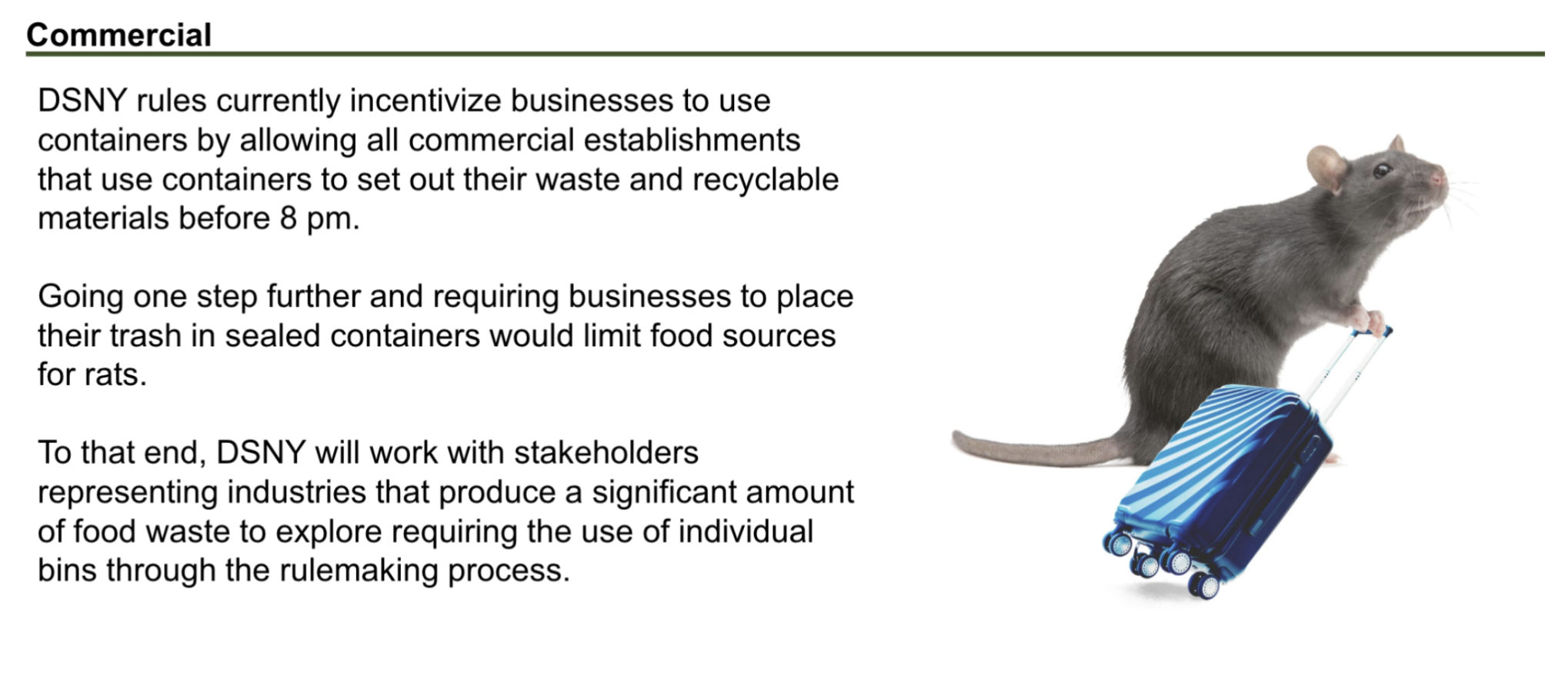
New York City Sanitation Deck Slide
A slide from the NYC Department of Sanitation's 2023 deck.

While the “consultants get paid millions for obvious recommendations” is a fun trope, $1.6 million feels more than reasonable if it helps clean up our rat problem.

More Business

See all Business
business

The Trump administration is reportedly planning a 50% made-in-America requirement for USMCA tariff relief

Qualifying for USMCA-related lower tariffs may soon require more US-made vehicle components, according to reporting by The Wall Street Journal.

The Trump administration is reportedly planning to introduce a 50% US content requirement for vehicles covered by the trade pact to receive lower tariffs. The content would be measured by cost, according to the WSJ.

There currently isn’t any US-specific requirement for those lower tariff rates, but in order to receive preferential tariffs, vehicles are must contain at least 75% regional content (components made in North America). Per Reuters reporting, the Trump admin is seeking to raise the regional requirement to 82%.

These reported plans are subject to change as the US negotiates USMCA terms with Mexico over the next few months.

Overall, Tesla will likely have the easiest time qualifying for any stricter requirements. The automaker’s vehicles contained the highest amount of US/Canadian content in 2025, according to American University research. Ford, GM, and Stellantis all scored lower.

Notably: the underlying government data that many domestic content measurements rely on intentionally combines US and Canadian components, so it’s difficult to know exactly how much of any given vehicle is specifically US-made.

There currently isn’t any US-specific requirement for those lower tariff rates, but in order to receive preferential tariffs, vehicles are must contain at least 75% regional content (components made in North America). Per Reuters reporting, the Trump admin is seeking to raise the regional requirement to 82%.

These reported plans are subject to change as the US negotiates USMCA terms with Mexico over the next few months.

Overall, Tesla will likely have the easiest time qualifying for any stricter requirements. The automaker’s vehicles contained the highest amount of US/Canadian content in 2025, according to American University research. Ford, GM, and Stellantis all scored lower.

Notably: the underlying government data that many domestic content measurements rely on intentionally combines US and Canadian components, so it’s difficult to know exactly how much of any given vehicle is specifically US-made.

business

The $640,000 Luce makes the average Ferrari look like a bargain

Put aside the shape; put aside the smoothing out of Ferrari’s iconic sharp edges; put aside, even, the calls from former Chairman and President Luca Cordero di Montezemolo to “take the Prancing Horse off.” On the grounds of price alone, Luce detractors might have a point.

By now, many of us will have read the criticisms of Ferrari’s first fully electric vehicle, as the Luce — which was unveiled to the world earlier this week and promptly saw the company’s shares crash out in New York and Milan — gets subtly shaded by competitors online and not-so-subtly shaded by basically everyone else.

What makes all of this worse for Ferrari is that, even by the luxury car maker’s notoriously high standards, they’ve slapped a pretty hefty price tag on the Luce, and the company’s CEO, Benedetto Vigna, has already been forced to defend the €550,000 ($640,000) price point, saying yesterday that it’s “fair to pay for innovation,” per Reuters.

While Ferrari’s cars have been getting more expensive of late, as recently as 2022, Ferrari’s average revenue per car sold was around $340,000. At nearly twice that price, this new electric model is obviously proving a little much (visually, conceptually, and financially) for many loyal and long-standing fans of the Prancing Horse to stomach.

Ferrari Luce cost chart
Sherwood News

By now, many of us will have read the criticisms of Ferrari’s first fully electric vehicle, as the Luce — which was unveiled to the world earlier this week and promptly saw the company’s shares crash out in New York and Milan — gets subtly shaded by competitors online and not-so-subtly shaded by basically everyone else.

What makes all of this worse for Ferrari is that, even by the luxury car maker’s notoriously high standards, they’ve slapped a pretty hefty price tag on the Luce, and the company’s CEO, Benedetto Vigna, has already been forced to defend the €550,000 ($640,000) price point, saying yesterday that it’s “fair to pay for innovation,” per Reuters.

While Ferrari’s cars have been getting more expensive of late, as recently as 2022, Ferrari’s average revenue per car sold was around $340,000. At nearly twice that price, this new electric model is obviously proving a little much (visually, conceptually, and financially) for many loyal and long-standing fans of the Prancing Horse to stomach.

Ferrari Luce cost chart
Sherwood News

Latest Stories

Sherwood Media, LLC and Chartr Limited produce fresh and unique perspectives on topical financial news and are fully owned subsidiaries of Robinhood Markets, Inc., and any views expressed here do not necessarily reflect the views of any other Robinhood affiliate, including Robinhood Markets, Inc., Robinhood Financial LLC, Robinhood Securities, LLC, Robinhood Crypto, LLC, Robinhood Money, LLC, Robinhood U.K. Ltd, Robinhood Derivatives, LLC, Robinhood Gold, LLC, Robinhood Asset Management, LLC, Robinhood Credit, Inc., Robinhood Ventures DE, LLC and, where applicable, its managed investment vehicles.