Business
Barefoot man jumping from parachute at sunset.
Getty Images

Iconic action camera company GoPro is struggling

GoPro defined a category beloved by extreme sports lovers and adventurers, but its fortunes are fading fast

In 2002, Nick Woodman, eager to find a better way to capture footage of himself surfing, envisioned a device that could help anyone get just the right angles to “go pro” (or, at least, look pro). What debuted 2 years later at a trade show, called the HERO camera, went on to become an essential in every weekend adventurer’s travel bag. Indeed, over the coming years GoPro became synonymous with action cameras, not unlike how brands like Post-it Notes and Band-Aids cornered the mindshare for their respective categories.

But, GoPro’s fortunes are fading fast. On Monday, the company announced a 15% reduction in its workforce as part of a broader restructuring effort to curb costs and navigate an increasingly challenging market.

A decade after its initial launch, GoPro hit its peak valuation of $12 billion. Today, the company is worth a tiny fraction of that, some $200 million, with its stock down 65% in the last 12 months. The latest quarterly results offered no respite, with revenue down 23% from the previous year and operating expenses climbing by 5%.
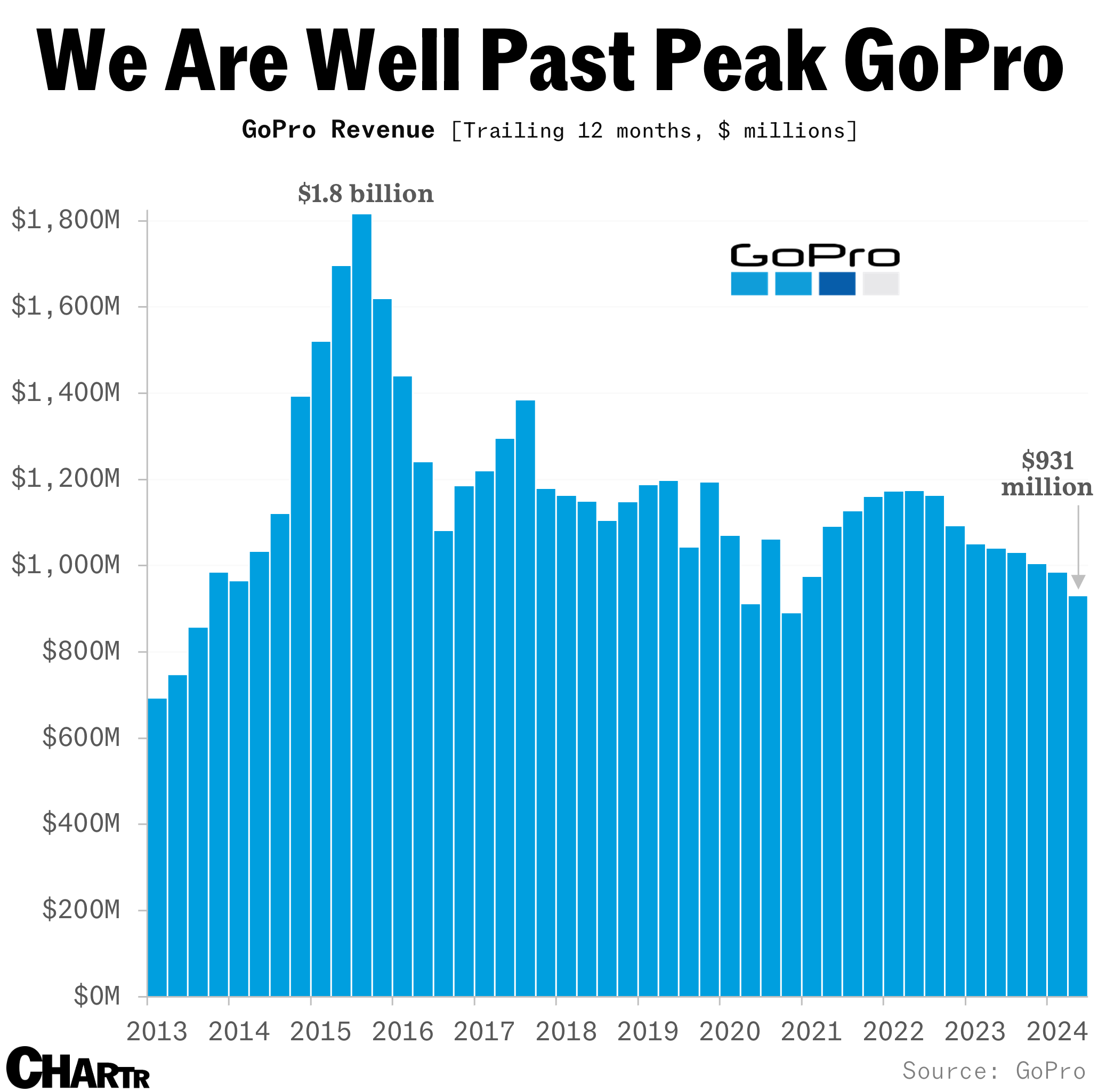
GoPro revenue falling
Sherwood News

HERO to zero?

It’s easy to blame the advent of better smartphone cameras for GoPro’s troubles, and they have certainly contributed to its decline, but cheaper knock-offs and competition have arguably played a bigger part, with GoPro’s revenue falling fairly consistently despite occasional boosts from new product launches. The influx of copycat products has even grabbed the attention of the U.S. International Trade Commission, which in May announced plans to investigate patent infringements against GoPro’s products.

Interestingly, some users on Reddit blame something else for GoPro’s financial worries: building a product so good that you only need to buy it once.

More Business

See all Business
business
Tom Jones

Demis Hassabis, Google DeepMind’s CEO and founder, was also an early Anthropic investor

A chess prodigy and an actual a knight of the realm in the UK, it’s perhaps no surprise that Demis Hassabis has made some strategic moves about his exposure to AI upside. According to people familiar with the matter, the influential AI architect became an angel investor in Anthropic, currently behind many of the leading AI models, per Arena AI leaderboards.

The Nobel Prize winner’s position in the Claude creator was previously undisclosed and, per the Financial Times, highlights Hassabis’ “growing influence across the AI industry.”

Google, which bought DeepMind, the company that Hassabis cofounded and heads to this day, for a reported ~$400 million in 2014, is also a key Anthropic investor. The tech giant reportedly plans to invest up to $40 billion in the AI company as part of the mutually beneficial relationship the pair have forged, with reports that Anthropic has committed to spending $200 billion in the other direction on Google’s cloud services over the next five years.

Im playing all sides, so I always come out on top

In addition to his financial support for Anthropic, Hassabis has also invested in a range of AI startups launched by colleagues, such as Inflection AI, a company set up by DeepMind cofounder Mustafa Suleyman (who is now CEO of Microsoft AI), as well as efforts from other collaborators, like David Silver’s Ineffable Intelligence.

Hassabis also emerged as a recurring figure on the fringes of the recent Elon Musk v. Sam Altman trial, cropping up repeatedly in testimonies and court documents and appearing to live, as The Verge put it, “rent-free” in Musk’s head.

Founded in 2021, Anthropic has recently raised funding at a reported $900 billion valuation, sending it soaring ahead of competitor OpenAI.

The Nobel Prize winner’s position in the Claude creator was previously undisclosed and, per the Financial Times, highlights Hassabis’ “growing influence across the AI industry.”

Google, which bought DeepMind, the company that Hassabis cofounded and heads to this day, for a reported ~$400 million in 2014, is also a key Anthropic investor. The tech giant reportedly plans to invest up to $40 billion in the AI company as part of the mutually beneficial relationship the pair have forged, with reports that Anthropic has committed to spending $200 billion in the other direction on Google’s cloud services over the next five years.

Im playing all sides, so I always come out on top

In addition to his financial support for Anthropic, Hassabis has also invested in a range of AI startups launched by colleagues, such as Inflection AI, a company set up by DeepMind cofounder Mustafa Suleyman (who is now CEO of Microsoft AI), as well as efforts from other collaborators, like David Silver’s Ineffable Intelligence.

Hassabis also emerged as a recurring figure on the fringes of the recent Elon Musk v. Sam Altman trial, cropping up repeatedly in testimonies and court documents and appearing to live, as The Verge put it, “rent-free” in Musk’s head.

Founded in 2021, Anthropic has recently raised funding at a reported $900 billion valuation, sending it soaring ahead of competitor OpenAI.

business

Jury rules against Musk in lawsuit against OpenAI and Altman

Jurors in Tesla CEO Elon Musk’s lawsuit against Sam Altman, Greg Brockman, and OpenAI found the defendants not liable on all claims on Monday.

In a unanimous verdict reached after less than two hours of deliberation, the Oakland jury found that Musk had waited too long to bring his case forward, exceeding the statute of limitations.

Musk had alleged that OpenAI abandoned its founding mission as a nonprofit dedicated to developing AI for humanity and instead became a profit-driven company closely tied to Microsoft.

The verdict caps off a three-week blockbuster tech trial that could have seen Altman and Brockman removed from OpenAI leadership.

Musk had alleged that OpenAI abandoned its founding mission as a nonprofit dedicated to developing AI for humanity and instead became a profit-driven company closely tied to Microsoft.

The verdict caps off a three-week blockbuster tech trial that could have seen Altman and Brockman removed from OpenAI leadership.

Latest Stories

Sherwood Media, LLC and Chartr Limited produce fresh and unique perspectives on topical financial news and are fully owned subsidiaries of Robinhood Markets, Inc., and any views expressed here do not necessarily reflect the views of any other Robinhood affiliate, including Robinhood Markets, Inc., Robinhood Financial LLC, Robinhood Securities, LLC, Robinhood Crypto, LLC, Robinhood Money, LLC, Robinhood U.K. Ltd, Robinhood Derivatives, LLC, Robinhood Gold, LLC, Robinhood Asset Management, LLC, Robinhood Credit, Inc., Robinhood Ventures DE, LLC and, where applicable, its managed investment vehicles.