SteppedUp
How Crocs became a clog-selling profit machine
Crocodilia
The renaissance of Crocs continues.
Two weeks ago, Crocs, Inc. reported that sales of its eponymous shoe brand were up ~15% year-on-year in the first quarter of 2024. That took revenues north of $740 million and puts the ugly-comfy shoe company on track to sell more than $3.2 billion worth of foam clogs and Crocs accessories this year, per company forecasts.
First invented 22 years ago, Crocs are no longer the funky new kid on the fashion block. Indeed, the brand has gone through two significant periods of strife, with sales falling for multiple years in a row before bouncing back in each case. Then, in 2021, sales exploded, and the company hasn’t looked back since — so how did Crocs do it?
Comfort mode
In the early days, Crocs sold itself on functionality over form, with the key selling point being the cushioning material they were made from: a proprietary foam resin that the company acquired in 2004 that it called Croslite.
Aesthetically the shoes were brazenly clunky, but that was almost the entire point. They were so not cool by early 2000s standards that just by looking at them the assumption most people made was “oh, they must at least be comfortable”. That selling point proved popular.
In the coming years the company shipped millions of pairs to people who spent a lot of time on boats, at the beach, looking after kids, being a kid, gardening, in kitchens, lounging around the house, or getting their feet wet. Indeed, in the first few years after their release the company’s supply struggled to keep up with demand, with sales growing more than 670% between 2005-2007.
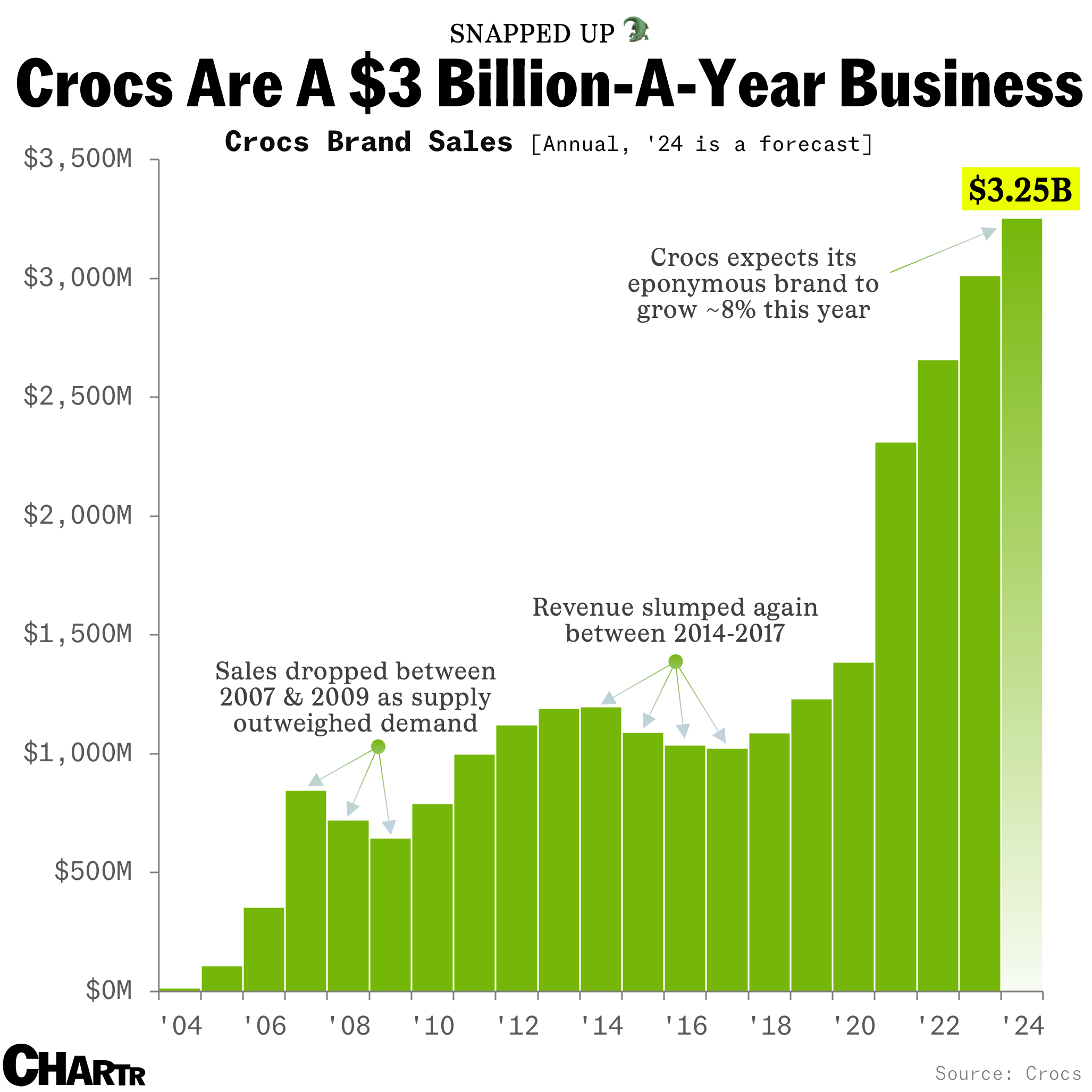
But, by late 2007, it was demand that was struggling to keep up with supply. Sales slipped, mountains of unsold foam clogs started piling up — inventories on the company’s balance sheet quadrupled in one quarter in 2007 — and it looked like the swathe of similar shoes from Walmart, Skechers, and others, might sink the brand. Discounting Crocs to clear the inventory hurt the brand substantially, and the company was far from universally loved. There were anti-Crocs Facebook groups with millions of members and a website called “Ihatecrocs.com” that produced videos of people doing things like cutting up Crocs with scissors.
The company had to close manufacturing plants, with its forays into sports gear also ending in unspectacular fashion, and in 2008 the company lost $185M — sparking a series of shareholder lawsuits. In 2009, turnaround specialist John Duerden took the reins for just a year, helping get the company back on its feet. After Duerden stepped down, new management expanded into selling shoes that didn’t look a lot like the original clogs. But, the second slowdown was just around the corner… as sales slipped 3 years in a row and Crocs had to close hundreds of stores.
Perfect pair(s)
But, in late 2016, with sales still sinking, there were 2 glimmers of hope: sales of its Classic Clog were actually up… and the company’s experimental collaboration with luxury designer Christopher Kane had been a hit.
Those two bright spots ended up forming the foundations of a refreshed strategy under new CEO Andrew Rees, who took the top job in June 2017. From functionality to high-fashion-fun, Crocs was about to enter a whole new world.
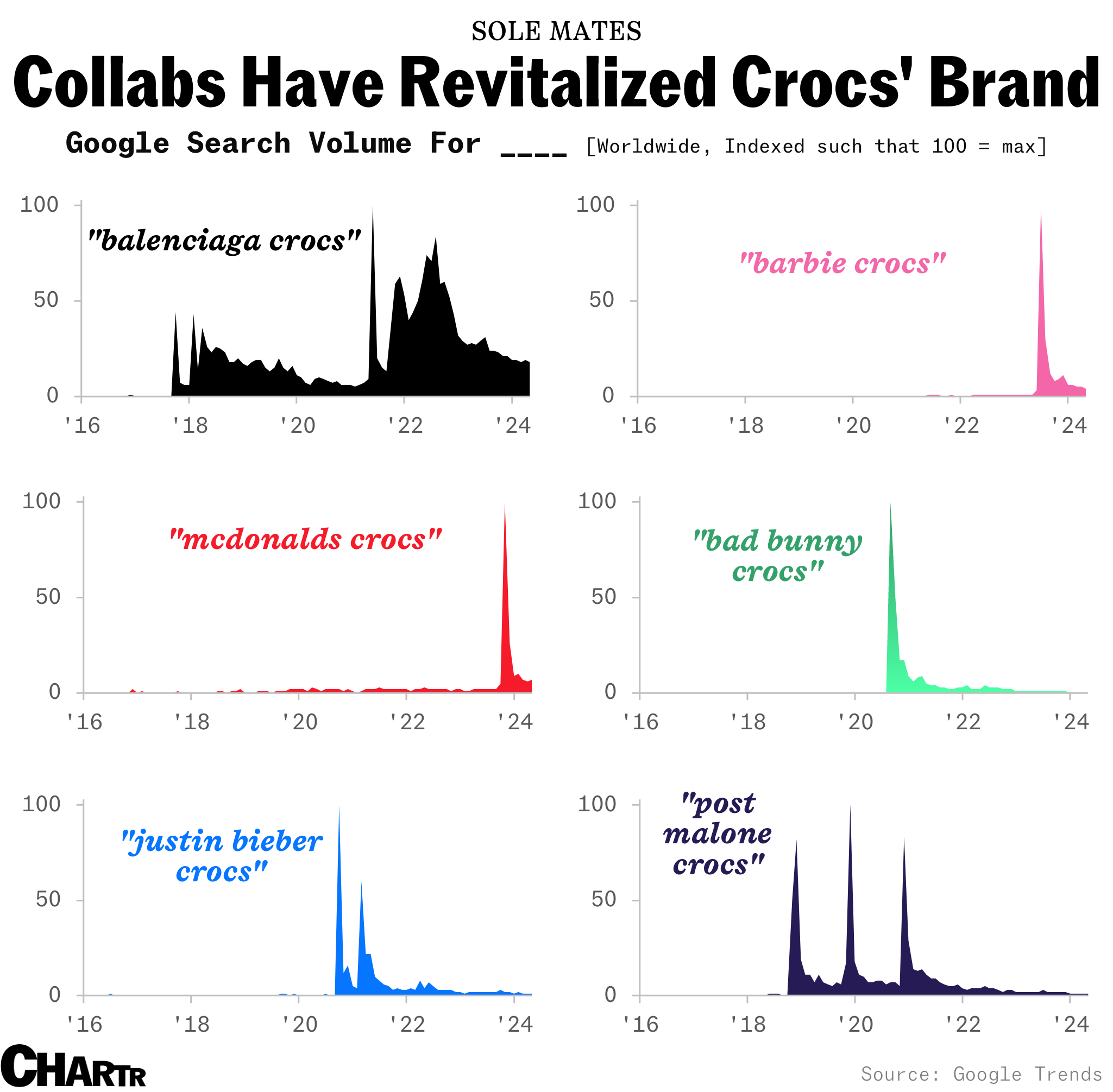
The partnership with Christopher Kane ended up being just the start, as Crocs began to release frequent collabs with major brands and celebrities, including Justin Bieber, Post Malone, McDonald’s, and recently Pringles (yes, the brand you’re thinking of). Arguably most important of all, was when Crocs teamed up with avant-garde fashion house Balenciaga — and so began a collaboration that took the humble Crocs into the world of high-fashion, with a series of rain boots, platform clogs, stilettos, and more.
Many of the collabs are easy to laugh at (do you want a pair of 7-Eleven Crocs?), but the amount of money Crocs is making is no joke, as Gen Z has learned to love the brand. Aided by a pandemic-induced craving for comfort, sales have exploded in the last 3 years, and profits have followed.
Sport mode
There are a lot of ways to measure “how strong is XYZ brand?” In fact, an entire industry of powerpoint-loving consultants have spent years answering that question for marketing executives, building “brand index” measures from a swathe of data. Some are useful, many are overcomplicated and unhelpful. One of the most powerful is simply asking people: “would you ever think of buying this brand”. That’s about as good a measure as any, and in those sorts of studies, such as this one from Morning Consult, Crocs has seen a renaissance.
Another — arguably even easier — way to measure brand strength is to ask: how much profit can a company extract from every dollar of sales? Other factors are obviously important, but margins are, quite literally, the bottom line. After you built the thing, spent money on marketing, and sold it to customers, how much did you make? On that measure, Crocs is fierce competition.
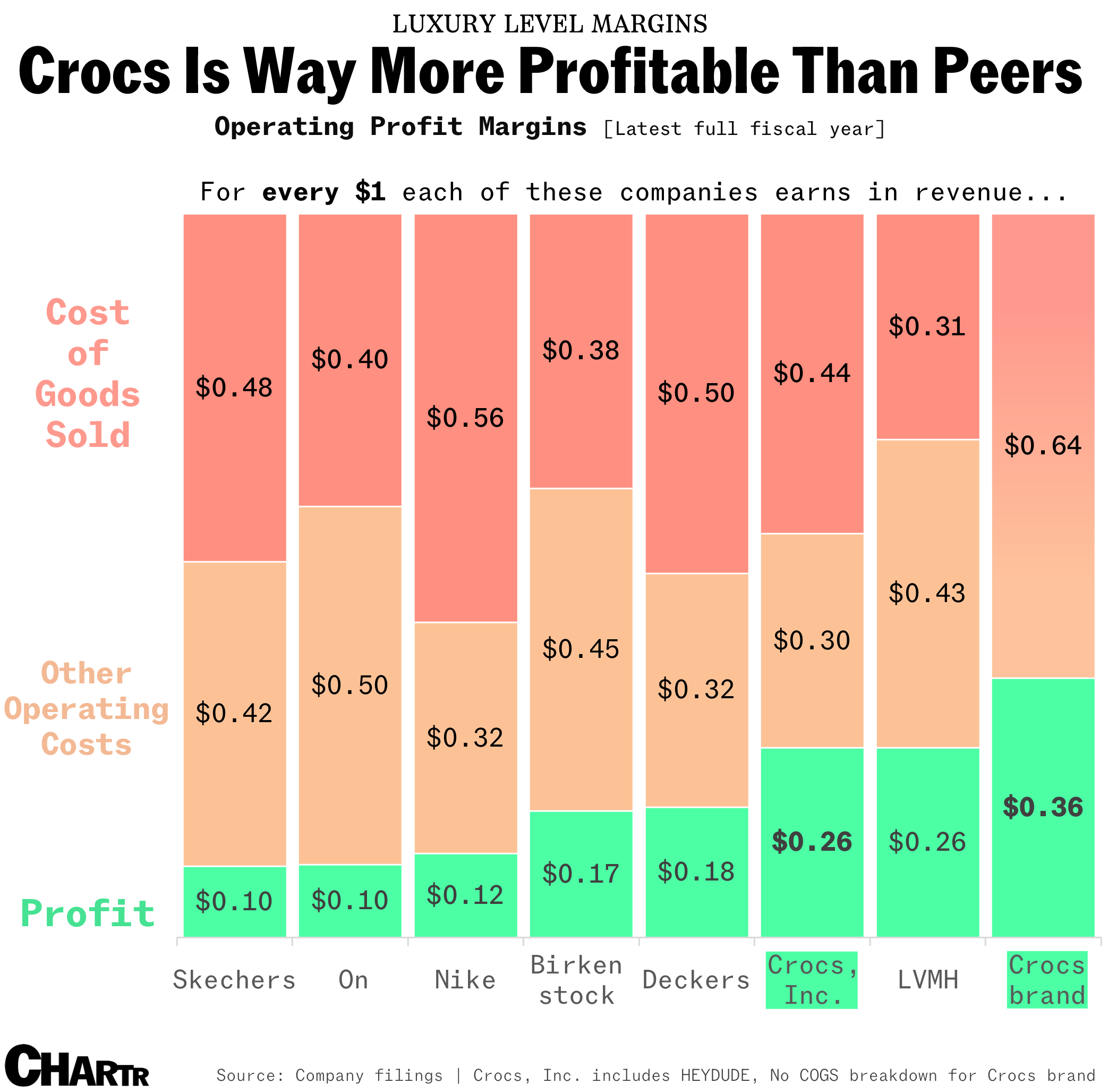
Crocs makes luxury goods level profit margins
Our analysis finds that Crocs is the most profitable of its largest shoe and apparel retail competition… by some distance. For the most recent financial year, Crocs, Inc. made a 26% operating profit margin. That blew shoe rivals like Nike, On Running and Skechers out of the water, and was even higher than what beloved brand Birkenstock managed. It even matches what luxury goods giant LVMH Moët Hennessy – Louis Vuitton (commonly known as LVMH) made last year… a company that sells handbags for $50K+.
In the chart above we’ve plotted Crocs, Inc., which includes the struggling HEYDUDE brand that the company acquired in 2021, and just the Crocs brand… which as a standalone division made an eye-watering 36% operating profit margin.
Crocs didn’t just dip its toe into the world of luxury goods, it dove feet first into the profit pool, and made a big splash.