
Business

Data Story

Amped up

Can streaming save the music biz?

Do-Re-Mi-Fa Spotify
Illustration by Bronson Stamp

The music business has undergone format change after format change. Will streaming usher in a new golden age for artists and fans?

Here comes the sun (streaming version)

For years streaming has been heralded as the potential savior of the music world, a harbinger of change that could bring riches back to a wider pool of struggling artists, labels, and publishers. But, especially on the back of recent news that Spotify is set to raise prices by $1-2 a month for the second consecutive year, some critics are starting to ask: why is it taking so long?

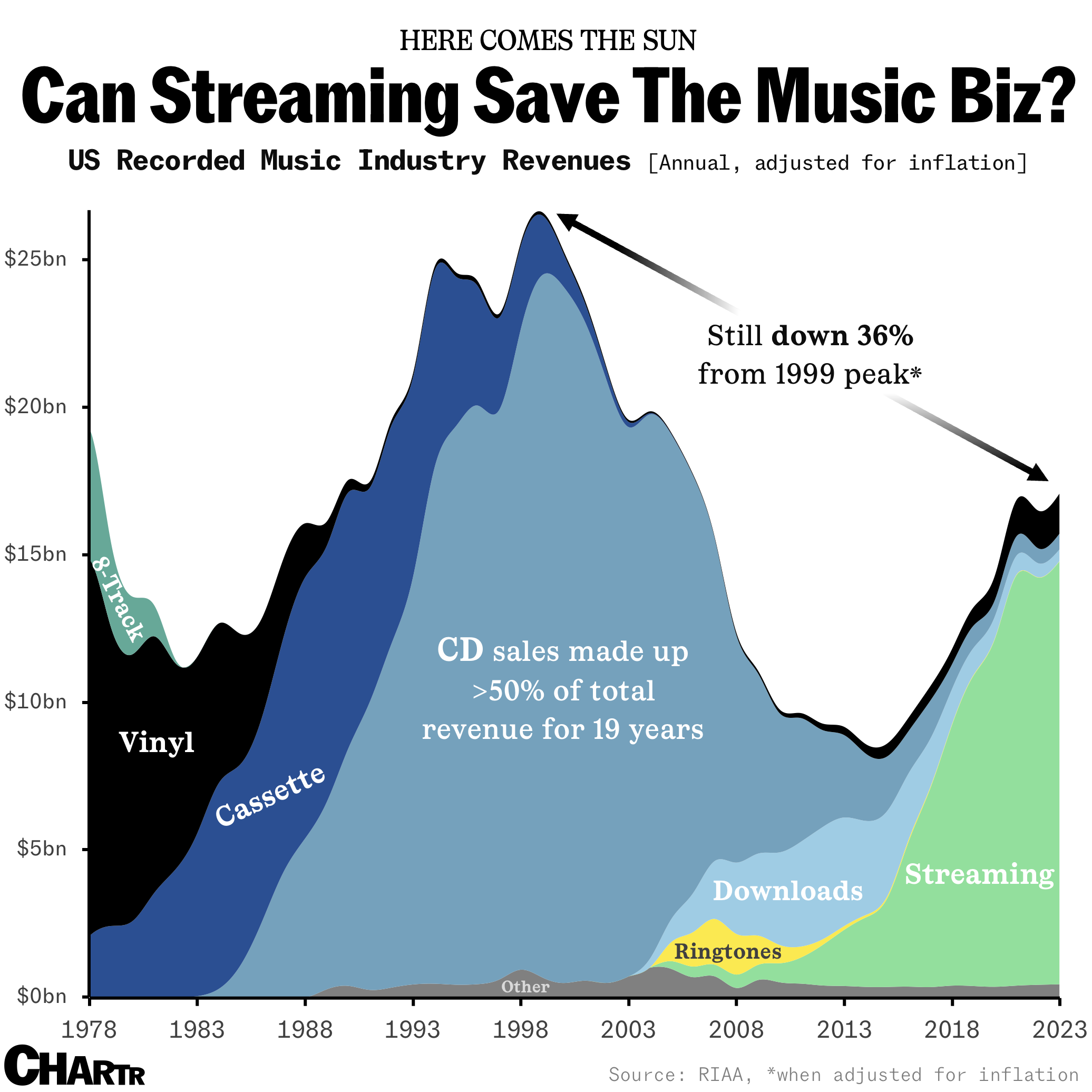
Indeed, though there’s never been a more convenient time to be a music fan — with millions of songs just a tap away — in purely financial terms, the American music industry is still a fraction of its former self. Data from the RIAA reveals that, once adjusted for inflation, recorded music revenues in the US are still down 36% from their 1999 peak, when millions were heading out to get their hands on CD copies of Believe by Cher or the Backstreet Boys’ Millennium.
Can streaming save the music industry?

Conspicuous convenience

The days of checking overplayed CDs for scratches, using a pencil to fix an unspooled tape cassette, or saving up for that state-of-the-art Walkman might seem as alien to contemporary music listeners as gathering around the gramophone, but it’s hard to overstate how much change the music industry has endured in recent decades.

Vinyl’s dominance in the 1970s, when artists like Stevie Wonder and Abba were selling millions of records, was an era of music-listening that is now heavily romanticized... even by Gen Z. But, if necessity is the mother of invention, convenience is surely a close relative, with music lovers keen to take their favorite tracks with them, and 12-inch records offering little in the way of portability. Smaller cassette tapes became the on-the-go option, only for CDs, offering the same flexibility with better sound quality, to displace the cassette in the 1980s — ushering in the industry’s golden age and eventually accounting for 89% of revenue at its peak in 1999.

Another one bites the dust

Of course, the internet changed everything. Compared to video files, audio files were considerably smaller… and they were easy to share online, kickstarting a 15-year dark period for the industry in which piracy crushed its income. Downloads — and for a weird few years, ringtones — offered some respite for artists and labels, but it wasn’t until the green shoots of streaming that the recorded music industry returned to real growth.

As more and more of us sign up to services like Spotify to enjoy our favorite songs on-demand, the income generated from streaming platforms has rocketed, with the Swedish streamer reporting more than $14 billion in revenue last year. But, despite its growth, Spotify has never reported a full year of net profit, and whether those revenues are flowing through to the maestros behind the music, remains a more complicated question.
More artists are making more money on Spotify

Money, money, money

Artist remuneration has been a hot topic for Spotify almost since its inception, with top artists like Taylor Swift and Radiohead’s Thom Yorke temporarily taking their songs off the service in past years and raising questions around how the company structures its royalties.

Spotify has been pretty fixed in its response to criticism from disgruntled bands and artists, often pointing to the billions of dollars it hands over to music makers each year. Indeed, Spotify reportedly paid some $9 billion to rights holders (artists, labels, publishers, distributors etc) in 2023, taking its lifetime total to more than $48 billion.

Harmony... or discord?

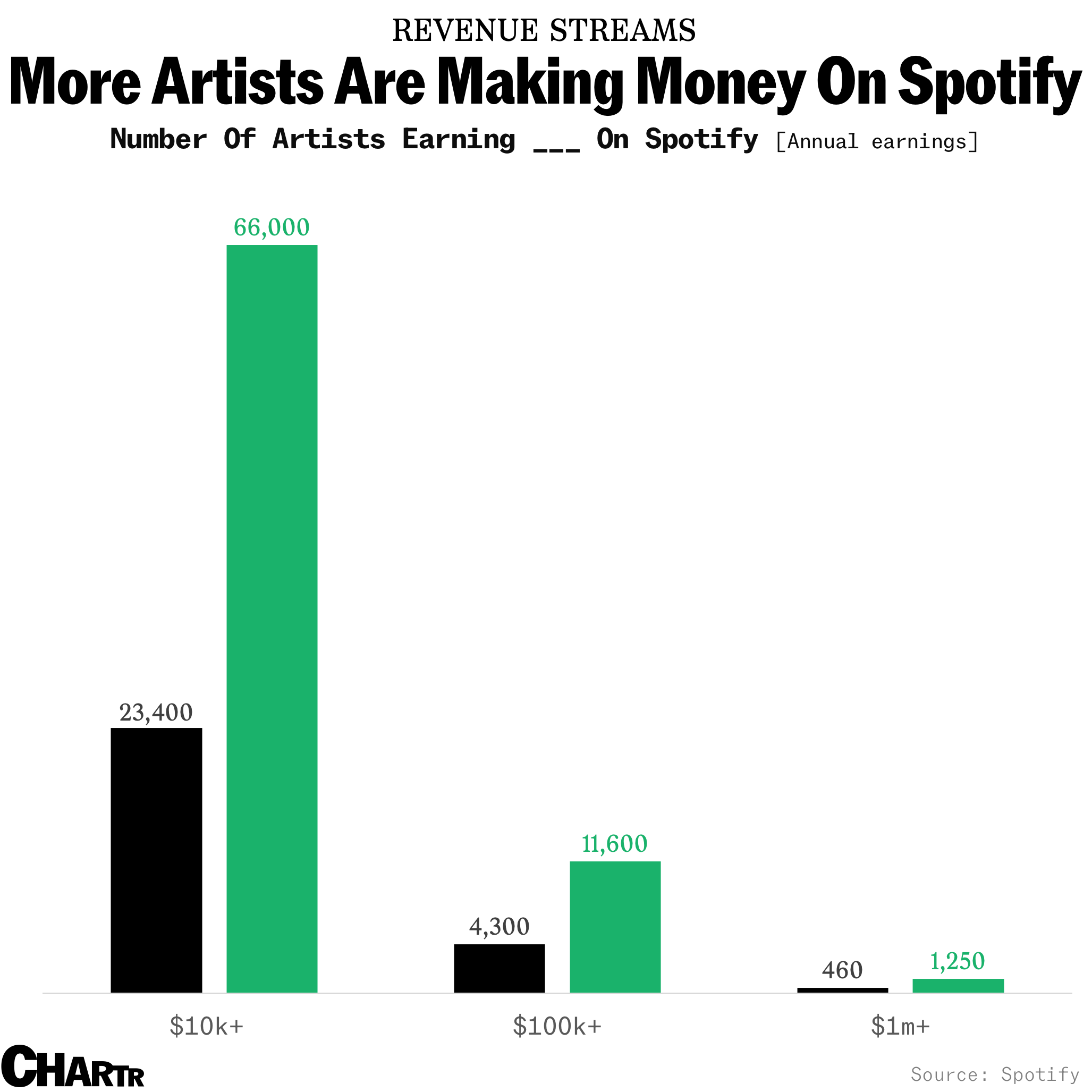
Those figures are from the company’s latest Loud & Clear report, which also revealed that the number of artists meeting various monetary milestones like $10k+ annual earnings has nearly tripled over the last 6 years, with some 1,250 musicians now making more than $1 million from Spotify streaming alone.

It’s worth noting, however, that with as many as 9.8 million artist profiles on Spotify according to some estimates, the 11,600 artists who are managing to make it to that $100k threshold represent a miniscule share of the overall talent on the platform, and that those figures represent payments to rights holders — not necessarily what ends up in artists pockets. Depending on individual arrangements, most will be split to varying extents with agents, labels and publishers.

While Spotify has objectively been paying more artists more money, there’s no doubt that relying on streaming payouts alone isn’t enough for thousands of bands and musicians. Many artists, are now looking elsewhere to cash in, with one tried-and-tested method proving particularly effective in recent years.
Americans are spending more on concert tickets

Play to the crowd

While performing live is obviously no new thing, it’s never been so crucial to the earnings of many musicians — and that’s playing out at the very highest levels within the business too, with Taylor Swift’s recent addition to Forbes’ Billionaire List largely attributed to her record-breaking Eras tour.

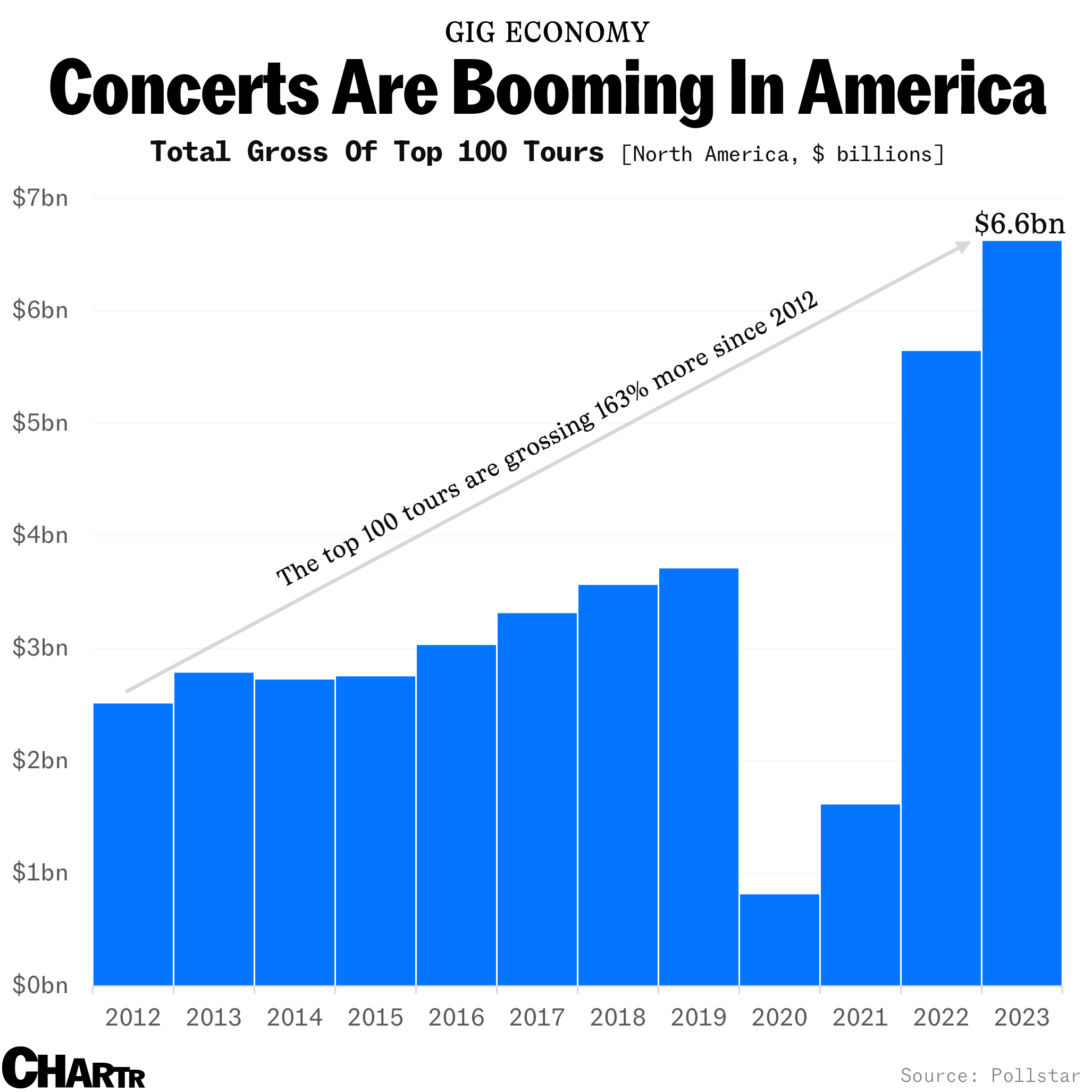
Industry publication Pollstar revealed that the top 100 North American tours, thanks in no small part to Ms. Swift and Beyoncé, grossed $6.6 billion in 2023, the highest on record. And, that’s not just down to “funflation” either, with entertainment giant Live Nation reporting record concert attendance and ticket sales for last year too.
Hit songs are getting shorter

Changing the game

Bands and artists haven’t just switched up how they make money because of streaming: the very way that many now write and construct songs is changing as a result of the medium too. Indeed, recent reporting from the Washington Post highlighted how Spotify’s monetizing methods, like its pay-per-play system or needing a listener to stick around for at least 30 seconds of a song, as well as the desire to go viral on TikTok, have led artists to write shorter, sharper, more attention-grabbing tunes.

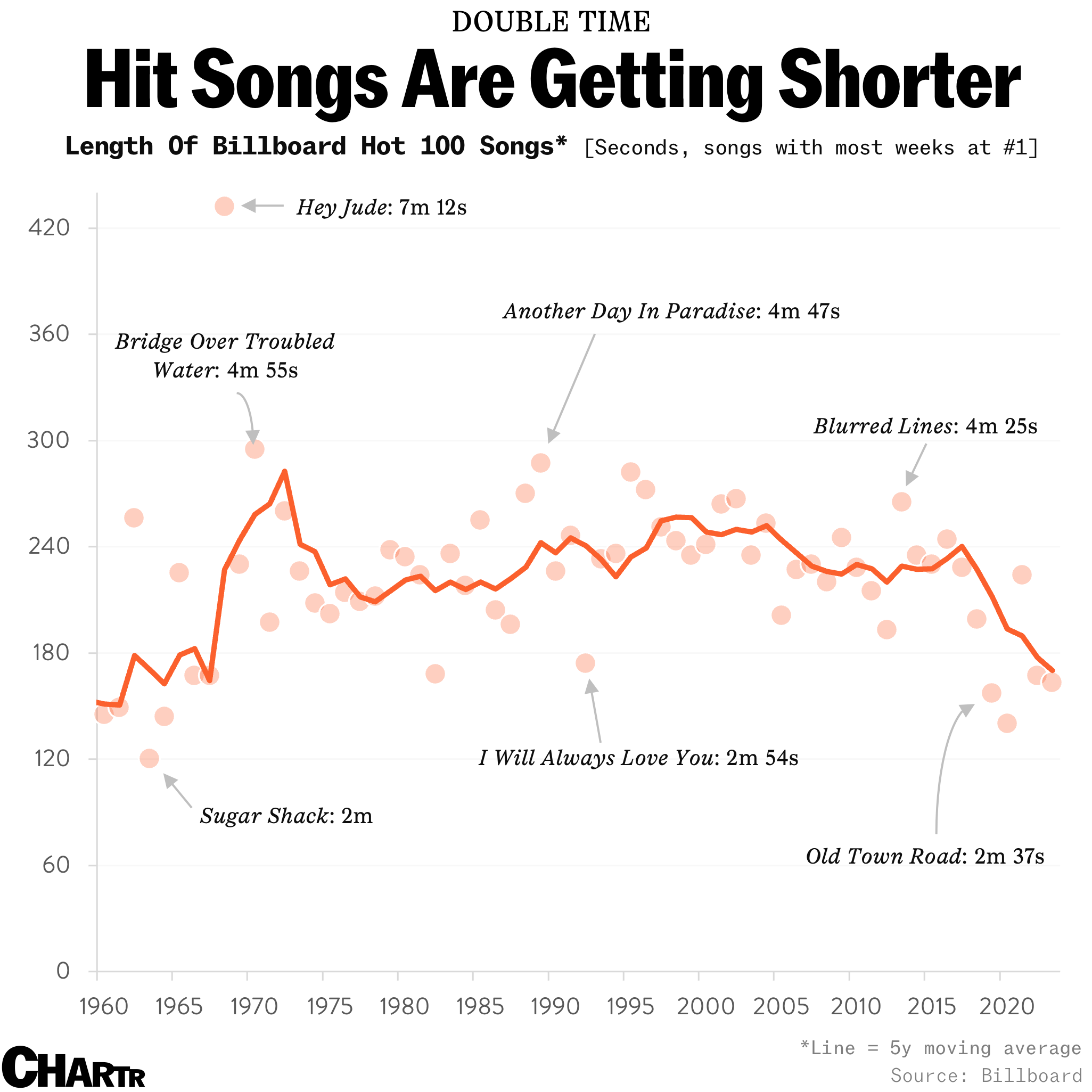
Looking at some of the biggest songs on the Billboard 100 for each year since 1960, we observed a similar trend, with top songs released in the last 5 years clocking in at 2 minutes and 55 seconds, compared to the 3 minutes and 59 seconds average throughout the 1990s during the golden age of CDs and the music industry more widely. When you get paid per stream, shorter is sensible.

More Business

See all Business
business
Tom Jones

Prime Day is here again and Amazon’s subscription service has never been more popular

Well, it’s that time of year again: many have made their wish lists, people are scraping together the money they’ve saved to pick out a perfect gift, some are presumably leaving out refreshments for the weary delivery drivers and, more and more, drones.

It’s Amazon Prime Day — meaning that it’s the second day of the four-day promotional event that Amazon still calls Prime Day — of course, and it’s even come early this year, with the company bringing the period into late June from July, when it’s been traditionally held for the last five years.

The Prime Age

Alongside the eyes and endless clicks that the arbitrary stream of listicles on “The Best Prime Day Deals” that almost every media outlet pours into, Amazon will also be cheering the fact that there’s now more Prime users than ever before to devour the retailer and its sellers’ sometimes-contested “discounts.” Indeed, according to the latest annual estimates from Consumer Intelligence Research Partners (CIRP), there were just over 200 million American shoppers using Amazon’s massive subscription service at the end of 2025.

business

Electronic Arts launches a platform to put more ads in its games

Video game publishing giant EA launched a new platform on Monday designed to make the process of selling immersive ad space in its popular games easier.

The company says the platform, called EA Advertising, allows brands to “integrate directly into gameplay through dynamic, real-time placements, from stadium signage to custom in-game content.”

More so than other studios, EA has incorporated advertising into its most popular titles. As Kotaku points out, the company’s ad efforts stretch as far back as 2006. Several of its sports franchises already feature partnerships with brands like Visa, Lowe’s, Red Bull, and PepsiCo.

In-game advertising hasn’t exactly been embraced by fans, but industry experts expect it to ramp up as companies seek more revenue to offset higher games budgets and surging memory costs. EA rival Take-Two has taken a different approach, with CEO Strauss Zelnick recently saying the company was “not at risk of doing brand partnerships” in the forthcoming “Grand Theft Auto VI,” and that ads in full-price games seems “unfair.”

The $55 billion deal to take EA private, led by Saudi Arabia’s Public Investment Fund, is set to close at the end of this month. Being the largest leveraged buyout in history, EA will likely look for more ways to boost revenue to cover interest payments.

More so than other studios, EA has incorporated advertising into its most popular titles. As Kotaku points out, the company’s ad efforts stretch as far back as 2006. Several of its sports franchises already feature partnerships with brands like Visa, Lowe’s, Red Bull, and PepsiCo.

In-game advertising hasn’t exactly been embraced by fans, but industry experts expect it to ramp up as companies seek more revenue to offset higher games budgets and surging memory costs. EA rival Take-Two has taken a different approach, with CEO Strauss Zelnick recently saying the company was “not at risk of doing brand partnerships” in the forthcoming “Grand Theft Auto VI,” and that ads in full-price games seems “unfair.”

The $55 billion deal to take EA private, led by Saudi Arabia’s Public Investment Fund, is set to close at the end of this month. Being the largest leveraged buyout in history, EA will likely look for more ways to boost revenue to cover interest payments.

business

JM Smucker says it sold $1 billion worth of Uncrustables in FY2026

After years of booming sandwich sales, JM Smucker has finally earned a billion-dollar crust.

On Tuesday, the company reported results for fiscal year 2026, highlighting better-than-expected profits driven by higher prices for coffee and sweet baked goods. However, at another point on the earnings call, CEO Mark Smucker pointed to one particularly jammy figure: in line with previous forecasts, the company sold $1 billion worth of its (almost always) crustless sandwiches, Uncrustables, in the last year alone.

business

Paramount reportedly offers concessions to resolve multistate antitrust investigation

Paramount has reportedly offered up some concessions in an effort to prevent an antitrust lawsuit by California and about 10 other states, according to Bloomberg reporting on Monday.

Reuters first reported on the potential suit from a group of unnamed states last week, which could throw a wrench in Paramount’s plans to buy rival Warner Bros. Discovery in a Hollywood megamerger.

The list of concessions is unknown, though Bloomberg previously reported that Paramount is open to divesting some of its kids TV assets to appease EU regulators.

Late last month, reports said US regulators appeared likely to approve the $110 billion merger, following a meeting between Paramount CEO David Ellison and DOJ antitrust staffers.

The list of concessions is unknown, though Bloomberg previously reported that Paramount is open to divesting some of its kids TV assets to appease EU regulators.

Late last month, reports said US regulators appeared likely to approve the $110 billion merger, following a meeting between Paramount CEO David Ellison and DOJ antitrust staffers.

$98B ⛽

The IATA released its latest financial outlook for the airline industry over the weekend, forecasting a $98 billion jump in the sector’s collective fuel bill. The world’s largest trade group representing airlines expects the oil spike to halve profits by 49% from last year to $23 billion.

The group also expects profit margins to halve year over year, falling from 2025’s 4.2% to 2%. Still, revenue is expected to climb to $1.17 trillion from $1.07 trillion.

A surge in the cost of jet fuel has rocked US and global airlines this year, leading Delta Air Lines, United Airlines, American Airlines, Southwest Airlines, JetBlue, and others to raise fares and ancillary charges like bag fees. Low-cost carriers, which operate on smaller margins, have been squeezed the hardest, resulting in Spirit’s shutdown.

“It’s a tough year for all airlines, especially those whose balance sheets had not yet recovered from COVID. And, of course, for those operating in the Gulf,” said IATA Director General Willie Walsh, who added that demand is holding up and about half of passengers expect to spend more on travel this year. “That bodes well for a strong northern summer peak season. The big unknown is how long travelers and shippers can tolerate the higher costs of connectivity.”

Latest Stories

Sherwood Media, LLC and Chartr Limited produce fresh and unique perspectives on topical financial news and are fully owned subsidiaries of Robinhood Markets, Inc., and any views expressed here do not necessarily reflect the views of any other Robinhood affiliate, including Robinhood Markets, Inc., Robinhood Financial LLC, Robinhood Securities, LLC, Robinhood Crypto, LLC, Robinhood Money, LLC, Robinhood U.K. Ltd, Robinhood Derivatives, LLC, Robinhood Gold, LLC, Robinhood Asset Management, LLC, Robinhood Credit, Inc., Robinhood Ventures DE, LLC and, where applicable, its managed investment vehicles.
